3.31.2015

My Body Mod

http://upload.wikimedia.org/wikipedia/commons/3/31/Tattoo_needle.jpgAt 42, I'm contemplating the statistical likelihood that I've already lived half my life.  The stereotypical male midlife crisis responses are threefold: affair, sports car, and earring.  Well, instead of cheating on my wife I'm adopting a baby with her.  And, because of said baby, instead of getting a convertible I'm converting to a minivan.

But the body modification choice seems to suit me.  Yet an earring is a little too out there for my taste.  So I'm going tattoo.  Maybe in my old age I'm getting frailer or loopy but since Amy has two (and I think they're really cool) I figure it would be neat for me to get one too.  I'll post a pic of what and where tomorrow.

3.30.2015

Palm Sunday Sermon Transcript

http://www.preschool-plan-it.com/images/palm-sunday.jpgHere is a full transcript of my Palm Sunday sermon from yesterday.

***


PALM SUNDAY SERVICE
MARCH 29, 2015
1ST READING: PSALM 50:8-15
2ND READING: MARK 11:1-23
“WHAT GOT JESUS SO RILED UP?”

I did not grow up in the church.  So even though I have been a Christian for almost 25 years, the rhythms of the church calendar are still somewhat foreign to me.  But I think I get what Palm Sunday is supposed to be.  It’s the Sunday before Easter, when Jesus enters Jerusalem to kick off what Christians call “Holy Week.”  Palm Sunday is about this triumphant entry, and in fact what do you think of when you think of Palm Sunday service?  If you grew up in the church, you think of getting a long palm leaf and parading around the sanctuary announcing Jesus’ triumphant arrival. 

I want to take this morning’s sermon in a slightly different direction.  I want to focus not just on Jesus’ triumphant entry into Jerusalem, but also on what He chooses to focus on right after this triumphant entry.  Because I think this will give us another perspective on what Palm Sunday really means.  So let me read this morning’s Bible lesson, but let me keep reading past the triumphant entry part so we can see what Jesus says and does right after.

[read Mark 11:1-23]

Did you catch the structure of Mark’s narrative of Jesus’ actions after the triumphant entry?  Verse 11, he goes straight to the temple to scope things out.  Verses 12 to 14, he has this somewhat strange confrontation with a fig tree.  Verses 15-19, he’s back in the temple, this time wreaking havoc.  Verses 19-26, he’s back to talking about the fig tree.  Temple, fig tree, temple, fig tree.  When you see this kind of structure in Bible-era writing, you know the author is making a connection between two things.  So what is the connection between the temple and the fig tree?

Let me back up a second and provide some context.  The Gospel according to Mark is a dance between three main themes: calling and instructing disciples, winning the hearts of the people, and raising the ire of the religious leaders.  These three themes crescendo at the beginning of Holy Week: the disciples are eager to join Jesus in his triumph, the people are filled with worship, and the religious leaders are beside themselves with indignation.  The Book of Mark is just good drama: the disciples and the masses can’t believe they have found the Messiah, the religious leaders can’t believe a mere man is acting like the Messiah, and no one could’ve predicted how the thing ends even though Jesus foreshadowed it over and over again. 

But the ending of Holy Week is next week’s sermon.  So tune in then!  As for the beginning, Jesus arrives in Jerusalem with great fanfare, and you know this story.  His disciples obtain a colt for him, the masses spread leafy branches in front of him, and he parades into town to cries of “Hosanna,” which means “O save us.”

But there’s something off here.  The people are treating Jesus like a conquering ruler.  The leafy branch treatment is what generals would get when they came back from a military victory.  And, in case the people’s perspective isn’t clear from that, consider what they say.  Verse 10: “Blessed is the coming kingdom of our father David; Hosanna in the highest.”  Translation: happy days are here again, because Jesus is taking us back to the glorious era of King David, when we were a free and triumphant nation with a conquering leader.

Only Jesus refuses to fit the part.  A military leader would come in on a horse, the symbol of war.  Jesus chooses a donkey colt, the symbol of peace.  You could stop right there and have a pretty good Palm Sunday sermon message: the triumphant entry of Jesus is not a brawny and conquering one, but one characterized by peace and humility.  That’s a good message. 

Except that for the rest of the chapter, Jesus doesn’t actually act very meek.  In fact, He’s pretty worked up.  A fig tree riles Him up.  And He gets downright violent in the temple.  What’s going on here?

Let’s start with the temple.  He goes straight from His donkey parade to the temple to check everything out.  He leaves without incident.  But when He comes back, all heck breaks loose.  He’s driving out people, turning over tables, and speaking fiery words.  What got Jesus so riled up?

More so than today, communal worship in a centralized place was important for people of faith.  The temple was where you came together as God’s people, to give your sacrifices and offer your praises and listen to God’s law.  It was a place designated for submitting oneself worshipfully to God’s authority.

What had happened over time was that people had set up tables where different animals could be purchased to be offered in worship to God.  Maybe some of these merchants were slimy, thinking they could make a buck off of people.  Maybe some merchants genuinely thought they were doing people a service by providing something they needed in a convenient and affordable way. 

Regardless of their motives, they had turned the temple into a place of transaction.  Not only their transactions, where they traded money for sacrificial items.  But they also turned worship into a transaction, whereby praising God was boiled down to rendering a burnt sacrifice to Him.

Even worse, where they set up shop crowded out the space on the temple grounds dedicated to non-Jews who wanted to worship the God of Abraham, Isaac, and Jacob.  This is why Jesus says what He says.  Verse 17: “My house shall be called a house of prayer for all the nations.  But you have made it a robbers’ den.” 

The merchants were keeping God’s people from truly worshipping God, by turning the whole thing into a sacrifice transaction and by taking up the space for people from all the nations to come in the first place.  No wonder Jesus was so violent and upset.  The whole thing needed to be turned upside down.  Some people were treating worship like a transaction rather than a posture of submission and obedience.  And other people, from other nations, were being crowded out from being able to approach God altogether. 

Which brings us to Jesus’ encounter with the fig tree.  He’s hungry, He sees a fig tree in full bloom, He approaches it, He sees it has no fruit, and He curses it.  Seems a little petulant, no? 

But it’s meant to be a metaphor, which becomes clear when He explains things to His disciples, who ask Him about it later as they were passing by Jerusalem.  Leaves and fruit usually go hand in hand.  So when we see a tree in the distance and it is in full leaf, we assume it is bearing fruit.  A fig tree in full bloom but with no figs is not only useless, it’s deceptive. 

And so it was with the temple.  Bustling with attendees and activity, from afar you could look at it and say that worship of God was alive and well.  But look closer and you’d find people transacting with God rather than truly praising Him, and you’d find others longing to be part of the worshipping community but crowded out by useless activity. 

This is the conquest Jesus is seeking as He rides triumphantly into Jerusalem.  It is not the military leader defeating an outside enemy.  It is the Son of God trying to open the eyes of the people of God to their own spiritual fruitlessness.  What mountain do you think He is pointing to in Verse 23: “Truly I say to you, whoever says to this mountain, ‘Be taken up and cast into the sea,’ and does not doubt in his heart, but believes that what he says is going to happen, it will be granted him.” 

Jerusalem, you may know is on a mountain, surrounded by mountains.  Jesus is not just saying that prayers of faith can move mountains, generically and metaphorically.  He’s also saying that prayers of faith can take a place like Jerusalem – where worship has been reduced to a mere transaction, where God’s people are crowding out other potential worshippers, where leafiness is abundant but fruitfulness is scarce – prayers of faith can take a place like that and throw it into the sea.

I’m not enough of a Bible scholar to understand what that means, whether the sea is meant to be place of rebirth or a place of judgment.  I fear it is the latter.  You can tell from this passage that Jesus is hacked off with what is happening at the temple.  What is happening there has gotten Him so worked up that He is cursing trees, driving people off temple grounds, and flipping over tables. 

You may picture Jesus on that donkey colt, calmly receiving the shouts of adoration.  But in the very next scene, He is anything but calm.  This is the beginning of Holy Week, and while we may be among the people singing “Hosanna,” let us not mistake what kind of salvation Jesus is really offering.  He is not redeeming us from some physical outside oppressor but rather from the spiritual waywardness of our own hearts and behaviors.

And so as you consider Jesus’ triumphant entry this Palm Sunday, and go with Him into the rest of Holy Week, I ask you to ask yourself the following three questions:

Number one: Am I bearing fruit or am I just trying to be leafy?  Leaves can be seen from afar and they suggest a healthy tree.  But God seeks fruit-bearers.

Number two: Am I crowding out people from worshipping God?  In our hustle and bustle, we can be doing all good things, and yet taking up space that could be made available for those on the outside to come in and join in worship of God.

Number three: Have I boiled God down to a mere transaction?  Do I consider worship to be about acts of sacrifice or offerings of obedience?  Recall the psalm that was read earlier this morning.  God doesn’t need our sacrifices.  He does desire our praise and devotion.  Call on him in the day of trouble; He will deliver you, and we will honor Him. 

I think that, as in Jesus’ days, there are a lot of people in this country that are playing church.  Looking all leafy from afar but up close no fruit.  Doing good stuff but crowding out others in the process.  Dealing with God in transactional terms instead of honoring Him by calling on Him in our day of trouble.

This week, Jesus is riding into Jerusalem for His triumphant entry.  He aims to be the One cherished in our hearts, in whom we take root and through whom we bear fruit.  Let us not be found leafy, crowding out others, transacting with God.  Let us be found offering our “Hosanna!” to the One who is honored not by burnt sacrifices but by calling on Him in our day of trouble.  Give Him room to be that God in Your life. 


3.28.2015

Support Sustainable Business Network of Greater Philadelphia


https://ticketleap-media-master.s3.amazonaws.com/87ce9117-4e72-451e-8519-579cea00b5cb/hero.jpgI’m hoping you will consider supporting Sustainable Business Network of Greater Philadelphia, which I’m on the board of, by attending and/or sponsoring our upcoming Sustainaball event on April 18.  See links below for more info.  It’s a really great event and a really great cause.  Hope you’ll join me in being part of it!


3.27.2015

The Losing Battle

http://static1.businessinsider.com/image/532c4a666da811b0375b5572-1200-723/arizona-state-loses-march-madness.png
I haven't watched a lick of March Madness.  But I have watched some highlight reels from years past.  It's gripping drama: upsets, buzzer beaters, pandemonium. 

A lot of attention is devoted to the euphoria of hitting the game-winner, of advancing, of winning it all.  But there's also the agony of defeat: having a chance to win it and missing the shot, committing a costly turnover at an inopportune time, realizing your season (and, for most players, their playing career) is over in an instant.  The hurt of losing is more crushing than the high of winning, if that makes sense.

March Madness is kind of like life.  Sixty-three of the 64 teams in the tournament will end the tournament with a loss.  More than half of all shots taken will not go into the rim.  The vast majority of graduating seniors will see their playing days come to an end as soon as their last game's buzzer hits zero.  It's a cruel thing, that there's so much failure and so final an end to the magic of being on a winning team. 

But that's life.  We can be seduced, in this country and by the media we consume, to think that everything is winning and that the good times last forever.  But losing is part of life, too, and so are endings.  Wise is the person who is able to understand this.  My heart goes out to all the players who will be given this lesson very painfully this month, and hopefully they take that life lesson to heart.

3.25.2015

In God We Trust

http://ecx.images-amazon.com/images/I/51uLkSRVLEL._SL500_SY344_BO1,204,203,200_.jpg"Sovereignty" is a big church word that I don't often use on this blog.  (A quick search yields only six times where I used the word, out of 3,000+ posts.)  But the concept is a central one to my belief system, the notion that God is in charge and truly does know best.

A powerful example of faith in this belief is the late James Montgomery Boice, who passed away from cancer in 2000.  Here is an excerpt from his last sermon, in which he muses about God's sovereignty in light of his terminal illness (emphasis is mine):

If I were to reflect on what goes on theologically here, there are two things I would stress. One is the sovereignty of God. That’s not novel. We have talked about the sovereignty of God here forever. God is in charge. When things like this come into our lives, they are not accidental. It’s not as if God somehow forgot what was going on, and something bad slipped by. It’s not the answer that Harold Kushner gave in his book, Why Bad Things Happen to Good People. God does everything according to his will. We’ve always said that. 

But what I’ve been impressed with mostly is something in addition to that. It’s possible, isn’t it, to conceive of God as sovereign and yet indifferent? God’s in charge, but he doesn’t care. But it’s not that. God is not only the one who is in charge; God is also good. Everything he does is good. And what Romans 12:1-2 says is that we have the opportunity by the renewal of our minds—that is, how we think about these things—actually to prove what God’s will is. And then it says, “His good, pleasing, and perfect will.” Is that good, pleasing, and perfect to God? Yes, of course, but the point of it is that it’s good, pleasing, and perfect to us. If God does something in your life, would you change it? If you’d change it, you’d make it worse. It wouldn’t be as good. So that’s the way we want to accept it and move forward, and who knows what God will do?
 God's sovereignty isn't cause for fatalism or recklessness or apathy, of course.   But it is a bedrock upon which to stand when life throws storms at you.  Think about it: even if you could change things, you wouldn't want to, because it would be less than the best that God has planned for you.

The process of adopting Asher has been, to put it mildly, tumultuous.  Unpredictable.  Heart-wrenching, at times.  Deflating and discouraging, a lot.  But, ultimately, we are in the hands of a God who is both in control and acting in our interests.  What a mighty truth to be rooted in.  I am still feeling shaky.  But at least I am aware of how close I am to solid.

3.24.2015

A Just Economy

NCRC 2015 Annual Conference
Later this week my company will be sending someone to the 2015 annual conference of the National Community Reinvestment Coalition, which is entitled "Creating a Just Economy."  Here is a blurb from NCRC's event page:

This event is the largest national gathering of community non-profits, policymakers, government officials, small businesses, media, and academia–all focused on how together we can create a more just economic framework to improve the lives of American families, our workers, our older adults, our children and our environment, while strengthening global access to credit and capital.

Sounds like a good time to me!  Ping me if you're going to be there too.

3.23.2015

Respectability Will Not Save Us

I simply must share this post by Stewart Coles, who is a friend of mine from my days at The Enterprise Center.  "Respectability Will Not Save Us" is a searingly personal narrative about the arrest of University of Virginia student Martese Johnson.  Given that Amy and I are about to welcome baby Asher into our family, I am sensitized anew to the range of emotions our decent young African-American men face on a daily basis - fear, rage, shame, pride, defiance, exasperation.

Stewart has captured this maelstrom of feelings in a deeply powerful way.  I am extremely proud of my friend for what he is shared.  And I am extremely worried about how Asher will fare when he is the same age. 

3.22.2015

Time and Money, Circa 2015

http://s3.amazonaws.com/rapgenius/time-is-money.pngHaving completed my taxes late last month, it's time for another edition of "time and money."  (Click here for similar posts, from 201320112009, and 2007.) 

Note that all of this is pre-Asher; in very short order, these proportions are going to get blown up, time-wise in terms of more baby duty and less sleep, and money-wise in terms of hiring a nanny and having Amy work part-time.  Also note that time is my time, whereas money is Amy's and my money. 

First, the time:


Sleep 30% (30% in 2013)
Work 35% (35%)
Kid errands like bedtime, meals, shuttling 10% (10%)
Prayer, church 2.5% (5%)
Adult errands like paperwork, chores, house 10% (7.5%)
Adult fun like dates, leisure, exercise 10% (7.5%)
Family fun like outings, board games 2.5% (5%)

Time devoted to work is still quite high, and administrative stuff takes up more and more hours.  As the kids get older and more independent, I don't spend as much time with them doings things like taking them to the zoo or supervising their play time.  Which means more me time!  I've been off church leadership since last time, so that's a chunk of time not given to meetings. 

Now, the money:


Taxes 30% (30% in 2013)
Saving for retirement, college 20% (20%)
Giving to church, charities 10% (10%)
Mortgage/transportation 10% (10%)
Utilities/telecom 5% (5%)
Child care 5% (5%)
Groceries, personal care 7.5% (7.5%)
Home furnishing/maintenance 2.5% (2.5%)
Health care 5% (5%)
Leisure, discretionary 5% (5%)


How very boring.  Thankfully, Amy and I both make more money now than two years ago.  Proportionately, most expenditures rose in commensurate fashion.  It'll be interesting to see if this holds true after the Asher shake-up; child care will certainly go up, while we'll try hard to keep up on saving and giving given the reduced income and increased living expenditures.

3.19.2015

Update on Asher

https://blogger.googleusercontent.com/img/b/R29vZ2xl/AVvXsEiXKX6bNMk8UEt17U5VsBZg0lCTPXshgIYM-PPNNXffPTRhqMFrXM2v0jufQ-J1kvWG0EVK6zMa_R7x2cvMOA7WtTfye5nSUeGwef-pkowgDevWwyyd0rFNp42R6UTHNbhlkTOS/s1600/breaking-news1.png
News flash: Asher is less than a week away from being birthed into the world.  This is way ahead of schedule, since we'd been told his due date was early May.  We are holding our breath regarding his health and frantically making plans to fly out to OKC. 

I will try to post more in the days and weeks to come on Facebook, Instagram, Twitter, and my Huang Kid Khronicles blog.  Would appreciate prayers as we slog through travel, preparations, and paperwork just to get to the joy of sleepless nights and endless feedings/changings. 

3.17.2015

Happy St. Patrick's Day

http://i.imgur.com/5tKlyhX.jpgLiving where I live, in a university neighborhood in a big city, one could be forgiven for observing St. Patrick's Day festivities and thinking the day to be about public drunkenness, slutty outfits, and the color green.   But the holiday, as you may know, has deeper and more historic roots.  (See here for a recent piece in Time Magazine.)  In a sense, it is a quintessentially American creation: rich spiritual origins and besieged immigrant pride giving way to fabulous festivity and blatant commercialism.  God bless this country today.


3.15.2015

No Place Like Home

I had the good fortune of traveling to Honolulu this past week to kick off a new work engagement.  After the winter we've had on the East Coast, many of my friends and co-workers were totes jelly of such an opportunity.  It is a great gig with fantastic teammates.  I've been going a million miles an hour so some leisure was in order.  And my main meeting was on a Friday afternoon, so the whole trip was just begging for a "make it a weekend" move.

And yet, later that evening, after being on island for a mere 28 hours (of which 17 involved some sort of work-related meeting), I found myself cabbing to the airport to begin my red-eye itinerary back home.  Wait what?

It wasn't because I didn't enjoy my company.  Far from it; my teammates, both the ones I've known and the ones I've only recently gotten to know, are the kind of people you absolutely adore spending time with.  And, obviously, it wasn't for lack of fun things to do or for desire to do fun things.  I mean, hello...Hawaii?!?

My reasons were waiting for me at home when I finally got there 14 hours after departing from a post-meeting team gathering in Waikiki.  Amy and the kids were playing Life, I sidled in next to them to boot up my laptop and catch up on emails, and next thing you knew we were at our neighborhood Lebanese restaurant feasting like kings. 

It occurred to me, mid-dinner, that it was barely noontime on Saturday in Honolulu.  Had I stayed an extra day and "made it a weekend," I'd be less than halfway through a glorious day of sunshine, sand, good food, and great activities.  And yet, weary red-eye flight notwithstanding, I was glad to be where I was, amid a pile of baba ghanouj and the familiar sounds of my wife and our two little minions glad to have their fourth wheel back.  There really is no place like home.  Not even a free day in paradise.

3.12.2015

Looking for Heroes

Last month's issue of Governing (in other news, I am a nerd) had a series of articles on gentrification.  I was too busy to get to it til this past weekend but was eager to dive into this thorny issue.  Alas, I was somewhat disappointed at the warmed-over coverage.  There were too many lofty platitudes and vague prescriptions, and not enough hard-hitting ideas. 

I did like Mark Funkhouser's idea of  "higher education relations officer," or as he deemed it, a HERO.  The significant economic footprint of universities in localities seems to beg for active engagement, to make sure that what universities are pursuing can be synchronized with what is good for local economies.  After all, there is the possibility for great synergy, but only if actively pursued.  Universities and localities do share similar aims, but are fundamentally different kinds of entities seeking different kinds of outcomes, so there's a big difference between meeting up and working together on the one hand, and not connecting and going separate ways on the other.

There is an irony in the fact that Funkhouser's column appeared in the gentrification issue.  More and more universities understand that, as anchor institutions, they are literally stuck where they are, so thee is enlightened self-interest in being the sort of neighbor that improves a community.  But in some cases, those improvements are the very catalysts for gentrification.  Here in my very own University City neighborhood, whether Penn is to be sainted or slammed for all it's invested in around here is a daily debate.  And this very ebb and flow is being played out in scores of other places where campus and community touch. 

That's a discussion for a longer time.  But the fact that that discussion is so rich, so fraught, and so potentially positive, does argue for more of Funkhouser's "heroes." 

3.10.2015

Building Capacity

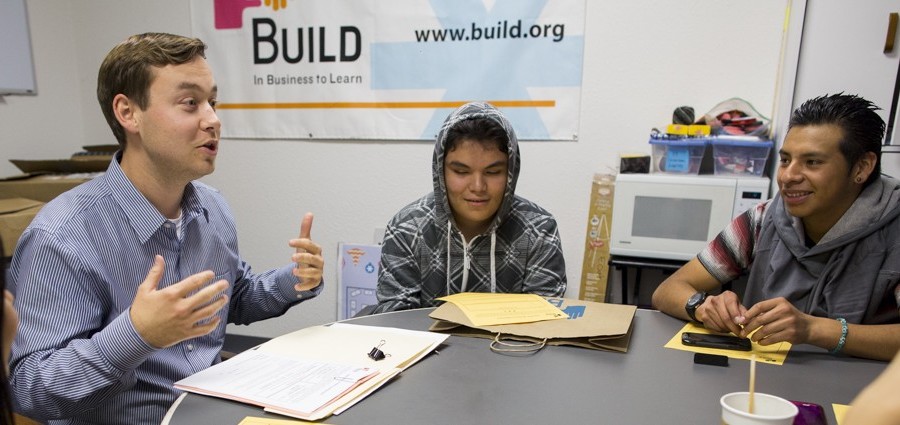
We’re in the New York Times!I am doubly delighted about this recent New York Times article about the importance of teaching entrepreneurship to at-risk youth.  First, because it salutes the work of Suzanne McKechnie Klahr of BUILD, a Bay Area based youth entrepreneurship program that now operates in Boston and DC as well (and is about to go live in NYC as well).  Suzanne is a long-time colleague of mine who I met during my days running a youth entrepreneurship program at The Enterprise Center, and it makes me very happy to see her program succeed and get the accolades it so richly deserves. 

Second, because Suzanne's contention, and the premise of the article, is that entrepreneurship is an awesome way to get kids on the college track.  To be sure, stories abound of young people who hit it really big in entrepreneurship and bypass college altogether (or, famously drop out).  And, there are even more stories of young people who don't hit it really big, but are able to sustain themselves and create jobs by birthing a new venture starting in their teen years.  These success stories are legion, and they ought to be celebrated.

But for the vast majority of the kinds of teens served by BUILD and by The Enterprise Center, the path to long-term success is marked out with college in mind.  In our increasingly knowledge based economy, going through the college experience - the credentialing, the learning, the learning how to learn, and the networking with other smarties - is paramount.  It has been many years since this was my day job, but I still firmly believe that teaching entrepreneurship is hugely important.  Economic literacy, financial savvy, and the skills gained in figuring out how to birth a new venture that makes money are essential life skills, useful in any endeavor young folks set their minds to.  And, they are extremely good motivators for young folks to understand the importance of college and to get there. 

Kudos to Suzanne, to BUILD, to The Enterprise Center, and to countless young entrepreneurs who are gaining skills every day and taking one more step towards a long and successful career in our modern economy.

3.08.2015

Preaching on Palm Sunday

http://nataliewarnert.com/wp-content/uploads/2013/11/flexmic-podium.png
In three weeks, I will be preaching at Woodland Presbyterian Church.  That Sunday is referred to as "Palm Sunday."  It is the Sunday before Easter Sunday, and sermons on Palm Sunday tend to focus on Jesus' triumphant entry into Jerusalem, which marks the beginning of what Christians call "Holy Week."

I will be preaching out of the 11th chapter of the gospel according to Mark, which is one of the major accounts of this triumphant entry.  However, my sermon will feature a little twist, in terms of what it focuses on.  Come by to hear where I go with this.

3.05.2015

Thorn in My Side

http://www.blacktoe.co.uk/pics/slippery%20ice.gifEarly last week, while running outside, I slipped on an icy patch and landed hard on my right side.  Unfortunately for my ribs, my elbow was caught underneath me, so instead of landing flat on the ground, all the impact was concentrated in one place on my side.  That day was extremely uncomfortable.  After a good night's sleep, the next few days were improved although still painful, but by Friday the area was still very irritated so I went to the doctor's. 

He felt everything in the area and concluded that there was no fracture or break, thankfully, but that I had just taken a really good blow to the area, that it was going to hurt for awhile, and that I should just rest it for a few weeks.  Already stir crazy about not being able to exercise, I asked him about stationary biking and he said yes, and I asked him about swimming and he said no. Of course, the next morning I tried to swim anyway, and my body wasn't having it. 

So exercise-wise I have been largely grounded, which has been a huge annoyance for me, given how much of my schedule and spirits are enhanced around my workout routine.  The pain itself isn't too bad, except that it hurts to cough or blow my nose, so I've developed a sore throat and need to be careful about not giving pneumonia room to creep into my life.  All of this because of a split second of not slowing down enough on my morning run. 

In the grand scheme of things, it's no big deal.  Amy has been annoyed at how much and how often I moan, as if I'm the only person in the history of mankind to have gotten injured.  If the life lesson here is that I should slow down and take it easy, I am failing that lesson miserably. Indeed, when I am stricken by illness or injury, I think of what David wrote in Psalm 119:71: "It was good that I was afflicted, that I may learn Your statutes."  

This particular injury reminds me of another Bible verse, the thorn in Paul's side, which he talks about in 2 Corinthians 12:

7Because of the surpassing greatness of the revelations, for this reason, to keep me from exalting myself, there was given me a thorn in the flesh, a messenger of Satan to torment me—to keep me from exalting myself! 8Concerning this I implored the Lord three times that it might leave me. 9And He has said to me, “My grace is sufficient for you, for power is perfected in weakness.” Most gladly, therefore, I will rather boast about my weaknesses, so that the power of Christ may dwell in me. 10Therefore I am well content with weaknesses, with insults, with distresses, with persecutions, with difficulties, for Christ’s sake; for when I am weak, then I am strong.


At times, my rib pain feels like an actual thorn in my side, constantly jabbing me with discomfort.  It is my always-on reminder that I am not at full-strength, that I can't do my normal morning exercises and that I have to be careful sneezing, laughing, and moving.  I would like to say that it has also been my always-on reminder to have Paul's attitude, to revel in God's strength amidst my weakness.  But I think that very infrequently.  Much more frequently, I groan aloud, second-guess my not decelerating before the icy patch, or dread being incapacitated for yet another week. 

Over a week after my fall, I am still afflicted.  And I am still learning His statutes.

3.03.2015

Additional Answers


https://img1.etsystatic.com/000/0/6418147/il_fullxfull.307196919.jpgAs you know from earlier this week, Amy and I will be doing a domestic adoption in the next couple of months.  An update of this magnitude begs a number of follow-up questions.  So here goes:

1.       Why now?  Fair question.  Some people know exactly how many kids they want to have, they have that many, and then they stop.  Others are constrained for some reason, whether health or finances, and so they know that’s it.  For us, we never quite knew.  For us, it kind of boiled down to the question, “Are we done yet?”  Or, more directly, “Does God have any more for us?”  Amy in particular felt we were incomplete.  I was less sure, but open.  And, the more I thought and prayed about it, the more I realized that as happy and full is my life, and as satisfying and all-encompassing are my pursuits outside of the home, at the end of the day the thing I felt was most important, most rewarding, most impactful, was being a dad.  And what if there are others I can be a dad to?  Why wouldn’t I be willing, open, and excited at the possibility?

2.       What does this mean for the Huang family?  Everything, of course.  Amy gets to be a stay-at-home mom for a season (the length of that season TBD, but at the very least three months).  Jada and Aaron get to have a stay-at-home mom and a little sibling; they seem more excited about the former because they don’t quite know what the latter means.  I become the household’s sole breadwinner, no pressure there when I have a job whose paycheck depends on my ability to get and do enough business to pay everyone and then myself.  The grownups are now outnumbered by the kids, and will soon gain new relationships in the form of people whose kids are the same age as our baby.  And, we reset the clock on our retirement, in that our last college tuition payment goes from being 14 years away to being 22 years away, and we have three sets of those payments to fret over (and only one income to save against).  

3.       Why a newborn?  We will never have the experience of pregnancy and childbirth.  And even though we got Jada and Aaron relatively young (7 ½ months and 4 ½ months, respectively), we missed out on their first days and weeks and months too.  I realize many parents will jokingly say that they could do without the sleepless nights and unending feedings.  But, honestly, if you had a choice, would you prefer to have your child right at birth or meet them for the first time a few months later?  I thought so. 

4.       Why domestic?  This is related to the question above, because it’s really the only way to do a newborn adoption.  It’s been a new experience for us, since our previous two were international.  This whole process of creating a profile, waiting for a match, having potential opportunities fall through, getting picked, following the birth-mother’s travails, gleaning information here and there…I must say that it has been way more expensive, way more time-consuming, way more nerve-wracking, way more emotional, and way more uncertain than I anticipated.  And bear in mind that while I handled most of Jada’s and Aaron’s stuff, Amy’s been largely in charge on this one, so I haven't even borne the brunt of the whole roller-coaster.  Amy’s been an absolute trooper from Day One, and has been the spiritual rock between the two of us throughout.  Many men are lucky to make a baby with the love of their life; I am lucky to adopt another one with mine. 

5.       Why African-American?  The short answer is that black lives matter.  The long answer is…there is no long answer; does there need to be?  I can say this: we are neither thrilled nor scared about the extra things we’ll be learning and doing – learning how hair works, figuring out how to respect and connect to that part of his story, having “the talk” about law enforcement when he gets older.  These are just things that parents do, and we’ll do them, and we’ll be richer for it. 

6.       What’s the birth-parents’ situation?  Unlike Jada’s and Aaron’s situation, we know a lot about where this baby is coming from, although the information is in many cases incomplete and unverified.  I’d rather not say much here, except to say that there are potential complications for the baby in the immediate and over the long haul, which is of course the case with any child but nonetheless cause for worry and prayer.  There is also the question of how much of what we know about the birth-mother and birth-father that we want to tell this child.  He has a right to know if he wants to know, and we know how to be appropriate and open if that day comes.  But, it’s also complicated, how he came to be and who he came from and why he was put up for adoption, and it will be a challenge to help him understand that he can be defined by much more than these things.  

7.       Why "Asher"?  From the beginning, this process has been incredibly spiritual.  We entered with hearts open to God’s leading, we have drawn closer to Him and to each other as we excitedly pondered things in theory, and we have been brought to our knees by the difficulty of the process and the potential challenges that this child may face.  Once we learned we were having a boy, it became important to Amy that his name come from the Bible, and that it mean something.  Asher was one of the 12 tribes of Israel, and it means “happy” or “blessed,” and that really resonated with us.  So Asher it is. 

8.       Could we use help? Uh, yeah!  We’d appreciate your prayers and encouragements as we give this a go.  If you have particular familiarity with some of the unique challenges we will be facing, we’d welcome your insights.  And, we’ve never had a newborn, and even the stages we did do we’ve given most of that stuff away, so if you’re in the Philadelphia area and have baby stuff you’re trying to get rid of, we’re interested.

9.       Where are you registered?  So glad you asked!  :)  Walmart and Babies R Us.  (No shower planned.)
10.       Why? Why? Why?  After all the questions above, this is the one I keep asking myself.  Our lives are awesome but crazy.  Why crash a baby, with brand new challenges and potentially special needs to boot, into the craziness?  The short answer is that we think God is leading us so.  But, we don’t know for sure; there has been no bolt of lightning, no hard-to-miss confirmation.  At the end of the day, all we can do is be led by the following questions: (1) What do we want our lives to be about? (2) What are we willing to bear time and money for? (3) Will we be worse off going for it and having it be a disaster, or not going for it and forever wondering what if?  I’ve been alive a long enough time but still haven’t figured out if this is the right way to make a life-altering decision.  But it’s what we’re doing.  By God’s mercy, we will proceed. 

3.02.2015

More on the New Addition


https://blogger.googleusercontent.com/img/b/R29vZ2xl/AVvXsEg_U6DR_OJ7ZZTqlf9ALn8AcUJ_P-VC4HilcJPXHnY9I1hZr6gshS0Z201tSSehVvrV6LbklHjinqiCgTYdg5LF7AiCpstAeezaCtvuxf_37pwg5rqhYR34kBcMaamcQR5bxYk/s1600/Free+Stork+Baby+Clip+Art.gifAmy and I have been working on a domestic adoption for the past year and a half, and I'm excited to report we have a match with a birth-mother in Oklahoma City.  

Due date is late April / early May, so once labor starts we're going to fly out there, hopefully be there for the birth, be in the state for about a week while the paperwork is finalized, and then be able to come home with a newborn baby.  

It is a boy (race: African-American) and we are naming him Asher.  We have been told that for this particular birth-mother there is a higher than average risk for medical complications, so we are holding our breath and praying for a healthy child.

We are thankful to God for the opportunity and thankful for an extended network of family and friends to share this good news with!  I’ll share more tomorrow.

Too Short for a Blog Post, Too Long for a Tweet 522

  Here are a few excerpts from a book I recently read, "Moby Dick," by Herman Melville. Again, I always go to sea as a sailor, bec...