1.29.2015

INTJ's as Project Managers

https://s-media-cache-ak0.pinimg.com/236x/10/03/85/100385984430f09ab403f87dd445c6d8.jpgYou will nod your head if you are an INTJ and you manage projects.  If you are neither, just nod your head, too, in sympathy for the unique pathology that is INTJ project management.  Welcome to the insanity that is my brain.

1. A project consists of a big overarching theme, broken down into tasks and sub-tasks down to the minutest detail.

2. There is no peace until there is an outline (for a project) or an agenda (for a meeting within a project).

3. It can take a while for new information to sink in and even longer for it to cause a change in the outline or agenda.

4. Importantly, any such changes are done alone, after deep contemplation, and then sent out to the whole group.  God forbid we should adjust on the fly and amongst team members.

5. Once those changes are in place, they are held as dearly as the previous perspectives were; and those previous perspectives are forever abandoned and never revisited.

6. On another level, though, new information is welcomed and delighted in, when something is unknown and the new information helps make something clear. 

7. Details are, paradoxically, both really important (enough to obsess over them) and easily dismissed (to the point of being completely forgotten or tuned out).

8. Impossible tasks on impossible timelines are just another challenge to overcome by deft planning, rigid adherence to the goal in mind, and a punishing commitment to staying on task. 

9. Though everything lives inside the leader's head, there is a significant amount of communications to team members, not only of their individual assignments but also of how they fit together.  Although such communications are often labored and stiff.

10. Even though it is understood that levity is good for a team, chit chat can seem forced (if tried by the leader) or maddening (if coming from team members).

11. Even on nice days, cries for mercy (due to illness, workload, or other impairments) are begrudgingly received. 

12. You'll work so hard you may even sweat at your desk.

I share these traits not to suggest that they are necessarily "best practices."  Indeed, in many cases, they are documented here to remind me to make the effort to break free of them when needed.  After all, if there's anything, among the many ways in which we are hard-wired, that defines INTJs it is the relentless striving towards self-improvement.


1.27.2015

Too Long for a Tweet, Too Short for a Blog Post XIV

http://cdn.cultofmac.com/wp-content/uploads/2011/10/steve-jobs-bio-e1317914684488.jpeg
Here's two excerpts from a book I completed earlier this month, "Steve Jobs" by Walter Isaacson:

Jobs was furious. He gathered the MobileMe team in the auditorium on the Apple campus, stood onstage, and asked, “Can anyone tell me what MobileMe is supposed to do?” After the team members offered their answers, Jobs shot back: “So why the f**k doesn’t it do that?” Over the next half hour he continued to berate them. “You’ve tarnished Apple’s reputation,” he said. “You should hate each other for having let each other down. Mossberg, our friend, is no longer writing good things about us.” In front of the whole audience, he got rid of the leader of the MobileMe team and replaced him with Eddy Cue, who oversaw all Internet content at Apple. As Fortune’s Adam Lashinsky reported in a dissection of the Apple corporate culture, “Accountability is strictly enforced.”

One day Jobs came into the cubicle of Larry Kenyon, an engineer who was working on the Macintosh operating system, and complained that it was taking too long to boot up. Kenyon started to explain, but Jobs cut him off. “If it could save a person’s life, would you find a way to shave ten seconds off the boot time?” he asked. Kenyon allowed that he probably could. Jobs went to a whiteboard and showed that if there were five million people using the Mac, and it took ten seconds extra to turn it on every day, that added up to three hundred million or so hours per year that people would save, which was the equivalent of at least one hundred lifetimes saved per year. “Larry was suitably impressed, and a few weeks later he came back and it booted up twenty-eight seconds faster,” Atkinson recalled. “Steve had a way of motivating by looking at the bigger picture.” 


One day Jobs came into the cubicle of Larry Kenyon, an engineer who was working on the Macintosh operating system, and complained that it was taking too long to boot up. Kenyon started to explain, but Jobs cut him off. “If it could save a person’s life, would you find a way to shave ten seconds off the boot time?” he asked. Kenyon allowed that he probably could. Jobs went to a whiteboard and showed that if there were five million people using the Mac, and it took ten seconds extra to turn it on every day, that added up to three hundred million or so hours per year that people would save, which was the equivalent of at least one hundred lifetimes saved per year. “Larry was suitably impressed, and a few weeks later he came back and it booted up twenty-eight seconds faster,” Atkinson recalled. “Steve had a way of motivating by looking at the bigger picture.” - See more at: http://aaronhuertas.com/2012/02/notable-excerpts-from-walter-isaacsons-steve-jobs-biography/#sthash.OipfV4mF.dpuf

One day Jobs came into the cubicle of Larry Kenyon, an engineer who was working on the Macintosh operating system, and complained that it was taking too long to boot up. Kenyon started to explain, but Jobs cut him off. “If it could save a person’s life, would you find a way to shave ten seconds off the boot time?” he asked. Kenyon allowed that he probably could. Jobs went to a whiteboard and showed that if there were five million people using the Mac, and it took ten seconds extra to turn it on every day, that added up to three hundred million or so hours per year that people would save, which was the equivalent of at least one hundred lifetimes saved per year. “Larry was suitably impressed, and a few weeks later he came back and it booted up twenty-eight seconds faster,” Atkinson recalled. “Steve had a way of motivating by looking at the bigger picture.” - See more at: http://aaronhuertas.com/2012/02/notable-excerpts-from-walter-isaacsons-steve-jobs-biography/#sthash.OipfV4mF.dpuf


One day Jobs came into the cubicle of Larry Kenyon, an engineer who was working on the Macintosh operating system, and complained that it was taking too long to boot up. Kenyon started to explain, but Jobs cut him off. “If it could save a person’s life, would you find a way to shave ten seconds off the boot time?” he asked. Kenyon allowed that he probably could. Jobs went to a whiteboard and showed that if there were five million people using the Mac, and it took ten seconds extra to turn it on every day, that added up to three hundred million or so hours per year that people would save, which was the equivalent of at least one hundred lifetimes saved per year. “Larry was suitably impressed, and a few weeks later he came back and it booted up twenty-eight seconds faster,” Atkinson recalled. “Steve had a way of motivating by looking at the bigger picture.” - See more at: http://aaronhuertas.com/2012/02/notable-excerpts-from-walter-isaacsons-steve-jobs-biography/#sthash.OipfV4mF.dpuf

1.26.2015

Lazy Linking, 146th in An Occasional Series

What I liked lately on the Internets:

146.1 Why West Philly is Philly's best neighborhood bit.ly/15sNdwC @thephillyvoice

146.2 Hey, millennials...taking notes by hand is better than by laptop bit.ly/1rSU342 @boston

146.3 Having trouble naming your baby? Hire a professional bit.ly/1rSU342 @telegraphnews


146.4 I knew it: the growl of your car engine is fake wapo.st/1JcTDz4 @washingtonpost

146.5 What is the economic impact of Facebook, and how do you calculate it? read.bi/1Bonil7 @businessinsider


1.21.2015

My King Legacy

http://cdn.hiphopwired.com/wp-content/uploads/2011/01/ph2007122101527.jpgWe honor Martin Luther King not only with a holiday but with a legacy.  He was a remarkable and extraordinary man, and is deserving of our accolades.  The clarity of his vision, the power of his words, and the courage of his actions warrant our deepest respect, and they ought to trigger our most fervent responses. 

I have enjoyed observing how different friends of mine choose to honor King's legacy.  Some opt for service, while others participate in demonstrations on issues advanced by Dr. King.  Even more admirable, many of my friends involve their children in these activities, committed not only to living out Dr. King's principles but to impressing their importance upon the next generation.

I am proud of how my friends use Martin Luther King weekend.  It is instructive and convicting for me, because it is not how I spent last weekend, nor how I usually spend that weekend.  My annual pattern is forged by the hustle and bustle of the holidays leading right into our annual trip to California to see my parents.  By the time we return in late December or early January, we face a mountain of personal and work related responsibilities to catch up on.  By mid-January, I am gasping for space to get fully caught up and/or to decompress after a furious rush to stay on schedule. 

I confess with shame that my first (and, sometimes, only) reaction to seeing Martin Luther King weekend looming on the calendar is that it is a welcome respite, a much-needed gift of extra space for me time.  This past weekend, when some marched and others served, I capitalized on the extra day in the weekend to assemble Ikea furniture for my bedroom and watch stand-up comedy on Netflix. 

Now, obviously, rest is a good thing.  And there's nothing inherently wrong with tending to your own house.  But I can't help but be struck by the dissonance between how I spent my holiday weekend and how others did, or more precisely with what sort of lens I viewed the extra day off.  For me, it has been an opportunity to look inward and take care of myself, whereas the spirit of the weekend has become about serving others and connecting to broader causes. 

I tend to downplay specific occasions.  For example, in my mind Christmas and Easter are special but only to the degree that we carry the Christmas and Easter messages with us throughout the remainder of the year.  Martin Luther King weekend ought to be the same, in that the things we commit to on those days ought to be things we continue to push on beyond that weekend.  My immediate takeaway from this past weekend is that I missed out on many local opportunities to contribute and engage.  My longer contemplation will be to examine the extent to which I do or do not do so throughout the year. 

1.20.2015

Happy Birthday to My Mom

My mom turns 70 today.  We were able to see her earlier this month when we were in town, and we're trying to figure out the next time we can go see her.  Til then, we'll just have to wish her a happy birthday from afar.  We love you!

1.19.2015

Lazy Linking, 145th in an Occasional Series

Stuff I liked lately on the Internets:

145.1 The racial aspects of Silicon Valley's origin story tcrn.ch/1BO8EVn @techcrunch


145.2 The role of behavioral economics in making school lunches healthier bit.ly/14wUbjD @byu

145.3 Lower gas prices = suburban home values increase wapo.st/1DQLelD @wapo

145.4 The solution to the world's water problems: higher prices, better property rights bit.ly/1DOVYzU @margrev

145.5 Gates Fdn's solution to poverty & HIV in developing countries: soap operas buswk.co/14Js40F @bw

1.13.2015

What's New is Old

http://assets.noisey.com/content-images/contentimage/48772/Screen-Shot-2015-01-05-at-12-19-37-PM-1.jpgEarlier in the month the Internets went into a kerfuffle when some unknowing young'uns thought that by getting name-dropped by Kanye, some unknown singer named Paul McCartney was about to become famous.  Obviously, McCartney is already quite famous, and we all had a chuckle about how ignorant young folks are about stuff from more than 20 years ago. 

I must say, though, that I find myself feeling almost as ignorant, and on a daily basis.  I am blessed to have many Facebook friends, representing a hugely wide range of interests, perspectives, and eras.  Many are profound and prolific when it comes to dropping knowledge, whether about pop culture, civil rights, or cutting edge technology.  When I can follow what they're saying, I feel very good about myself, that I can hang with such a world-savvy and socially conscious crew.

The only problem is that I can't often follow what they're saying.  One post drops an iconic "where were you when" entertainment reference, and I know neither the genre nor the episode.  Another post laments something racially ignorant, and I am sent scurrying to look up the offending vocabulary or historic incident.  And, unfortunately for me, I can't claim the post was too obscure for normal people to "get," because there are already comments appended from scores of other friends, who clearly get the references and are able to laugh/smile/curse/lament along.

The reason we blast our youth for their ignorance is not because of schadenfreude.  It's because we know that that ignorance is borne of a disrespect of the past and its importance in interpreting the present.  What seems new now is actually old, or at the very least can be better understood if we knew better the old from which it came.  I am reminded, almost daily when I cruise my Facebook feed and am left unable to connect with something that a friend has posted and that their friends have chimed in on, of my own ignorance.  Let's all commit to respecting the role of the past in our present by getting to know more of it each day. 


1.12.2015

Lazy Linking, 144th in an Occasional Series

Stuff I liked lately on the Internets:

144.1 "Best Rapper Alive" crowned for every yr since '79 bit.ly/1rYejWO @complexmag

144.2 Ben Franklin, Founding Father, is also founder of the modern Philadelphia bit.ly/14cCcPf @phillynews @samkatz60

144.3 If Rudy got his own football movie, Reggie Ho should too bit.ly/14cClSI @angryasianman

144.4 Urban affairs news site spearheaded by Patrick Kerkstra - recommended! bit.ly/1waWUXs @citifiedphl

 144.5 Not 1 but 2 wow conclusions: (1) Poker is "solved" (2) Machines can "learn" thru "regret" bit.ly/1Krm3H2 @naturenews


1.08.2015

Turning the Corner

Urbanism in Tysons Corner?  According to this Washington Post article, there is reason to believe that the future of this oft-ridiculed "edge city" is one of community-fostering parks, plazas, and playgrounds.  Though pervasive private ownership makes it hard to align the incentives to create public-serving space, there is such a yearning for green gathering points that developers are starting to fork over the dough to provide them.

To me, this is symptomatic of the tension between cities and suburbs.  One is not better than the other, but they are drastically different.  In one place, high density makes driving difficult and privacy impossible, in exchange for multiple travel modes and vibrant social mixing.  In the other place, low density makes non-auto forms of transportation difficult and serendipitous meetups impossible, in exchange for ease of travel and personal space.

Of course, we value different things at different points in our lives.  Historically, we craved cities when we were singles and then preferred suburbs when we paired off and had kids.  But, being Americans, we now want it all: high social mixing and distinct personal space, the ability to be free from our cars as well as use them freely and easily.

Sometimes things can be "both and" - Los Angeles is as car-centric as it comes, but it can be enjoyed at the pedestrian level too - and sometimes there are trade-offs.  Let's keep an eye on Tysons Corner, to see if these early moves towards urbanism are the green shoots of what becomes a thriving community or alternatively the quickly deteriorating evidence that it's hard to have it all when it comes to land use patterns.

1.06.2015

2014 Car Usage

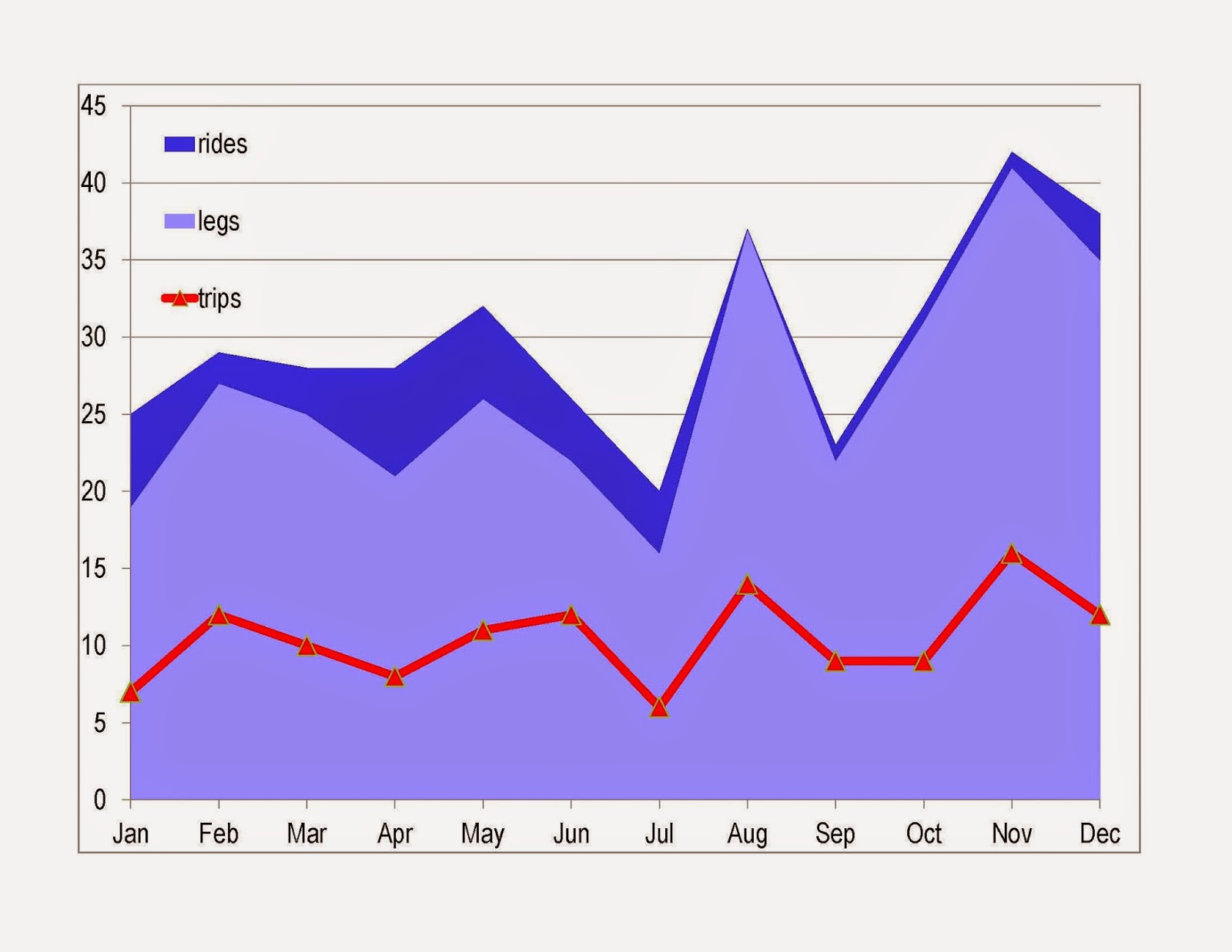
This is the sixth year I have tracked car usage, so I think it's safe to say this has become a habit. As has the nerdy tracking and graphing of it in Microsoft Excel. (You can check out 2013 here, 2012 here, 2011 here, 2010 here, and 2009 here.)

As before, the Philly totals represent, in order, number of trips, number of legs represented in those trips (i.e. going to and from my in-laws, making one stop to get gas, counts as three legs), and number of legs in which I was driven (rather than driving). The other city totals represent, in order, number of times I was in that location, number of days I was in that location, number of trips, number of legs represented in those trips, and number of legs in which I was driven.


January 7/19/6
February 12/27/2
March 10/25/3
April 8/21/7 Arkansas 1/1/1/7/0
May 11/26/6 Pittsburgh 1/1/1/6/0
Jun 12/22/4 Connecticut 1/1/1/6/0
Jul 6/16/4 Hershey 1/3/3/9/0
Aug 14/37/0 DC/Wbg 1/8/12/34/0
Sep 9/22/1
Oct 9/31/1 Hershey 1/1/1/4/0
Nov 16/41/1
Dec 12/35/3 SJ 1/8/13/36/2 Baltimore 1/1/0/0/0 NYC 1/1/0/0/0

So my Philly total is 126 trips involving 322 legs, plus another 38 legs in which I was driven.  So that works out to about 10 car trips a month, and 1 leg per day.  A hair more than before, which I chalk up to the kids having more extra-curriculars that involve driving as well as a flurry of furniture shopping (and returning and exchanging, groan!). 


1.04.2015

Huang Family Newsletter, December 2014

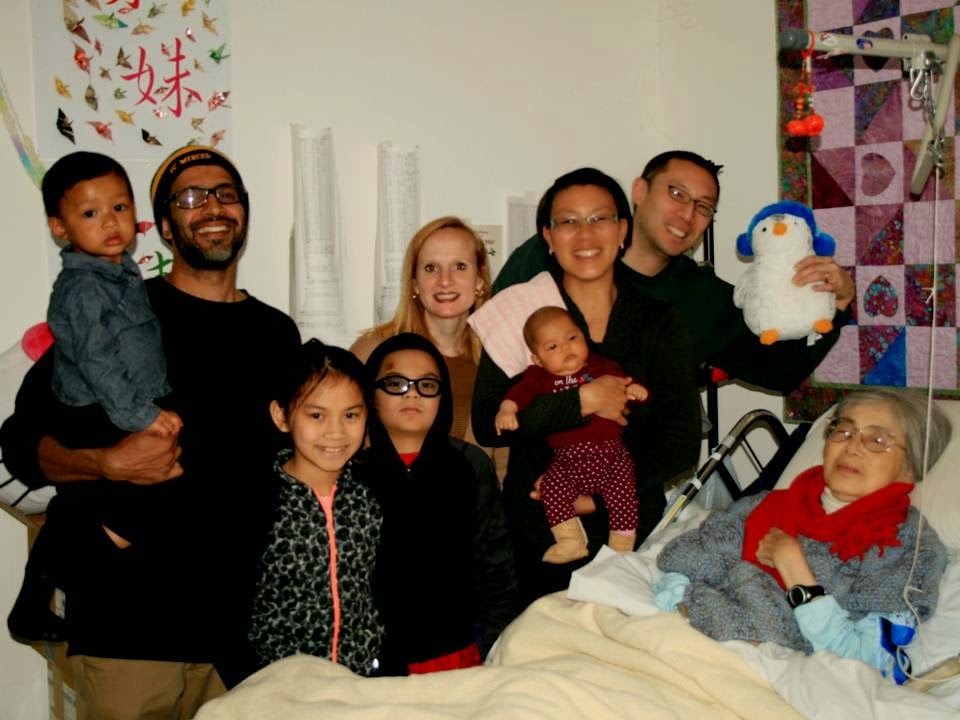
Crazy but fun month for the four of us.  Amy and Lee ran themselves ragged at work.  Jada performed in two holiday concerts (violin and choir).  We all went to California for a week to see Lee's family, squeezing in trips to Gilroy, Monterey, and San Francisco while we were out there.


1.03.2015

Facebook Shrinks the World

http://ncowie.files.wordpress.com/2011/11/facebook.jpg?w=600One way Facebook shrinks the world is through birthday wishes.  Our universe of Facebook friends is an agglomeration of all of the phases and facets of our existence, and when we hear from so many from so many parts of our lives (like I did yesterday when I turned - gasp! - 42), it floods our minds with thoughts of how rich we are in friendship and love.  Who doesn't like the wonderful surprise of being in a party in your honor and having random friends and family members pop in unannounced to be with you?  Now imagine dozens and dozens, from high school and college and work and church, from East Coast and West Coast and overseas, folks I see every day and folks I haven't seen in decades.  That was my yesterday.

What's particularly special is that, especially with folks I don't get to see often, occasions like birthdays are an opportunity not only to send well wishes but to express how rich it is to follow each other through social media, and in doing so to join in a little bit in each other's lives.  Though we are distant socially and geographically, yet we are able to do life together.  Weddings, vacations, kids' birthdays, funerals, politics, social commentary.  These snippets forge a true connection and are a real way to feel connected to others. 

All of which to say it was very nice to be feted on my birthday by so many of my Facebook friends.  It was an overwhelming reminder of how many good people there are in my life, who are rooting for me, delight in my happy moments, and stand with me in my sad moments.  I am thankful to God for His provision of people, as well as of the mechanisms by which I can have a touch with them.  It is easy to feel the world is vast and cold, and nice to feel when the world seems small and cozy.

1.01.2015

Happy New Year

http://www.scribewise.com/Portals/202647/images/2015.jpgGrowing up, years like 2015 seemed so futuristic and out there.  Well, the future is here.  Happy New Year and let's have a great/prosperous/safe one together!

Too Short for a Blog Post, Too Long for a Tweet 522

  Here are a few excerpts from a book I recently read, "Moby Dick," by Herman Melville. Again, I always go to sea as a sailor, bec...