
1.31.2014

Huang Family Newsletter, January 2014

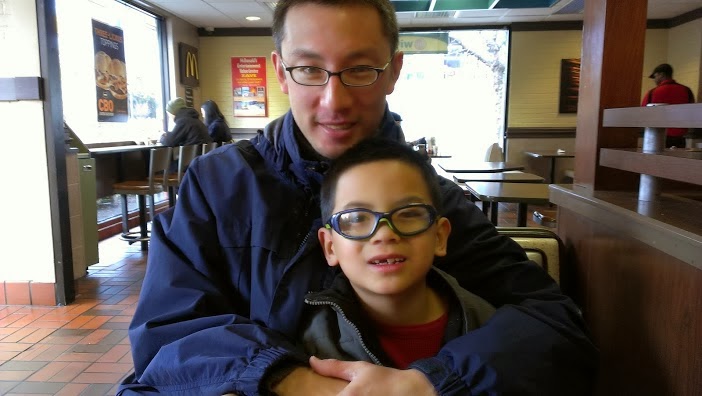
 From the warmth of San Jose to the bitter cold of Philadelphia, the Huangs survived a brutal January, but just barely.  Amy and Lee were slammed by work up to their eyelids.  Aaron celebrated his 7th birthday, while Jada is already planning her 9th for next month.  Weekends we laid low, with Aaron and Jada reveling in their recent Christmas loot: American Girl doll (Jada), Beyblades (Aaron), and mp3 players (both).  


1.29.2014

Learning from a Fellow Introvert

http://www.introvertleader.com/wp-content/uploads/2012/08/photo.jpg
I had the pleasure of catching up with a colleague of mine earlier this month who I hadn't met with in several years.  He runs a successful not-for-profit organization in town and he has grown it considerably in size and impact in the 10+ years he has been running it.  And, like me, he is an introvert.

So it was particularly instructional for me to hear how he manages his time and runs his organization, not just because he's done well at his job because he's done it as an introvert.  Yes, introverts can be top dogs, press the flesh all day, and constantly seek out new contacts and new interactions without falling to pieces.  Here are my three takeaways that I will be trying to incorporate into my professional life so I can do better and still stay sane:

(1) Hire good people and trust them to do the work.  Like me, my colleague enjoys the inner logistics of his organization.  But at this stage in his organization's growth, his role has to be externally facing.  So what he used to do, what he enjoys, and what he does well, he now has others do, and he lets them do it.  After all, playing the outside game takes time and energy, especially for an introvert.

(2) Rest, reflect, and re-engage.  How do you stay on top of a complex entity?  Take a break every weekend, revisit your key functions/issues/people, and fire out the email missives.  I do this too.

(3) Read.  Ah, the soothing rejuvenation that is a good book.  Yet another classic instance of introvert behavior.  Even as I get busier and busier, I'm doubling down on this.

1.27.2014

Lazy Linking, 106th in an Occasional Series


http://photos.visitphilly.com/federal-donuts-pennsport-philadelphia-600.jpg
A 1:60 Scale Boeing 777 Built Entirely from Paper Manilla Folders by Luca Iaconi Stewart sculpture paper models flight airplanes What I liked lately on the Internets:

106.1 Love 1/2/3 on this list of local Philly food chains http://bit.ly/1mTk56q @zagat

106.2 A Penn/Drexel alum is at the helm of Upworthy (fastest-growing media site ever)
http://bit.ly/LZ3QHq @phillyweekly

106.3 Top HS's by SAT score - 7 in Bay Area, incl. my alma mater at #7! (suck it, Monta Vista)
http://read.bi/1ep3PFU @businessinsider

106.4 Jet planes everywhere = we're running out of places on earth that are totally quiet
http://bbc.in/1jdoOgy @bbcnews

106.5 1:60-scale Boeing 777 made entirely out of manila folders, sure why not http://bit.ly/1aoav8Q @thisiscolossal

1.24.2014

The Problem of Sin

https://blogger.googleusercontent.com/img/b/R29vZ2xl/AVvXsEjyW2r_nnjuBXxYG_1TMwLeuD9DgcU3dF7j_HNRynWWhyphenhyphenasGnbUYsz7L7geUUfbnSQrBDybZSLLB6cd0hRLI8_mwcn44cORiPqwBEqRj5hKmXWS6kQihOMAU3m1FR73AWCAcoDg/s1600/Meeting+GOD.jpg
Picking up on yesterday's post, I think the huge fork in the road that the Christian narrative presents is because of the concept of sin.  If there is no such thing as sin, then the big questions in life are relatively easy: since we're all OK, then we're fine choosing whatever we want to believe and however we want to live, so long as we're not doing harm to ourselves or others.  In other words, why can't there be many ways to a fulfilling life now and eternal salvation later, if in fact the plight of our souls isn't that dire?  I can see how such a worldview would be appealing.  But that doesn't necessarily make it true. 

Interestingly, it is sometimes humanity's worst people who seek salvation most earnestly.   If they have committed grievous deeds and have a conscience, they know they are utterly lost and can do nothing to atone for their actions, so they seek salvation from an external source.

For the rest of us respectable people, we greet such searching with admiration.  We hear about someone who was down and out who found religion and we think, "Good for them."  We're glad they're doing what they're doing.  But what they're doing is "for them."  Meaning "not for us."  We don't think of salvation from an external source as being as necessary for us, because we're not like "them," because we're doing alright for ourselves.

Even we Christians, who profess to sin and hell and salvation, don't often feel as lost as we really are.  And you wonder why non-Christians are annoyed at our proselytizing.  Telling others about the way to salvation when we ourselves don't believe deep down that we needed much help to be saved just comes across as haughty and narrow-minded and insensitive.

If you know your Bible, think instead of Isaiah having his encounter with God in Isaiah 6 or Peter having his encounter with Jesus in Luke 5.  These two men were face to face with holiness personified and became utterly unglued in its presence:

Isaiah -“Woe is me, for I am ruined!  Because I am a man of unclean lips, and I live among a people of unclean lips; for my eyes have seen the King, the Lord of hosts.”

Peter - “Go away from me Lord, for I am a sinful man!” 

Also uniting these two responses is what happens next.  Both are assured, and both are commissioned to tell others.   You can imagine that their stories to others took the reality of sin seriously, not as a theoretical possibility but a very real problem begging desperately for outside help.  

If you don't believe in the problem of sin, then I don't blame you for not taking seriously the claims of Christianity, least of all because of the poor example we Christians have been in our own behavior and in our own reaction to the problem of sin.  But I urge you to reconsider.  If sin is a problem, there is a solution.  Coming to face to face with holiness may yet leave you feeling ruined and lost, but then cleansed and saved.

1.23.2014

Split Ends

http://rallyhaus.com/wp-content/uploads/2012/05/Highway-1-Intersection-105-110-Los-Angeles-California.jpg
I've had two conversations this month that share a common theme.  The first was with a colleague of mine who told me that all religions serve the same purpose, which is to provide meaning in life, direction for one's own life, and motivation to do good in that life.  The second was with a friend of mine who told me a mutual friend, tired of the hypocrisy of so-called Christians who didn't give a damn about social issues, had recently shifted her "religion" on Facebook from "Christian" to "justice-seeker." 

If you know the worlds I swim in, these conversations shouldn't be very surprising.  For the life philosophy contained in them is, one can argue, the dominant line of thinking among my peers.  Perhaps it is even the majority view for society as a whole, this notion that religions are either multiple means to the same ends or alternatively narrow-minded and dangerous.  That seems to be the main vibe one gets with the Christian faith, at least around these parts: if what "Christian" means is being kind, avoiding vices, and caring about the poor, then "alright!"; but if it means believing that Jesus is the only way to God, then "hey now!"

If religions are the means, what are the ends?  In other words, what do we truly seek with our lives, which we'll orient much or all of our daily activities and lifelong dreams towards in order the achieve?  I'm sure there are others, but off the top of my head, I can think of nine, which I present in alphabetical order and in as unbiased a way as possible:

Comfort.  This can either mean ease or healing.

Culture.  Whether country of origin, ethnicity, religious tradition, profession, or institution (or even sports allegiance?), some group with norms that we so identify with that it is what we orient our lives around and want to pass on to others.

Fame.  This can either mean being famous today or leaving a legacy for tomorrow.

Justice.  Some of us are wired to want to do as much good as possible in resolving social and structural injustices.

Kindness.  Some of us are wired to want to do as much good as possible to our fellow humans.

Pleasure.  Pleasure-seekers tend to be more physically oriented and more now-oriented.

Possessions.  For some, possessions are a means to another end, but for some, possessions are the end.

Power.  Outside of the fame that comes with it, power can be an end to some who seek the influence that comes with it.

Truth.  Truth-seekers tend to be more cerebral, since it takes a focus on the mind to wrestle with big questions like the meaning of life.

Christians have (or at least should have) an answer for every kind of person above, and I actually don't think that answer necessarily needs to be that you are seeking the wrong end and need to pick a nobler one.   Of course, Christians should think that the ultimate end is, in the words of the great catechism, "to glorify God and enjoy Him forever."  But, I think, all of these ends above can all be good things to pursue within the construct of glorifying God and enjoying Him forever. 

Different religions have something to say about each of these nine ends, and Christianity is no exception.  Though we may be, through nature or nurture, predisposed towards some of these ends and against others, we are free to choose which one truly governs our life, and we are free to choose which religion or philosophy provides the best framework and motivation for successfully pursuing those ends.  But that doesn't mean that our choices are necessarily right - right for us or right in general - and I think most people would agree with that statement.

Where you'll find more disagreement is with a tenth end, which is salvation, the sense that we are in need of redemption, reclamation, cleansing, atonement, deliverance, rescue, recovery, however you want to think of it.  There can be some contention about how one is saved, and whether it is logical/fair/true/nice to say that other ways are better than others, let alone that there is only one way to be saved.  Heck, there can be some contention about whether one needs to be saved at all.  Let me stop here and hope that in the next day or two I can complete this line of thinking. 


1.22.2014

Being the Best and Being a Believer


http://www.footballperspective.com/wp-content/uploads/2012/08/Russell-Wilson.jpg
http://sports.cbsimg.net/images/visual/whatshot/clayton-kershaw-1011913.jpgChristianity in American sports is usually one of three narratives: (1) athletes using their fame to share their faith and their money to do good works (think Tebow), (2) athletes wrestling to live out their faith in a milieu full of temptations (lust, materialism, power, ego), or (3) athletes confronted about their views on contemporary social and political issues (gay marriage, Israel). 

I want to go in a slightly different direction today, which is to say that it is possible to be a Christian and an elite professional athlete.  I have been pleased to read more about the faith journeys of Clayton Kershaw, Russell Wilson, and Kevin Durant.  You will not find three more successful athletes in their respective crafts of baseball, football, and basketball.  By all accounts, you will also not find three nicer people to be around, which is nice to know. 

http://www.yesimfresh.com/uploads/8/3/8/8/8388654/475849_orig.jpgSure, these three have used their fame and money to share their faith and do good works in ways that you and I cannot.  And, obviously their day-to-day lives are markedly different than ours, making living out their faith a different challenges than what we face.  But, in other ways, they are ordinary followers like you and me: they read their Bibles, they struggle with sin, and they strive to be better people and better Christians every day. 

In other words, they are no different from us in terms of what they want and how they go about it.  Where they are different from us - practically other-worldly - is being good at something physical, and putting in the preparation time to take those physical gifts and convert them into elite professional athlete status.  Kershaw just signed a seven-year, $211 million contract and is by all accounts the best young pitcher in baseball, Wilson is playing in the Super Bowl next weekend, and Durant leads the NBA in scoring. 

Something I tell my kids all the time is to not be afraid of being really good at something, and to not be afraid of the time and commitment that it takes to get really good at something.  Sure, becoming world-class in something can be thought of as a means to an end: to gain fame and fortune, or to use that fame and fortune to share your faith and do good works.  And, sure the pursuit of becoming world-class can be fraught with temptation: to make the thing you're pursuing your god instead of God Himself, to cut corners, to step on people on the way up, or to become full of yourself along the way. 

But, being the best at something is not something that is incompatible with being a follower of Jesus.  It can, by itself and not as an end to something else, be something meanwhile and worth pursuing.  I appreciate the humility and professionalism exhibited by Kershaw, Wilson, and Durant as they seek to be better Christians and better athletes each and every day.  They know what's really important in life, and they live lives worthy of the things they believe in.  But they also take pride in their craft, and they aspire to the highest heights in their respective leagues.  All of that is worth emulating.


1.21.2014

How Should You Respond to a Question You Find Offensive and Hateful

Judd Apatow Jenni Konner Lena Dunham GirlsOn today's topic, I'm late, ignorant, and clueless, but that's never been a deterrent to posting dreck in this space.  I'm speaking of the furor around journalist Tim Molloy asking Lena Dunham of "Girls" why her character is naked so often on the show. After responding to the question itself in one sentence - "It’s because it’s a realistic expression of what it’s like to be alive, I think, and I totally get it," she punched back against the question, as did the show's two executive producers, Jenni Konner and Judd Apatow.  Molloy was left to fend off accusations of misogyny, which he tried to during the interview as well as in an article later that day.

Understandably, this is a tricky question to ask, although I agree with Molloy that it's fair to ask.  But let's assume for a moment that it is in fact an offensive and hateful question to ask.  If you were Dunham, Konner, or Apatow, what would you do? 

(A) Condemn the sentiment behind it.  "I can't believe you just asked something so vile."

(B) Try to educate the question-asker as to why the question is so wrong.  "Here's why what you're asking is so offensive."

(C) Seek to understand where the question is coming from.  "What exactly are you getting at?"

(D) Answer the question however much you dislike the sentiment behind it.  "I'm glad you asked that question.  Here's why there's so much nudity on the show..."

In life, we are going to come across some ignorance, some stupidity, and some out-and-out evil.  How we choose to respond, I think, depends on what we're trying to accomplish.  Do you truly want to enlighten people or do you prefer to score points for yourself by vilifying others?  Do you revel at the chance to articulate the philosophical intent behind your artistic decisions or would you rather not have to explain yourself?  Many of you, I'm sure, think you know where Dunham, Konner, and Apatow are coming from; I simply do not know these people at all so I can't say. But each of us can know where we are coming from.  Let's hope we handle questions we consider misguided in ways that build up rather than tear down. 


1.17.2014

The Lessons You Learn While Waiting for Your Bus

http://www.septa.org/media/short/2010/pictures/03-18a.jpg
Last week, I had a meeting with a colleague of mine in South Philadelphia, so I headed southbound on the Broad Street Line, got off, and waited for a bus to take me to the doorstep of his building.  It was, to quote a Winnie the Pooh book, a very cold and blustery day, and I looked down the street in vain, trying to will the bus to come sooner.

While I was waiting, a fairly menacing-looking dude approached me and gruffly asked if I had a phone because he needed to call his mom.  When I didn't immediately respond affirmatively, he insisted that I could hold the phone the whole time and that all he needed was to tell his mom something.  I mumbled something about my phone being low on battery and that's when he lit into me: "You're lying and I know it.  That's cowardly!  You're a liar and a coward!"  And then he stormed off.

Now, it's never good to be called a liar and a coward, but I've been called far worse before.  And, it was broad daylight and there were plenty of people around, so I never really feared for my safety.  But the incident still shook me.

It shook me because I profess to believe in God, Jesus, the Bible, the whole nine.  And it's pretty clear that the living out of that belief includes, at the very least, doing something for people when they are in need.  And yet I never once had even an inkling of desire to help this poor guy. 

Now, you might argue that I was just being prudent: he could have hurt me or tried to scam me.  But, within reason, the Christian is supposed to take that risk.  As noted, it would not have been much of a risk for me to pull out my phone, dial the number the guy told me to dial, and hold the phone to his head while I spoke with his mom.  It would not have been much of a risk but it could have been a meaningful act of charity toward a fellow man.

Why did I not help, and why did I not once even consider helping?  Was I so caught up in my own troubles that I couldn't get out of them for one second to assist someone in more need than me?  Did I feel no sense of connection with someone so different from me in dress and demeanor?  Was it because the guy was black?

The thing about living in the city is that when you go from Point A to Point B, sometimes God inserts Himself into your path to provide you with a life lesson.  He has a lot of work left to do on me, so I better keep my eyes open for more such lessons in my travels.

1.15.2014

Thinking Fast on the Field of Life

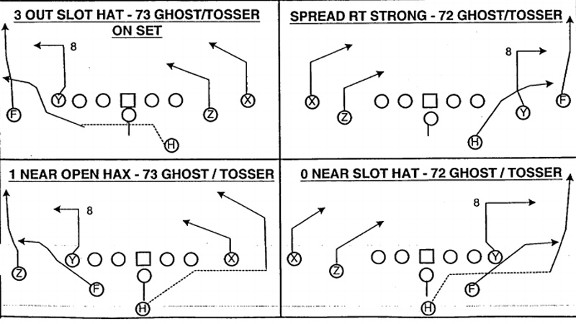
http://a.espncdn.com/photo/2013/0116/grant_ghost-tosser_sy_576.jpgI'm sure you know someone whose desk is a mess but "I know exactly where everything is."  I believe it: it may seem like chaos to the outsider but it is actually order to someone. 

I am the opposite: my desk is usually pristine.  But once I get so busy that multiple piles start forming, I lose the ability to function and I can't find anything. 

It has been obvious to me for awhile that the most successful people aren't necessarily the ones with the cleanest desks.  What has taken longer for me to realize (yes, I am that dense) is that while a clean desk can be very helpful for my productivity, an inability to adapt to just a little bit of chaos is very detrimental to my productivity.

I was reminded of this lesson when I read this article in the New Yorker about what makes a football player smart.  Football can seem such a brutal and physical sport that we forget just how intellectual it really is.  And I'm not talking about advanced stat; that's the purview of analysts and fans.  No, the players themselves have a lot to digest in a short week of preparation, and even less time on the playing field. What other sport has only 16 games per season, necessitating severe amounts of film study to familiarize yourself with an opponent you may only play directly once every two or three years?  And what other sport has 22 players on the field at the same time, which is a lot of bodies and angles and velocities to keep track of on each down?  At an elite level, then, the best players aren't necessarily the most physically freakish ones but the ones who can study harder during the week AND think faster during each play. 

That "and" is the key to football success and the lesson for my life.  I know the importance of putting in the time to plan ahead and be prepared.  I am learning the importance of thinking faster on the field, processing new information and adjusting my responses accordingly. 

Of course, this lesson can be applied to more than just my work life and the status of my desk.  There is only so much we can prepare for in our lives.  Sometimes chaos, uncertainty, and mess crash into our lives.  Just as I am thrown for a loop when my once-pristine desk gets cluttered even a little bit, I become irritated and frozen when life lurches in a new direction. 

I am learning to deal with a little clutter when at my desk.  But God still has a lot of work to do in me to make me supple to the curve balls He throws me.  They are intended to move me to a place where I respond with faith, trust, and openness, rather than frustration, panic, and distress.  And I wonder why I get so many of them.


1.13.2014

Facebook is the TV Version of Us

http://static.someecards.com/someecards/usercards/MjAxMi1hNGU4OGU2NTkzZjJhMzg0.pngReports that show Facebook activity flattening or even declining among youngsters are not surprising.  After all, whether it is social media or physical locations, once us oldsters crash into these once-trendy places, youngsters are sure to not want to linger around.

This NPR post also notes, though, that it can be tiring for young'uns to live up the pressure they impose upon themselves to present perfection in their online personas.  As they are bombarded with the most flattering pictures, funniest anecdotes, and biggest life moments in the lives of the friends on their news feed, young folks are straining to properly curate their own contributions to the feed.

Of course, those of us who are older and wiser are immune to this sort of relentless anxiety.  Nah, we're just as susceptible and just as guilty.  What we consider "perfect" may be different if we are in our 40's than if we are in our teens, but we still emerge from too many reviews of what our friends are up to feeling like our lives are empty and unexciting.

It's the modern-day version of what I once heard an insightful public speaker discern about TV.  We all watch TV, and we all know that what we watch is fiction and not fact.  And yet, subconsciously, we forget just how unlike the real world TV is.  On TV, everyone is beautiful, and crises are introduced and resolved in less than an hour in a neat, predictable pattern.

Most importantly, TV captures only the high points of any narrative.  You don't see Olivia Pope paying her bills or the kids from Glee studying for a history midterm.  And even though modern character development is much more nuanced and complex than during pre-syndication days, we're still fed a relatively straightforward message about each person we see; there are no extraneous data points to cloud our interpretation of whether someone is good or bad, rising or falling.

Life, of course, is not like this.  It is also not like what we see we consume our news feed on Facebook.  Sure, our lives consist of vacations and first steps, date nights and promotions.  But they also consist of vacuuming on the weekends, waiting in line at the grocery store, and grinding out long days at work and school.  Our Facebook profiles aren't quite us as much as they are the TV version of us: the highlights, and nothing else.

Our Facebook profiles aren't quite us in another way.  There we can show the best side of ourselves.  I mean this in a literal sense - be honest, when was the last time you posted a photo that include yourself in it and it wasn't a great photo of you?  I also mean this in a figurative sense - what we link to and what we share is carefully determined by what we want people to think about us, that we are socially conscious or witty or big-hearted or successful.

Real life is messier, more boring, and not as attractive.  If you could help it, why wouldn't you want to avoid messier, more boring, and not as attractive?  And so you participate, just like everyone else is.  But if you feel you can't be as tidy, exciting, and attractive as everyone else comes off as, why wouldn't you tire quickly and wish to disengage?  And so you say good riddance to Facebook.

Of course, these urges and dangers were with us long before Facebook or even TV arrived on the scene.  And they're important things to consider, for ourselves and our own wellbeing, as well as that of the young'uns in our midst.  Let's hope that we don't spend too much time fixating on providing commentary on the mediums that we forget to tend to our souls.

1.09.2014

Recommended Reads, 16th in a Quarterly Series


http://zenandgenki.files.wordpress.com/2012/09/booknook.jpg?w=593Stuff I've read lately that I'd recommend:

LeBron’s Dream Team: How Five Friends Made History (James/Bissinger).  Before he was the man, he was a boy from Akron just trying to win a state championship with his boyhood friends.

Eat That Frog: 21 Great Ways to Stop Procrastinating and Get More Done in Less Time (Tracy).  Even for someone who prides himself on efficient time management, I learned a few things from this book.

OK: The Improbable Story of America’s Greatest Word (Metcalf).  Loved how fanciful and scandalous is the story behind the English language’s most common and ordinary word.

One Nation Under Sex: How the Private Lives of Presidents, First Ladies and Their Lovers Changed the Course of American History.  Man, what a field day we would’ve all had if Twitter and TMZ existed when Dolley Madison, Abraham Lincoln, and JFK were alive.

Father’s Day: A Journey into the Mind and Heart of My Extraordinary Son (Bissinger).  A beautiful albeit brutally honest look at a dad’s relationship with his mentally impaired son.

The Lucky Ones: One Family and the Extraordinary Invention of Chinese Americans (Ngai).  This book has it all: race, class, politics, immigration, assimilation, and intrigue, much of it in the Bay Area to boot.

Here’s Looking at Euclid: A Surprising Excursion through the Astonishing World of Math (Bellos).  Really cool how you can find math pretty much everywhere you look.

1.08.2014

What Am I Working On

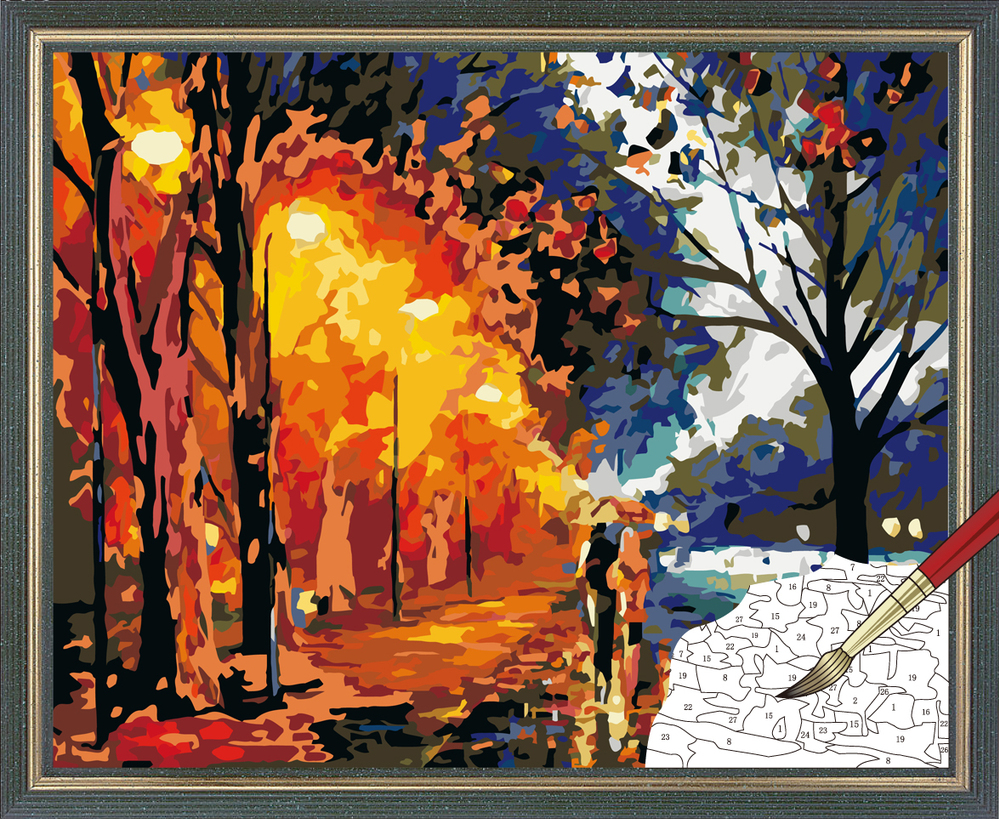
http://i01.i.aliimg.com/wsphoto/v0/702454807/Framed-Stepping-On-The-Rainy-Street-Painting-DIY-Paint-by-Numbers-50x40cm-20x16-PH7102.jpgAs has become my custom every three months, here's what I'm working on now at work. I won't repeat anything from last time that I happen to still be working on, and for confidentiality's sake I have to blur some of the details for some of these studies.

Assessing the financial feasibility of a proposed recreational area in New Jersey.

Doing a cost-benefit analysis of a proposed downtown revitalization in the South.

Quantifying the economic contributions of a specific subset of not-for-profit institutions in a big East Coast city.

Quantifying the public return on an investment in a major outdoor amenity in Philadelphia.

Estimating the economic and fiscal impact of a proposed hotel and residential development in the downtown area of a big East Coast city.

Articulating the economic gains associated with investing in supermarkets in under-resourced neighborhoods.

Conducting a financial feasibility study for a tourism destination's proposed new set of ticketed offerings.

Completing an employment impact study for a developer seeking funds from the US Citizenship and Immigration Services' EB-5 Immigrant Investor Program.

Completing a development impact statement for a developer seeking to build a new residential building in the Philadelphia suburbs.


1.07.2014

Letters to Congress: Immigration Reform

http://shariaunveiled.files.wordpress.com/2013/01/statue-of-liberty-1-2-small.jpg?w=627&h=405
Every six months or so, I like to be a good citizen and write something to my elected officials in DC.  This time's topic is immigration reform.

***

I know that immigration reform is something you are working on right now, and I know it is a complex topic with legal, political, economic, social, demographic, and geographic drivers.  I don't discount just how difficult it is to do even the simplest thing in Washington, let alone something as multi-layered at this.  I respect that your job involves answering to constituencies, and that you you have a lot of different sets of constituencies on this issue and they're all saying different things.

That said, I hope you'll remember that, by and large, anyone who is trying to come into country possesses the kind of attitude that we need more of in our country, our communities, and our economy.  For them, the American Dream evokes not cynicism or nostalgia or rebuke but longing, deep longing that is matched only by a deep desire to do whatever it takes to access it, live it, and achieve it.

My parents were immigrants.  They came for grad school, but more so they came to make a new life, a better life.  They were lucky to be well-educated, to come here by choice, and to have opportunities afforded them.  I realize not all immigrants are so fortunate.  But most all do share my parents' respect for the rule of law, their devotion to making life better for their children, and their abiding loyalty for the greatest nation in the history of mankind. 

I hope to live in this country for a very long time.  I'd like to stack it with as many people like my parents as possible.  I'm thinking their kids will turn out alright as well, so that's not a bad thing, either.

1.06.2014

Lazy Linking, 105th in an Occasional Series

http://i1.ytimg.com/vi/u9Wf8y_5Yn4/maxresdefault.jpgWhat I liked lately on the Internets:



105.1 High cost of cheap labor: 61M Chinese kids live in villages while their parents work in cities wapo.st/1cEZIpd @washingtonpost

105.2 Give more to fewer charities or less to more charities? Depends on what we're giving for bit.ly/Kokq2r @freakonomics

105.3 Search costs, signaling, scarcity: the economics of online forms of dating, job searching bit.ly/18ozS9f @harvardbiz

105.4 The effect – some good some bad – of NYC's red-hot real estate market on the urban built form bit.ly/1hn5pMc @jamessrussellny

105.5 Heartbreaking words from a poet re his 4yo nephew, how hard it is to grow up black in America bit.ly/1a7bCYn @javonism


1.05.2014

2013 Car Usage

This is the fifth year I have tracked car usage, so I think it's safe to say this has become a habit. As has the nerdy tracking and graphing of it in Microsoft Excel. (You can check out 2012 here, 2011 here, 2010 here, and 2009 here.)

As before, the Philly totals represent, in order, number of trips, number of legs represented in those trips (i.e. going to and from my in-laws, making one stop to get gas, counts as three legs), and number of legs in which I was driven (rather than driving). The other city totals represent, in order, number of times I was in that location, number of days I was in that location, number of trips, number of legs represented in those trips, and number of legs in which I was driven.

Philadelphia 107/246/44
Baltimore 1/1/0/0/0
California 1/15/13/45/15
Chicago 2/2/0/0/0
DC 1/1/0/0/0
Detroit 3/4/2/6/8
Harrisburg 4/4/0/0/0
Long Island 1/2/2/7/0
NYC 2/2/1/2/0
SJ 1/8/15/42/2

You'll see that the last two Philly numbers add up to just well under 365, so while in town I averaged less than one leg per day in 2013, thanks to our urban setting and the many everyday locations I can get to without a car. Here's hoping that that delays when we need to purchase a new car, and that it makes a difference for the environment.


Too Short for a Blog Post, Too Long for a Tweet 522

  Here are a few excerpts from a book I recently read, "Moby Dick," by Herman Melville. Again, I always go to sea as a sailor, bec...