3.29.2013

Recommended Reads, 13th in a Quarterly Series


https://blogger.googleusercontent.com/img/b/R29vZ2xl/AVvXsEheQCydbBpiTAMzNCZwCIC2UIslQpXxT62FKdtjrxfJAJ02Ec_Ju1COEB_8t3z1XZTdIwWYnVtGYubpm14hipXHXPiVt8U3CuweOHcQI1jydJ1SyNJtMBepI4QlPKTXlc6gldjj4g/s1600/the+new+year+2012+207.jpgStuff I'd recommend from the past few months:

Sex and the Supremacy of Christ (Piper).  A good, Biblical perspective on sexual sin - why it's wrong, why we do it anyway, and why and how to overcome it.
 
Lincoln: The Biography of a Writer (Kaplan).  We've all read Lincoln bios, but this one is a fun lens by which to understand the one many consider to be our greatest president, which is as a crafter of written arguments.
The Age of Gold: The California Gold Rush and the New American Dream (Brands).  Even though I grew up in California and studied the gold rush in grade school, I had no idea how big, how global, and how transformative it was.

The Big Burn: Teddy Roosevelt and the Fire that Saved America (Egan).  A dramatic account of a huge fire and the before and after politics of the Forest Service.
.  
SuperFreakonomics: Global Cooling, Patriotic Prostitutes, and Why Suicide Bombers Should Buy Life Insurance (Levitt).  Levitt and Dubner at their best, with clever and counter-intuitive arguments culled from econometric analysis and economic theory.
Guns, Germs, and Steel: The Fates of Human Societies (Diamond).  Diamond goes way way way back, and gets at the fundamental causes behind regional differences in human advancement.

A Short History of Nearly Everything (Bryson).  Not nearly as laugh-out-loud funny as his other stuff, but just as engaging.

3.28.2013

MLB Predictions Guaranteed or Your Money Back

http://www4.pictures.zimbio.com/gi/Freddie+Freeman+Atlanta+Braves+v+Los+Angeles+SF44F7l-iUgl.jpgIf I knew as a child how little time I'd have as an adult to follow sports, I'd do everything I could do delay adulthood.  Back then, I lived and breathed sports: I agonized during A's and Raiders games, dissected box scores as if they held the meaning of life in them, and sorted baseball cards until the wee hours.

Now?  I fast-forward through football games, watch no more than 10 NBA games a year (also on fast-forward), and spend less than an hour a week on ESPN and sports blogs.

And March Madness?  I got confused by the fact that there were three rounds of games in the first week, tried to figure out how Philly was simultaneously hosting games in the South and Midwest Regionals, and realized I can't name a single player on any team anywhere.  So, no, I didn't fill out a bracket and I haven't watched and read about any of the games: I have nothing in my head that this information would stick to.

But it is my diminished following of baseball, my first love, that is the most pronounced.  Last year, I watched a grand total of zero games - live, on TV, or fast-forwarded on my VCR.  I maybe watched the highlights or read the recaps of less than 20 games total.  This, from someone who once could recite baseball stats from decades ago at the drop of the hat, and who read every single baseball book in the library three or four times as a kid.

So take these predictions with a grain of salt.  They are based on the thinnest of thin slices.  Play ball!

AL: W-Angels, C-Tigers, E-Rays, WC-A's, O's
NL: W-Giants, C-Reds, E-Braves, WC-Nats, D'Backs
DS: Angels over A's, Rays over Tigers, Reds over Nats, Braves over Giants
WS: Braves over Angels

3.27.2013

Where Does the Time Go (Part II)

Yesterday's post about time focused on the additional time I put in on the work side to market myself and my company.  Today I want to talk about the family side of the work-family balance.  Just as it's hard for me to toggle between desk work and outside work, it's hard for me to toggle between consultant and dad.

I know this is not true for others.  Others thrive on the fluidity of their schedules, flowing seamlessly between multiple roles and feeling grateful for the flexibility to work from home and take from work to do family stuff. 

I am not like this, and seem to have become even more compartmentalized as my life has complicated.  I find this neither good nor bad, just a way that I deal with the many important things that make up my life. 

One thing I alluded to in my post about time and money earlier this week is the trading of money for time by outsourcing various tasks to others.  Here's an inventory of things that took my time this month that are commonly outsourced to others by parents:

21 school drop-offs
17 school pick-ups
5 swimming classes at the Y
4 ballet classes at the neighborhood dance studio
2 doctor appointments
2 dentist appointments
5 grocery runs
5 hours of indoor chores (cleaning, vacuuming)
31 times feeding the kids breakfast
15 times feeding the kids lunch
27 times feeding the kids dinner62 times washing the dishes


And that's just one of the two grown-ups in the Huang Family Corporation.  I'm not sure math has invented numbers big enough to quantify my wife's share of the load.  ("Load" being a deliciously apt word to use here, given the mounds of laundry she does 100 percent of.)

And so between the two of us, it is a daunting amount of time spent on the maintenance of our lives and the care of our children.  Which, between that and demanding jobs and the inability to get by on superhuman levels of sleep, means not much down time and not much shelter from weariness. 

So you look at that list above, and, feeling the tiredness at your core, you start to think about where money can be traded for time, what things you actually enjoy and would miss, and how to balance being a good parent by being there with being a good parent by making sure you're not completely fried.  And that's as far as I go today with this post, conceding that I haven't the foggiest what to do and realizing that this challenge is both widespread among many of my peers and yet each situation (and thus each solution) is unique.

3.26.2013

Where Does the Time Go (Part I)

http://alongtheyellowbrickroad.files.wordpress.com/2010/03/hourglass.jpgPicking up on yesterday's post about time and money, let me take a couple more days to think through time.  As a new partner in my firm, I have the same responsibilities as I had before (quarterbacking gigs, writing up reports, holding clients' hands, seeing engagements through to the finish line) but many more others, most notably marketing the company, working my own personal networks, and shaking the proverbial trees for money. 

The inside-outside game of powering through analyses and reports at my desk on the one hand, and pressing the flesh and cultivating relationships on the other hand, is particularly tiring and invigorating at the same time.  Sometimes I wish I only had to worry about one or the other, since toggling between both can be tiring for this introvert.  Sometimes I'm glad I get to spend time on both, because I enjoy both and it's fun to connect the two: reports are made more useful by talking to actual human beings, networking leads to analytical work that is interesting.

At any rate, I was busy before I took on these new responsibilities, so it's been a challenge figuring out how to get just as much desk work done as before while spending more and more hours pounding the pavement and curating contacts.  Just this month, over and above the usual complement of meetings on projects and proposals, I have had 12 one-on-one's and attended 2 events.  By the fall, I'd like to get that to 20 and 4. 

That's a lot of time to spend on things not immediately related to current work or imminent work.  But it's what you do to work the pipeline.  And, of course, it's not like it's not enjoyable.  In fact, it can be quite invigorating, to riff with smart people and to think big picture about a wide range of topics and concerns.  But it does take a considerable amount of time and energy, two finite resources I'm struggling to figure out how to manage. 

3.25.2013

Time and Money, Circa 2013

http://www.smpswisconsin.org/site/wp-content/uploads/2012/09/saves_time_money.jpgI finished my taxes earlier this month - but won't be mailing them in for another couple of weeks; since I owe instead of being owed, I'll take my sweet time in giving Uncle Sam my money, thank you very much.  I also use this time of the year to generate summary financial statements for myself - a balance sheet to check on my assets and liabilities and make sure everything's good there, and an income statement to see if our family's budget makes sense. 

Which is why, around this time of the year, I'm in a pretty good position to comment on our allocation of money across various expenditure categories.  So I do, every other year - see 2011 and 2009 and 2007.  Here's how 2013 looks, roughly:

Taxes 30% (up from 20% last time)
Savings (retirement, college) 20%
Giving (church, charities) 10%
Mortgage/transportation 10%
Utilities (house, phone) 5%
School/camps 5% (down from 10% last time)
Groceries, personal care 7.5% (down from 10% last time)
Home furnishing/maintenance 2.5% (down from 5% last time)
Health care 5%
Leisure, discretionary 5%

Thankfully, Amy and I both make more money now than two years ago.  It's interesting to see what expenses go up proportionate to our higher earnings, and what expenses stay flat and therefore decrease as a proportion of our earnings (savings and leisure being among the former, groceries and home stuff being among the latter).  The bigger tax bite largely represents going from getting a big refund to writing a big check around April 15.  And the smaller school/camp bite is because both our kids are in public school (vs. two years ago, Aaron was still in private preschool).

As for time, here's how I look (just to clarify, the money numbers above are for Amy and my salary combined, while the time numbers below are for just my time):

Sleep 30%
Work 35% (up from 30% last time)
Kid errands (bedtime, meals, shuttling) 10%
Religious (personal prayer, church meetings) 5%
Adult errands (paperwork, chores, house) 7.5% (down from 10% last time)
Adult fun (dates, leisure, exercise) 7.5% (down from 10% last time)
Family fun (zoo, play dates, horseplay) 5%

Of course, I have exactly the same amount of time now as two years ago.  (Still haven't figured out how to manufacture an eighth day in each week.  Still could use it.)  Work takes up slightly more time (actually, 5% is about 8 1/2 hours, so that's a pretty good chunk).  Where has that time come from?  A little bit less adult fun, and a little bit less adult errands - the former means less grown-up leisure, the latter means nothing except that we're doing less house projects than we were in 2011.  I would've assumed kid errands would have declined, except that (1) there always seems to be a doctor's appointment or a school thing, and (2) with Amy being busier I do a slightly higher share of stuff like this than two years ago. 

One last word about time and money.  Of course, we trade between the two all the time.  One way we trade money for time is buying food for the family on the weekend; a bunch of sandwiches and platters at the local  Middle Eastern halal restaurant or pizza joint makes everyone's bellies happy and reduces the amount of cooking that needs to be done, at a financial cost of 35 bucks or less.

Conversely, one way we don't (yet) trade money for time is hiring people to do some of the kid errands I mentioned above.  It's not for lack of cheap options - we live in a place with lots of college kids and young people.  I guess it's partly thriftiness, and partly wanting to be the people that take our kids to ballet and baseball rather than outsource that to someone else.  But I imagine that, when I do this two years from now, this will be one area where we trade money for time.  Most of our kids' friends' parents do this all the time, and their kids seem fine; in fact, if it means they can get to more fun stuff than if they had to depend on their parents to get them there, it's actually a preferred option and not a necessary Plan B. 


3.22.2013

Quantitative Tools for Consulting

http://upload.wikimedia.org/wikipedia/en/e/e4/Fels_Institute_of_Government.jpg
I'm officially on again to teach Quantitative Tools for Consulting (GAFL517) at the Fels Institute of Government this summer.  The course covers a wide range of quantitative methods that are used in consulting settings, and through the process we also touch on a number of policy topics and on the role of consultants and of quantitative analysis in advancing those topics. 

Since grad school, especially at Fels, is a participatory type of activity, one of the things I am going to institute as a fun learning device is a class Twitter account.  Every week, students will have to find and tweet an article that relates to that week's quantitative tool.  My hope is that this assignment will help students see quantitative analysis in action in a wide range of policy discussions and encourage healthy discourse on those topics. 

Once the course starts, I'll share all the handles so you can follow along and participate as you are interested.  Until then, if you or anyone you know is interested in the class, I encourage you to sign up.

3.21.2013

Easter Festivities at Woodland

http://i43.photobucket.com/albums/e388/Swinefeld/Spruce%20Hill/SH_025.jpgLots of good stuff going on at our church, which all are welcome to check out.  And, by the way, when I say "all," I mean it - given how crazily diverse we are, I can't think of anyone who would feel out of place among us (unless of course you're stuck up and think you're above mixing it up with anyone besides people just like yourself). 

All events below are at 42nd and Pine Streets unless otherwise indicated.  You can call the church office for more information or go to www.woodlandpres.net.  See you around!

Su 3/24 10:30a Palm Sunday worship service
Fr 3/29 7:00p Good Friday worship service
Sa 3/30 12:30p Easter egg hunt for the kids
Su 3/31 8:00a  Easter morning worship service at Clark Park
Su 3/31 9:00a Easter morning breakfast and testimonies
Su 3/31 10:30a Easter morning worship service


3.20.2013

Falls Into the Earth and Dies

http://postrecession.files.wordpress.com/2009/04/green-shoots.jpg"Martyr" has taken on a negative connotation, usually associated with someone who is blatantly showing off how much they're sacrificing and suffering for the good of others.  Which is a shame, because real martyrs are the most humble and selfless people possible, being willing to literally extinguish themselves in order to exalt something (Someone) else besides themselves.  Which is why biographies of Christian martyrs are so inspiring and challenging to read, because they represent the kind of posture we should all have in all of our lives.

Too many times, Christians are seen as tame, unthreatening souls who avoid vices, work hard, and take care of their families.  Too often, we Christians are indistinguishable from much of the rest of the world in terms of what we are trying to get out of the world: a steady living, enough to take care of our families, and the occasional pleasure or indulgence, and we are happy.  But we ought not be so easily satisfied.

The metaphor I would like to use to offer a counterpoint to this bland approach to the faith is, ironically, from the world of evolution.  One of the basic tenets of evolution is that propagation of the species trumps all.  Because life is precious, and because only the living have offspring, our desire to survive and reproduce is paramount.  Even seemingly selfless acts can be explained from this perspective: for even more important than our own lives is that our species flourishes, so when faced with a choice between the two, organisms can and do choose the multiplication and safety of their offspring over their own lives.

And so it is with martyrs.  While we are alive, we ought to thank our God and cherish our being.  But life, in this finite body, is not the true end of the believer.  And so there is a very real sense in which, if faced with the choice between survival of the flesh and propagation of the message, martyrs make the rational choice.  As Jesus Himself says in the twelfth chapter of the gospel according to John: "Truly, truly, I say to you, unless a grain of wheat falls into the earth and dies, it remains alone; but if it dies, it bears much fruit."  He was speaking of Himself, but the truth also applies to those who die in the service of the spreading of His message. 

There is much more to say about martyrs and martyrdom.  But I'll stop here.  Again, I encourage you to read the accounts of those who paid the ultimate cost for their beliefs and for their desire to share those beliefs.  I trust you will find in these accounts an inspiring and challenging call to behave similarly: to care more about the spreading of a life-giving message than about the sparing of one's own finite life. 

3.19.2013

No Vacancy

http://planphilly.com/uploads/media_items/http-planphilly-com-sites-planphilly-com-files-vacancy-victories-are-rare-city-says-reform-coming-jpeg.600.450.s.jpgFYI in light of all the policy discussions happening in City Hall and Harrisburg, I wanted to share that I just wrote an article for The Region's Business on the economics of vacant land.  I've pasted it below for your convenience, or you can also view it here.

Vacant Land Continues to Be a Drag on Philadelphia


Vacant land isn’t usually thought of in economic terms.  Rather, it tends to provoke a visceral reaction: there’s an eyesore in your neighborhood, and you’d like it dealt with as soon as possible.

But framing the issue of vacant land in economic terms may be what is needed to best understand why and how to address the problem.  After all, vacant land produces not only negative visceral reactions but also very real negative economic consequences:

Vacant land drags down neighboring property values, destroying individual household wealth and shrinking the tax base for the City and School District;

Vacant land is expensive for the City to maintain, safeguard, and clean, diverting scarce resources away from other essential public services;

Vacant land is likely to also carry tax delinquencies, further diminishing the funds available to the City and increasing taxes for other residents and businesses.

Take Philadelphia, for example: all told, there are some 40,000 vacant parcels throughout the City, each exacting their cost on City government, City residents, and the City’s visual appearance and public reputation.


We didn’t get this way overnight.  The City reached a population of 2.1 million in 1950, planning to max out at 2.5 million in 2000.  Instead, over the next 50 years, it lost over half a million residents.  That’s a lot of closed businesses, boarded up homes, and unused lots.

But that’s not Philadelphia’s story anymore.   We are seeing population increases in neighborhoods throughout the City (Northern Liberties, Italian Market, University City), and businesses are forming or relocating in every month.  With this positive momentum comes the opportunity to turn our vacant lots from negative influences to positive ones: development opportunities for residential or commercial purposes, or other public uses for broader benefit. The Pennsylvania Horticultural Society (PHS) and other non-profits are also stepping up to the plate and turning run-down lots into clean, open green spaces.

Vacant land in Philadelphia therefore brings us back to a simple question: what is the cost of doing nothing? This is the economic argument for addressing the problem of vacancy in the City, and for making sure vacant parcels can be efficiently and productively converted into some positive use.  By doing so, we will minimize the negative economic consequences of vacancy – diminishing property values, increased maintenance costs, and accumulating tax delinquencies.  And, we will add public amenities and private development to these locations, further beautifying the City and growing its population and tax base. Dealing with Philadelphia’s vacant land will lead to a virtuous cycle of improvement.

How this kind of reform can happen is, admittedly, a complex policy question.  But whether and when such reform should be pursued can be answered with simple economics.

3.18.2013

For Shame

http://l1.yimg.com/bt/api/res/1.2/rsQAiy6Xj35f9el93CRcpw--/YXBwaWQ9eW5ld3M7cT04NTt3PTMxMA--/http://media.zenfs.com/en/blogs/thelookout/teen-pregnancy-collage.jpgI half-agree and half-disagree with this recent article in the New York Times about the role of shame in a liberal society.  "A Case for Shaming Teenage Pregnancy" attempts to rebut the fury against New York City's campaign to shame pregnant teens by reasoning that it is good to provoke shame about bad things. 

Yes, it is true that shame is a good thing, and that it is a bad thing when people have lost their ability to feel shame.  (Which, by the way, you grammarians: what is the difference between shameful and shameless?  I'm sure I'm going to reverse the two so I'm going to avoid using them in this post.) 

And, yes, shame is only truly shame when it is experienced in an outward and somewhat public way.  Sure, we can feel inward shame, and even if no one else knows about our bad deed, we can feel bad about ourselves that we will change our behavior, and that's all good.  But shame really makes sense from the construct of certain societal or group norms, and the bad feeling we ought to feel isn't just our own private awareness of falling short of our own individual standard but also our public admission of falling short of some broader standard that others besides us adhere to.

However (and, I realize this may belie my political preferences rather than evoking some absolute or universal truth), I'm not sure I am comfortable with the government being the shamer.  Although I consider the existence of this ad campaign less a bad move by New York City and more a sad indictment of our collective inability to apply healthy shame - in our families, in our neighborhoods, and in our faith communities - against behaviors that people should feel bad about doing. 

As for me, I am nervous about government fulfilling that role.  But let there be no doubt that someone does need to fulfill that role.  And shame on us when we haven't stepped up in our own relational and organizational circles. 

3.15.2013

Social Entrepreneur

http://thegreenhorns.files.wordpress.com/2013/02/book-cover-image-for-good-morning-beautiful-business.jpg?w=425&h=634I first met Judy Wicks during my senior year at Wharton, when I was assigned to work on her foundation as part of my small business consulting class.  Being 22, I knew nothing about foundations, business, or consulting, and yet Judy was ever patient with and open to me.  She had strong convictions and knew what she wanted to do, but was always receptive to new ideas and offered me generous amounts of her time and attention.  (I also got a free meal at the end, and if you've ever been to the restaurant she started, the White Dog Cafe, you know that she's got skills in that area as well.)

I bumped into Judy late last year at a business conference and she was glowing about her new book, which is starting to make the rounds in book reviews.  "Good Morning, Beautiful Business" is basically Judy's philosophy of business: think about how your business operations affect people, do as much good as you can in those operations, and don't feel you have to choose between making a profit and making a difference.  We all know this now, but only because pioneers like Judy put it into action and showed us the way. 

I haven't gotten a chance to read the book yet but I plan to.  If reading it is anything like getting to know her like I have had the fortune to, then I cannot commend it to you enough. 

3.13.2013

Confession as Worship

http://www.cslewisinstitute.org/webfm_send/905Confession, for many people, is self-focused: I have messed up, I feel dirty as a result, and confession is what I do to get cleansed.  For the God-fearing, I encourage you to consider confession as a form of worship, as well, which is less about taking care of ourselves and more about exalting something greater than us.

We live in an era in which it is celebrated for us to do whatever feels right to us.  Individualism reigns, and to suggest anything other than that we each decide what is best for ourselves is to be labeled nosy, arrogant, and primitive.

But (at the risk of being labeled nosy, arrogant, and primitive) the fact the matter is there is a God, He is the Absolute Judge, and He is the Original Creator of our bodies and minds and souls.  So when we confess, we are going against the grain of this generation, and saying instead: "You made us.  You set the standard.  You judge us.  And we have fallen short.  Have mercy on us."

Confession, in other words, isn't a "get out of jail free" card to play to get ourselves out of a jam.  It is a humbling posture of getting outside of our desire to be our own god, and submitting ourselves before God.  It isn't a transaction that results in our being clean where we were once dirty; it is an act of worship that exalts God as Creator and Judge and Authority and Mercy-Giver.

The majority view in most of the circles I run in is that there really is no such thing as "sin," in terms of our behaviors having consequences apart from whether or not we hurt ourselves or others.  From this viewpoint, confession is either wholly unnecessary ("why burden yourself with so much guilt") or purely transactional ("if you must feel guilty, do this and this and then you'll be made whole again"). 

But if you believe in a God and in His right to have a standard and to measure those He has created against that standard, then confession is both necessary for us to do and honoring to Him when we do it.  Would that we who believe in such a God approach confession in a manner that is consistent with that belief.

3.11.2013

I Went to the Penn Campus to Check Out College Women - But It's Not What You Think

irish drunkSt. Patrick's "Day" is a bit of a misnomer, at least around here: somehow, young folks (and the bars and restaurants that cater to them) have turned it into a whole month's worth of partying.  Invariably, Amy and I think to ourselves, "Hey, wouldn't it be great to bring our kids right into the middle of this?"  And so we found ourselves eating dinner on the Penn campus last Saturday, along with about 50 college kids in various states of inebriation.

Once we realized what we had gotten ourselves into, I didn't panic.  In fact, I was kind of glad.  Because I like to check out college women at this time of the year.

Whoa, that didn't sound good.  Although I wrote that on purpose, just to be provocative.  Let me explain, because I mean something completely different from what you're thinking.

Having a daughter makes men rethink their views on women and sexuality and attire and hooking up and all sorts of related issues.  I'm no different.  And for some reason, I am drawn to St. Patrick's Day as my check-in on what it's like to be a female in a college setting.

To be sure, what we saw is not at all representative of all college women.  I understand that.  But I still think it is a useful window into what women go through and what are the different ways women choose to respond.

Unfortunately, most of what I gathered from this review saddened me.  I'm not a very good reader of people, but it wasn't hard to read what was going on for many women.  Some weren't very shy about what they were trying to convey to those around them, while others were more guarded but you could still tell what was going on. 

Whether it was clothing or body language, the way they walked or the way they interacted with men, there was so much to process, and much of it was discouraging for fathers of future college-age daughters.  Some were fiercely confident because they saw the influence they were able to exert on men as a result of their looks or their behavior.  Others felt less sure, and went more extreme in their dress or their flirting to compensate.  Still others seemed completely lost, as if they knew that what they were wearing and how they were acting wasn't right but not knowing what else to do or how else to be.

To say that self-esteem is at the root of all of these responses is a bit simplistic, but sometimes simple is good.  At the least, it made me double down on making sure Jada has my help in knowing where her self-worth comes from, in being comfortable with who she is, and in not feeling she ever has to compromise herself in order to get people to like her. 

It may seem weird to suggest that checking out college women makes me a better dad.  But I will say this: every time we end up on the Penn campus during St. Patrick's "Month," I end up praying more fervently - that these women won't get hurt that night (and that they'll know just how precious they are apart from how they look or what they wear), and that my little girl will never become so unrooted in her sense of self-worth that she feels she has to act or dress or be a certain way that isn't who she really is.


3.09.2013

The Increasing Importance of Diversity in Your Friendships

https://drawception.com/pub/panels/2012/4-19/F3wONK2jL1-6.pngI consider myself reasonably well-read.  I read the Philadelphia Inquirer every morning, The Economist every week, and numerous online news sites as time permits.  But, let's face it: I get a lot of my news scoops from my friends sharing stories on Facebook.  I imagine that many of you do as well.

This isn't all bad: unless you're weird, your friends are, in the aggregate, a good group of people to get news from, since they're people you trust and who you think highly of.  But one must be careful of the inherent biases you'll take in if you're not careful: oftentimes, when friends share stories, it's because something has them riled up, either positively (This is really important! Like like like!) or negatively (This disgusts me!  Can you believe this!).  And if your friends are all on one side of whatever spectrum, whether political or economic or religious or whatever, you run the risk of receiving your news with a decidedly unbalanced tint to it, instead of seeing all sides and forming your own opinion.

Diversity is the buzzword to end all buzzwords.  But it really is important to have diversity in your friendships, at least if you're like me and you stay informed in large part from their status updates and news shares. 

3.08.2013

14 Things

http://farm6.staticflickr.com/5012/5461188253_9235dba3cd_z.jpg
I've appreciated the mileage that this article, from Forbes Magazine on 14 Things Successful People Do on the Weekends, has gotten, as I've had it shared with me and in turn have shared it with others.  This is, of course, exactly the kind of thing I like to mull over, as I think about how to be successful (both in worldly and spiritual terms) as well as balanced (work vs. non-work, giving vs. recharging).

Last weekend, one of my self-imposed to-do's was to make a list of categories of activities that I wanted to think about on a weekly and monthly basis.  You may recall my post on Quadrant II activities last month, and this is along those lines: what are things that are really important to do, but that could easily fall through the cracks if I don't plan ahead and make sure I figure out when and how to do them.

Here's my list (in no particular order, except to sort them into larger categories), which I've created a grid for myself to fill out for every weekend and for every month. 

Self
1. Body
2. Mind
3. Spiritual
4. Recharge
5. House

Relationships
6. Amy
7. Kids
8. Family
9. Friends

Work
10. Clients
11. Networking
12. Learning
13. Organizational
14. Civic

Obviously, my weekend tasks are smaller than my monthly tasks; I think of my monthly tasks as Covey does about Quadrant II activities, as big tasks to make sure the big things get done in my life, whereas weekend tasks are small pieces that hopefully add up towards them.  I hope that makes sense.

3.07.2013

Always Welcoming

http://media.philly.com/images/600*450/I-120519299.jpgLast night, I got a chance to attend the 2013 Solas Awards banquet, hosted by the Welcoming Center for New Pennsylvanians.  One of the honorees was Anne O'Callaghan, founder and president emeritus of the Welcoming Center.  Herself an immigrant, Anne has been a tireless advocate for immigrants in the Philadelphia region.  Immigrants mean so much to our region, and Anne has meant so much to them.  She is, to me, a former client, a role model, and a deserving honoree.  Congrats, Anne!

3.06.2013

Questions for the Urban Church

http://www.pbs.org/independentlens/letthechurchsayamen/images/church_top.jpgA colleague of mine who pastors an urban congregation recently asked me for some discussion questions about churches in the city.  Here's what I came up with:


(1) What keeps churches from working together? (Be honest now.)

(2) How does the act of churches working together manifest God's story to each church and to the worlds around them?

(3) To what extent can churches work together with other religious or secular institutions? When can/should it not?

(4) Where are urban churches, in the aggregate, richer in resources (not necessarily monetary) than suburban churches?

(5) Where urban churches are, in the aggregate, poorer in resources (monetary or otherwise) than suburban churches, how can that become an opportunity and not a constraint to doing God's work?

(6) How can churches "help" those in need in ways that are actually not helpful? (e.g. reinforcing bad patterns of dependence) What kinds of sensitivities must churches have when trying to serve? How can those in need be "served" by being activated into serving?

At the risk of being too cerebral, I think that mulling over these kinds of issues is important for churches that want to make a lasting and impactful impression on the cities they serve.   It is all too easy to become reactive - to congregants' preferences and residents' wounds and citywide ills - that you are doing without stepping back and making sure you are doing the right things the right ways.  Again, one can become too inactive, to be sure; but action without thought can easily lead to burnout and chaos.  Here's hoping urban churches activate their minds and their hearts and their hands and their feet, for the sake of their cities and for the glory of their God. 

3.05.2013

Despite the Preponderance of Opposing Evidence, I Remain Sexist

http://www.nwhm.org/blog/wp-content/uploads/2012/02/whm-collage.gifIn honor of Women's History Month, a number of my friends and colleagues have posted or tweeted things by or about women.  I have appreciated these because I have much to learn from and about women.  For, despite the preponderance of opposing evidence, I am ashamed to report that I remain sexist.

I wish I could say I was enlightened, but even a cursory self-examination reveals that I have a ways to go.  I am tarnished by the world's perversions of female sexuality, give in to tired stereotypes about strength and emotion, and too often think or say inappropriate things in mixed company.  I am probably not alone in these flaws, but they are undesirable flaws nonetheless.

It is unfortunate, given how many and how varied are my positive examples of women.  My mom and my wife, of course, but also my previous boss for 10 years, my current pastor, and my supervisor when I did campus ministry.  These were all women, all different, all with something unique to show me about being a leader, an influencer, and a caregiver.  I have learned a lot from each, and yet I fall short in so many ways.

Perhaps you are reading this with incredulity or indignance; I ask for your patience with me as I grow.  Or perhaps (male readers) you are convicted as I am, and we can grow together.  Or perhaps you had not thought of whether and where you harbor sexist beliefs, and this spurs you towards some healthy self-examination.  Wherever you are, men, I hope you will join with me in honoring women: honoring the women in our lives, and honoring women in general by changing our ways where we are wrong and seeking out ways to learn from and honor women from the past and the present. 

3.04.2013

March Forth

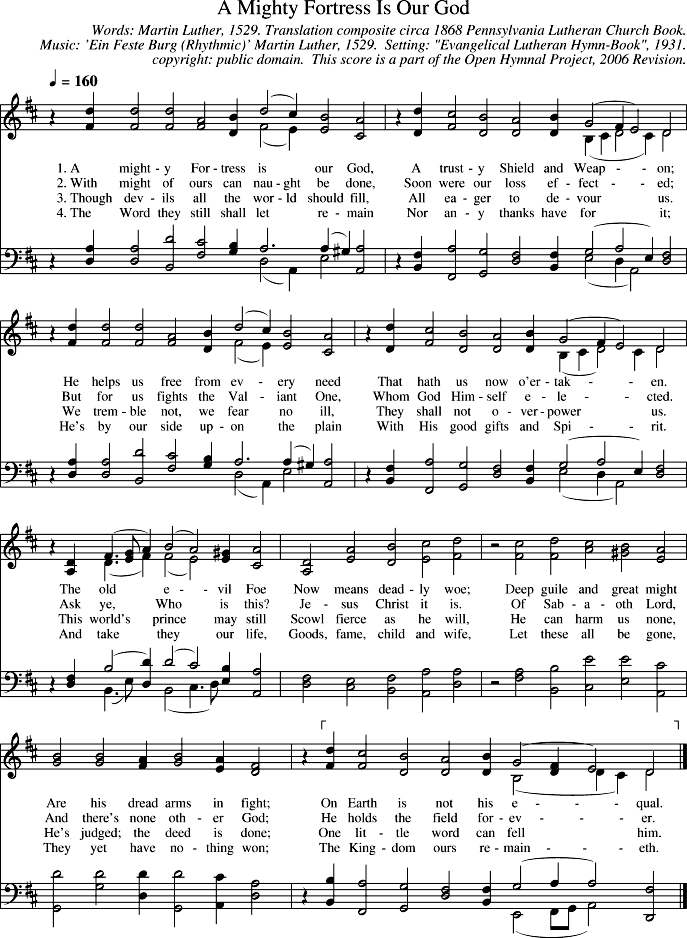
http://openhymnal.org/Gif/A_Mighty_Fortress_Is_Our_God-Ein_Feste_Burg_Rhythmic.gif
Many, many years ago, while I was still doing Christian work on the Penn campus, I mentored a student whose dad was both a pastor of a church in Hunting Park and an accomplished classical musician.  I remember hearing this pastor preach once, not out of the Bible but from Martin Luther's "A Mighty Fortress is Our God."  It was a terrific and powerful sermon, and since then that hymn has been one of my all-time faves.

It has been referenced lately by my pastor, and I appreciate the reminder that its message represents.  For, individually and as a congregation, it is not hard to feel assailed, outnumbered, under-resourced, and outright defeated.  Luther's lyrics don't sugarcoat the hardships of life; if anything, they describe them in stark, spiritual, and fearsome terms.  And we are reminded, as if we needed to be told in the midst of our fearsome trials, that we don't stand a chance on our own.

But wait, there's hope.  The hymn, and the Christian narrative in general, are brutally honest about the fierceness of our opposition and the insufficiency of our own strength.  But they hold forth a Savior and a saving action, which decisively secured victory and which guarantees future triumph.  His name is Jesus and His conquest did not come in the form of brute force or superior numbers, but in humble submission and torturous death. 

The message is both exhilarating and sobering.  Assailed, we have a Deliverer; what a relief!  But, our access to deliverance still requires a stark decision, to surrender as He did.  There is no halfway when it comes to believing in or tapping into such a life narrative.

Indeed, some of the great saints that went before us understood that "the body they may kill, God's truth abideth still."  Whether martyrs in distant lands or civil rights heroes fighting generations of racism and injustice, God's people believed in a Savior who had won the victory, and were willing to hold loosely "goods and kindred...this mortal life also" because there was a greater and more lasting prize waiting at the end. 

May we be found marching forth, believing the same things and living our lives according to that belief in the same ways.  When life assails us beyond our ability to cope, and our enemies seem too fierce to fight alone, let us take refuge in our mighty fortress and never-failing bulwark.

A mighty fortress is our God, a bulwark never failing;
Our helper He, amid the flood of mortal ills prevailing:
For still our ancient foe doth seek to work us woe;
His craft and power are great, and, armed with cruel hate,
On earth is not his equal.


Did we in our own strength confide, our striving would be losing;
Were not the right Man on our side, the Man of God’s own choosing:
Dost ask who that may be? Christ Jesus, it is He;
The Lord of Hosts, His Name, from age to age the same,
And He must win the battle.


And though this world, with devils filled, should threaten to undo us,
We will not fear, for God hath willed His truth to triumph through us:
The Prince of Darkness grim, we tremble not for him;
His rage we can endure, for lo, his doom is sure,
One little word shall fell him.


That word above all earthly powers, no thanks to them, abideth;
The Spirit and the gifts are ours through Him Who with us sideth:
Let goods and kindred go, this mortal life also;
The body they may kill: God’s truth abideth still,
His kingdom is forever.

3.01.2013

A Wearable Feast

I usually don't get geeked out by new technology but holy shmoley, between Google Glass and the Myo gesture control armband, that's an impressive amount of new-wave functionality and cool factor.  Add in Nike and Apple vying for wrist watch supremacy and we are in the midst of a burst of wearable technology goodness.  Even better, all of these concepts are going to improve dramatically in look, intuitiveness, and sheer volume of function, as consumers try them on and as computing continues to grow (in power) and shrink (in size) exponentially. 

What a wonderful and dizzying time we live in.  May the best companies win the competition for our hearts and wallets, motivating even more waves of innovation and make life even better for us all.  And yet even as these tools spark an arms race of ideas and uses, I anticipate they will also be game-changers and playing field levelers; consider, just to give one example, how stuff like this can be a huge boon to the physically impaired.  I look forward to telling my grandkids that, yes, in fact I did own a watch that just told the time and did nothing else, I generated text by typing on something called a QWERTY keyboard, and I didn't have video documentation of every single second of my life. 

Too Short for a Blog Post, Too Long for a Tweet 522

  Here are a few excerpts from a book I recently read, "Moby Dick," by Herman Melville. Again, I always go to sea as a sailor, bec...