5.30.2019

Too Short for a Blog Post, Too Long for a Tweet 180

Image result for fearless pedersonHere are a few excerpts from a book I recently read, "Fearless: How an Underdog Becomes a Champion," by Dan Pompei and Doug Pederson.


It really helps me to start each day with some quiet time, reflecting on life, my challenges, and whatever God wants me to hear that day. I’m in my office about 5:30 every morning and sit at my desk and spend thirty minutes alone in my chair with no distractions. I take a couple of deep breaths and put my day in perspective. I grab my prayer book, Jesus Calling. There is a devotional and a scripture on each page. It takes two minutes to read, but the messages are powerful. Then I start journaling. I dive into my Bible a little. I say prayers—whether it be for the team, my family, or a friend or loved one who is struggling with something. I bring all of that to God in the morning. As I’m driving to work, I often wonder how I will accomplish everything that I need to get done that day. This quiet time sets the tone for my day and focuses me, puts me at peace. At the end of the day, I always look up and realize that everything is done that needed to be done.

5.28.2019

Too Short for a Blog Post, Too Long for a Tweet 179

Image result for roxane gay rape cultureHere are a few excerpts from a book I recently read, "Not That Bad: Dispatches from Rape Culture," by Roxane Gay.


(Roxane Gay)

It was comforting, perhaps, to tell myself that what I went through “wasn’t that bad.” Allowing myself to believe that being gang-raped wasn’t “that bad” allowed me to break down my trauma into something more manageable, into something I could carry with me instead of allowing the magnitude of it to destroy me. 

But, in the long run, diminishing my experience hurt me far more than it helped. I created an unrealistic measure for what was acceptable in how I was treated in relationships, in friendships, in random encounters with strangers. That is to say that if I even had a bar for how I deserved to be treated, that bar was so low it was buried far below ground.


5.22.2019

Too Short for a Blog Post, Too Long for a Tweet 178

Image result for Origin Story: A Big History of Everything (Christian)Here are some excerpts from a book I recently read, "Origin Story: A Big History of Everything," by David Christian.


The spooky thing about life is that, though the inside of each cell looks like pandemonium—a sort of mud-wrestling contest involving a million molecules—whole cells give the impression of acting with purpose. Something inside each cell seems to drive it, as if it were working its way through a to-do list. The to-do list is simple: (1) stay alive despite entropy and unpredictable surroundings; and (2) make copies of myself that can do the same thing. And so on from cell to cell, and generation to generation. Here, in the seeking out of some outcomes and the avoidance of others, are the origins of desire, caring, purpose, ethics, even love.

5.20.2019

Too Short for a Blog Post, Too Long for a Tweet 177

Image result for The Restless Wave: Good Times, Just Causes, Great Fights, and Other Appreciations (McCain)Here are a few excerpts from a book I recently read, "The Restless Wave: Good Times, Just Causes, Great Fights, and Other Appreciations ," by John McCain.


We are blessed, and in turn, we have been a blessing to humanity. The world order we helped build from the ashes of world war, and that we defend to this day, has liberated more people from tyranny and poverty than ever before in history. This wondrous land shared its treasures and ideals and shed its blood to help make another, better world. And as we did we made our own civilization more just, freer, more accomplished and prosperous than the America that existed when I watched my father go off to war. 

We have made mistakes. We haven’t always used our power wisely. We have abused it sometimes and we’ve been arrogant. But, as often as not, we recognized those wrongs, debated them openly, and tried to do better. And the good we have done for humanity surpasses the damage caused by our errors. We have sought to make the world more stable and secure, not just our own society. We have advanced norms and rules of international relations that have benefited all. We have stood up to tyrants for mistreating their people even when they didn’t threaten us, not always, but often. We don’t steal other people’s wealth. We don’t take their land. We don’t build walls to freedom and opportunity. We tear them down. 

To fear the world we have organized and led for three-quarters of a century, to abandon the ideals we have advanced around the globe, to refuse the obligations of international leadership for the sake of some half-baked, spurious nationalism cooked up by people who would rather find scapegoats than solve problems is unpatriotic. American nationalism isn’t the same as in other countries. It isn’t nativist or imperial or xenophobic, or it shouldn’t be. Those attachments belong with other tired dogmas that Americans consigned to the ash heap of history. 

We live in a land made from ideals, not blood and soil. We are custodians of those ideals at home, and their champion abroad. We have done great good in the world because we believed our ideals are the natural aspiration of all mankind, and that the principles, rules, and alliances of the international order we superintended would improve the security and prosperity of all who joined with us. That leadership has had its costs, but we have become incomparably powerful and wealthy as well. We have a moral obligation to continue in our just cause, and we would bring more than shame on ourselves if we let other powers assume our leadership role, powers that reject our values and resent our influence. We will not thrive in a world where our leadership and ideals are absent. We wouldn’t deserve to.

5.16.2019

I'm a Teenager at Work

Image result for turning 13I finished grad school in 2006.  I did my school's ceremony on a Sunday, walked with the rest of Penn on a Monday, and 13 years ago this morning I headed to a new job for only the second time in my life.  I guess that makes me a teenager at work.  I don't love everything about my job, but it still gets me up in the morning, downright gets me giddy at times, and helps provide for my family.  I feel extra blessed considering it all today. 

5.14.2019

Recommended Reads, 33th in a Quarterly Series

Stuff I read recently that I'd recommend:
Image result for book nook


The Silk Roads: A New History of the World (Frankopan).  Cool to get a grand sweep of history from a non-Western perspective.
 
Beauty in the Broken Places: A Memoir of Love, Faith, and Resilience (Pataki).  What an insightful window into dealing with the scariness and chaos of a loved one being really sick.

The Butchering Art: Joseph Lister's Quest to Transform the Grisly World of Victorian Medicine (Fitzharris).  Incredible to consider just how little we knew a scant 180 years ago, and how hard it was to get people to get past old ways of thinking and doing.

Grant (Chernow).  So glad I invested the whole month it took me to read this tome, as I learned a lot about the man and about Reconstruction.

The Rise and Fall of the Dinosaurs: A New History of a Lost World (Brusatte).  I grew up devouring everything about dinosaurs, but decades later we've learned so much more about them and it was neat to read all about it.

Believe It: My Journey of Success, Failure, and Overcoming the Odds (Foles).  Nick the folk legend is also Nick the really nice, humble, and faith-filled guy.


5.10.2019

Playing the Long Game

Image result for planting onionsI am all for civil discourse, patience, and moderation, but I understand how irritating that can come across to some people on some issues.  When your house or head is on fire, it's not the time to hear "well let's take a step back and listen to all sides" or "let's politely agree to disagree."  Anger is an appropriate emotion at times, and it can lead to the expression of that emotion through protest, disruption, and even what some would characterize as violence.  Jesus, after all, overturned tables, and more than once God is described as angry and vengeful.  So we need to give room for these sorts of expressions, in our lives and in the lives of those who are hurting and outraged around us.

And we also need to play the long game.  Rachel Held Evans, the late Christian blogger, evokes a wonderful analogy in her blog post about her son being born into a Trump presidency.  She writes of author Madeleine L’Engle deciding in the midst of her anxiety about raising children in the midst of the Cold War to plant onions, as "an act of faith in the future," and a tangible way to invest in a small and quiet task that would take a long time to yield dividends.  What a beautiful metaphor.  Let us rage where rage is warranted, for indeed our houses and our heads are on fire.  But in the midst of that, let us consider what are the onions that we can plant, and in doing so believe in a future that is worth fighting and preparing for.

5.09.2019

His Footprints Were There All Along

Image result for footprints poem
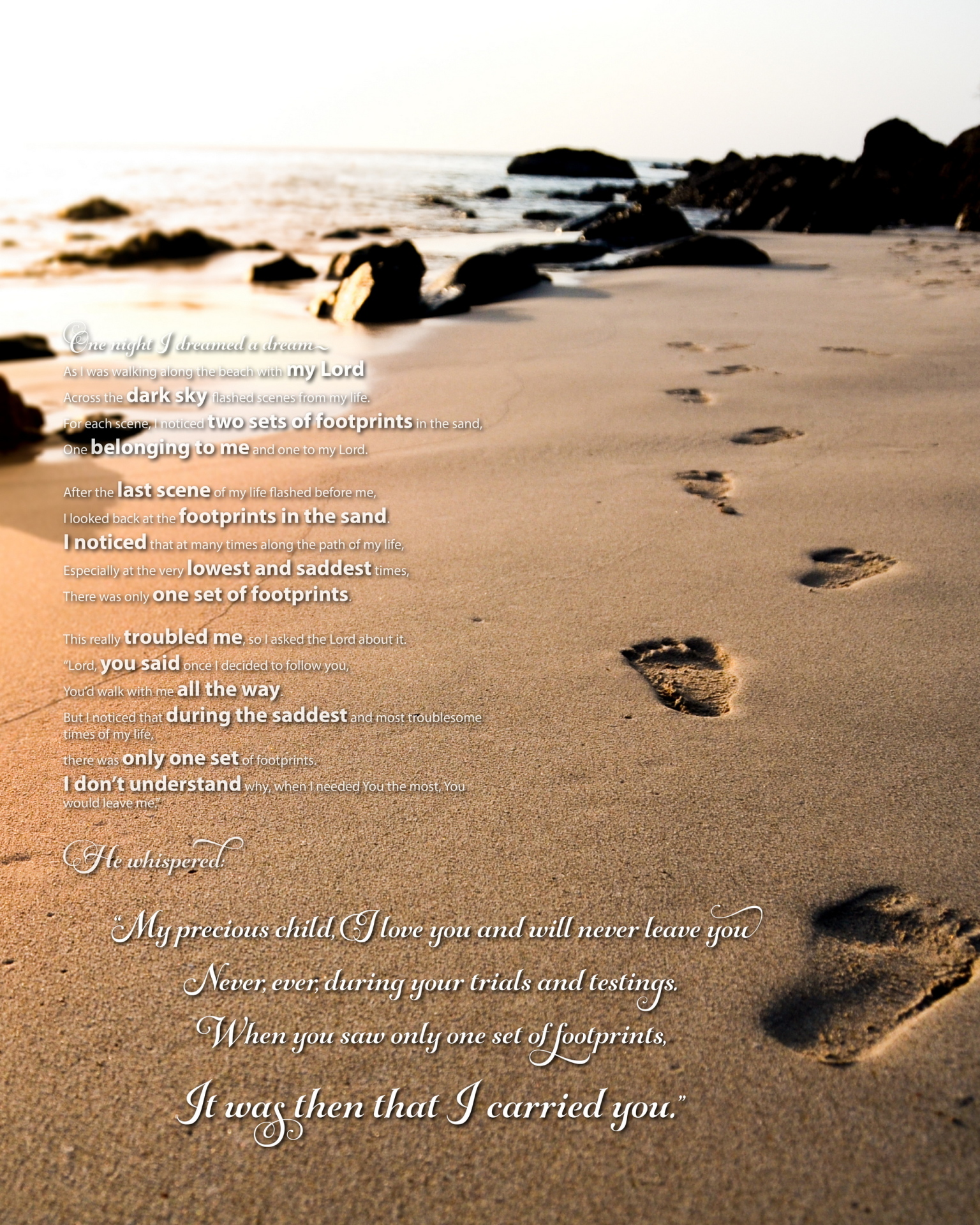
A friend of mine recently wrote me to say how deeply appreciative he was to read my happy birthday wishes for himself and his children over the years.  The wrinkle is that I was using the wrong email address for him, and so it was only when he randomly checked the address I had used (which he long since switched from) that he was able to read greeting after greeting from me on each anniversary of his birth and his children's births. 


I was a little embarrassed that I had been using the wrong email all along, but was thankful that my birthday wishes were finally received, even if years after they were sent.  It made me think of different ways God has reached out to me over the years and I didn't even know it until much later.  Like the famous "Footprints" poem, I may have forgotten him or thought him not near in key moments in my life.  But in fact He was there, His words and His presence, carrying me through.  And I too am deeply appreciative. 

5.06.2019

Too Short for a Blog Post, Too Long for a Tweet 176

Image result for Weapons of math destructionHere are a couple of excerpts from a book I recently read, "Weapons of Math Destruction  How Big Data Increases Inequality and Threatens Democracy," by Cathy O'Neil:

Students in the Chinese city of Zhongxiang had a reputation for acing the national standardized test, or gaokao, and winning places in China’s top universities. They did so well, in fact, that authorities began to suspect they were cheating. Suspicions grew in 2012, according to a report in Britain’s Telegraph, when provincial authorities found ninety-nine identical copies of a single test. 

The next year, as students in Zhongxiang arrived to take the exam, they were dismayed to be funneled through metal detectors and forced to relinquish their mobile phones. Some surrendered tiny transmitters disguised as pencil erasers. Once inside, the students found themselves accompanied by fifty-four investigators from different school districts. A few of these investigators crossed the street to a hotel, where they found groups positioned to communicate with the students through their transmitters. 

The response to this crackdown on cheating was volcanic. Some two thousand stone-throwing protesters gathered in the street outside the school. They chanted, “We want fairness. There is no fairness if you don’t let us cheat.” 

It sounds like a joke, but they were absolutely serious. The stakes for the students were sky high. As they saw it, they faced a chance either to pursue an elite education and a prosperous career or to stay stuck in their provincial city, a relative backwater. And whether or not it was the case, they had the perception that others were cheating. So preventing the students in Zhongxiang from cheating was unfair. In a system in which cheating is the norm, following the rules amounts to a handicap.


Data is not going away. Nor are computers—much less mathematics. Predictive models are, increasingly, the tools we will be relying on to run our institutions, deploy our resources, and manage our lives. But as I’ve tried to show throughout this book, these models are constructed not just from data but from the choices we make about which data to pay attention to—and which to leave out. Those choices are not just about logistics, profits, and efficiency. They are fundamentally moral.

5.02.2019

Same Course, New Format

Image result for online teachingLater this month I'll be kicking off the graduate-level class I teach at the Fels Insitute of Government at the University of Pennsylvania, Quantitative Tools for Consulting.  As busy as my schedule has become, I truly look forward to this opportunity, because I enjoy teaching, because I enjoy the material and I enjoy interacting with students around the material.

This will be the eighth year I've taught this class, but this go round there are a couple of twists.  First, after two straight years of doing this during the fall semester, I am back to summer session.  And as much as you might think I'd grown about giving up precious free time during the summer months, I welcome the change, because it's easier than squeezing the teaching load into an already maxed out fall schedule.

Second, and this is the really big twist, I'll be teaching the course for the first time in the hybrid format of some in-person sessions and some on-line sessions.  Shout-out to all the folks at Penn who helped me set up my material in this new format and coached me on how to make the most of the different mechanisms that are available.  I feel like an old dog, except I am welcoming the chance to learn some new tricks.  I'm sure there will be hiccups, but it'll be a good experience all around.  Here I go again!

Too Short for a Blog Post, Too Long for a Tweet 522

  Here are a few excerpts from a book I recently read, "Moby Dick," by Herman Melville. Again, I always go to sea as a sailor, bec...