
5.31.2014

Huang Family Newsletter, May 2014

 May brought busy work schedules for Amy and Lee.  Jada is wrapping up
gymnastics and Aaron is getting into baseball.  Lee started teaching his
summer class at Penn.  We celebrated Mother's Day weekend by staying in
a hotel downtown, and spent Memorial Day weekend getting our garden
ready and going to the Brandywine Zoo.


5.30.2014

RN + IT = TLC

http://www.nist.gov/healthcare/images/09ITL001_LR.jpg
With apologies to my lovely wife and all others affiliated with the nursing profession, I express my disapproval of the sentiment behind this campaign by National Nurses United: "When It Matters Most, Insist on a Registered Nurse."  I don't disagree at all with the opinion that a human being trumps a computer; I just don't like the two being pitted against each other, especially when the alternative to RNs is portrayed as a dystopian, money-grubbing automaton. 

The fact of the matter is that technology does disrupt economies, and it destroys millions of jobs in the process...and this is a good thing.  Agriculture and manufacturing once employed big chunks of our society, and now they do not.  And it's not because of outsourcing but because of automation, innovation, and infrastructure.  This has created a quantum leap in our quality of life, it has freed us up for higher-end pursuits, and it is our best hope for feeding a starving world that will reach 9 billion by 2050.

Similarly, the way to the best and most health care possible is to relentlessly innovate, invest in the right support infrastructure, and throw the optimal mix of machines and humans at our most vexing medical challenges.  Diagnoses, cures, and care depend on good nurses, yes, but also on good technology.  Give me a smart nurse over a dumb workstation any day; but I prefer to have access to both, working together to figure out how to heal me and fix me. 

5.29.2014

Too Long for a Tweet, Too Short for a Blog Post II

http://thebeachsideresident.com/wp-content/uploads/2011/04/2v7_Baseball-In-The-Garden-Of-Eden.jpg
Here's an excerpt from a book I am reading now, Baseball in the Garden of Eden by John Thorn:

"I suggest that three essential ingredients facilitate the growth of any localized game to national sport.  First, gambling.  Adults must care about the outcome, and their willingness to place a wager is a reasonable measure of their interest. As a game matures, investors and civic boosters may pool their interests in order to absorb a greater risk, placing their bets on the protracted success of a club or a ball grounds. Second, statistics.  Whether merely game scores or primitive box scores, these numerical attachments to prose accounts accord a mantle of importance to the matches, an importance like  that of trade or transport or government; in addition, quantifying the game's constituent parts further fuels the first mover of sport, gambling.  Third, publicity.  Regular press coverage is a necessary development to convey the enthusiasm exhibited at a single contest, however it may have been fueled, to those only reading about ti afterward, often at great distance from the event.  Before baseball came to dominate the sporting scene in the last quarter of the nineteenth century, these three elements had previously advanced the popularity of other sports: the turf, the ring, sculling, cricket, and the pit (blood sports such as ratting ,baiting, cockfighting, and dog fighting).  Whether the crowd drawn by the activity was low or genteel, the ingredients and the progression were similar.  American sporting papers, beginning in the 1820s, paved the way for each sport to mature by providing records and prognostications related to events of interest to the sporting set and, underlying it all, the basis of a potential wager."

5.28.2014

Change Your Filter

http://www.magicalexperiments.com/wp-content/uploads/2012/11/filter.jpgThanks to the wonders of Facebook and Twitter, we have unprecedented and unending access to countless snippets of information.  I could never so much as sniff a paper, news site, or TV and still know that Jill Abramson got canned from the Times, there was a mass murder in California, and Beyonce's sister got into a thing with Jay-Z.  This New York Times columnist calls it "Fake Cultural Literacy," but I call it a free and efficient curating of all the stuff out there in the world that I don't have time to digest directly on my own. 

But if there is a downside to this way of consuming information, it's not that we're being deceptive (unless, of course, we are lying, say by saying that we did read Piketty when we actually haven't) but that we've been deceived.  Let me explain.  When our opinions about something are formed not by actual sources but derivative ones, we are more apt to get half the story or less.  Which may seem obviously bad or worse, but most of us don't seem to mind and clearly seem to prefer it.

You see, our real sin when it comes to staying informed isn't that we're lying but that we're biased.  We all have a worldview, and everyone's entitled to one.  But we also have a filter, and that filter repels things that contradict our worldview and absorbs things that reinforce it.  I get that reasonable and intelligent people will have divergent takes on politics, religion, race, and economics.  What I don't like is when people are selective in their exposure to data points that inform those topics.

I'm probably more sensitive to this than most, since often my job involves debunking popular viewpoints that rest on two or three widely believed but often incorrect or incomplete arguments.  You can imagine that it's hard work to form a reasoned counter-argument when people have heard what they want to hear and can't fathom that the story unfolds any other way.  I take offering a different and fuller story seriously because that's often what I get paid to do. 

But I'd also like to think I care because I believe in keeping an open mind, in giving all sides a fair hearing, and in not jumping to conclusions.  The real story is often counter-intuitive, nuanced, and not completely in sync with our carefully constructed view of how the world works.  It takes time, humility, and openness to let the fullness of an issue envelop you, and to let new information and new perspectives fundamentally change your opinion on something, even and especially something that is really important to you, like how you think the world works economically, politically, and socially.

I don't mind if the way you keep up with things is your Facebook news feed or Jon Stewart or conservative blogs.  Just make sure you're not using the wrong filter, the one that screens out anything that you disagree with or rocks your worldview a little.  That filter is bad for public discourse, bad for giving you the real scoop on things, and bad for your soul.

5.27.2014

Race in America

http://legalinsurrection.com/wp-content/uploads/2014/05/Ta-Nehisi-Coates-on-Melissa-Harris-Perry-show-reparations-620x442.png
Philadelphia Mayor Michael Nutter says "Pull your pants up."  Actor and comedian Bill Cosby says "Come on, people."  And, this past, week, ESPN pundit Stephen A. Smith said, "Educate yourself, work hard."   

Ta-Nehisi Coates, columnist at The Atlantic, pushes back on this:

http://markcubanblog.com/wp-content/uploads/sites/12/2014/05/Untitled-2-470x358.jpg"One thread of thinking in the African American community holds that these depressing numbers partially stem from cultural pathologies that can be altered through individual grit and exceptionally good behavior. The thread is as old as black politics itself. It is also wrong. The kind of trenchant racism to which black people have persistently been subjected can never be defeated by making its victims more respectable. The essence of American racism is disrespect. And in the wake of the grim numbers, we see the grim inheritance."

I am a child of industrious Asian immigrants, so the weighting of individual responsibility over systemic disparity is appealing.  Not that my parents didn't value or participate in broader social causes.  But the overriding life message they conveyed, through word and mostly deed, was: put your head down, work your tail off, and nothing else matters. 

Even if this worldview isn't coursing through your blood, you can see its appeal.  Changing laws, changing others' biases, and changing a whole society is daunting work.  It seems cleaner and easier to just focus on what I can control, which is my own ability to stay out of trouble and exert myself to the nth. 

On the other hand, the opposite can seem true as well.  When we diagnose the problem as "out there in the world," we can absolve ourselves of the hard work we need to put in to succeed in that world, and avoid the crushing possibility of trying and failing and having no one to blame but ourselves. 

Of course, both sides are right, when it comes to life in general and specifically as it relates to the experience of blacks in this country.  This nation has harbored systemic and insidious prejudices that continue to inflict damage into the present day.  For a country that prides itself on the notion that anyone can succeed, it is an uncomfortable truth that your chance of success depends heavily on your skin color and zip code.  It is even more uncomfortable to think that both our own personal biases and our own government's institutional policies are what have dug so deep a hole.  

Different people will always have different chances of success, and that is fine.  But I cannot accept such a tilted playing field as what we have now.  The solution is to work at all levels to level that playing field, which involves action in the realms of politics, economics, religion, health care, housing, and the list goes on. 

And, the solution is also personal.  It is to encourage those for whom the playing field is adversely tilted that it is still possible, though it will take exceptional determination and effort, to succeed in life.  There is no special pathology that dooms you to failure.  Nor is there progress without personal effort. 

To say only that all we need is hard work and determination is to minimize the wounds inflicted by past and present racism.  But to focus exclusively on "fixing the system" is to minimize the importance of personal responsibility and individual effort.  We need both.  We need to hear and heed both Stephen A. and TNC. 

5.26.2014

Lazy Linking, 122nd in an Occasional Series

Stuff I liked lately on the Internets:http://www.virginmedia.com/images/2-versus-mariah-590x350.jpg
122.1 Another take on Jesse Owens, Adolf Hitler, and the '36 Olympics qr.ae/y0aOh @quora

122.2 We've been to Mars & back...but we left some bacteria behind (to be continued?) bit.ly/1krZfur @naturenews

https://img.4plebs.org/boards/pol/image/1392/27/1392279020704.jpg122.3 Nice infographic of vocal ranges for popular singers (go Mariah Carey!) bit.ly/1lUWuA4 @voxdotcom

122.4 A univ degree is useful for many job tasks...incl. learning the Phila Eagles' playbook on.wsj.com/1sXPDIx @wsj

122.5 Marc Andreessen on net neutrality, Bitcoin, & DC vs. Silicon Valley wapo.st/1njoMcV @washpo

122.6 The evolution of SRC chair Bill Green's thoughts on education bit.ly/1jSNOxa @newsworkswhyy

http://www.infowars.com/wp-content/uploads/2014/05/250514tile5.jpg122.7 Do spreadsheet errors undermine Piketty's conclusions on.ft.com/1mf8LAV @ft

122.8 Will state regs deter Elon Musk from putting the new Tesla plant in CA bit.ly/1iihxtL @nextcityorg

122.9 TNC on systemic racism, black/white disparities, & the case for reparations bit.ly/1ha12zO bit.ly/1sZ47bj @theatlantic

122.10 Stephen A: “Everybody can’t be Jay-Z, that’s 1 in a billion.  Educate yourself, work hard.” bit.ly/1ppKxos @dailycaller

5.23.2014

Not Your Daddy's Philadelphia

http://www.uwishunu.com/wp-content/uploads/2012/09/ucd-parklet-family-680uw.jpgLast weekend's graduation at Penn also brought back alum for their 15th or 20th or 25th or whatever reunion.  (Btw, how crazy is it that my 20th is next year...can I be that old?)  Much of the chatter from Facebook friends of mine from those eras was along the lines of "Wow, I could hardly recognize campus, what with all the new construction!" Indeed, Penn's turned over a lot in the last 15-25 years.  And so has University City and Philadelphia. 

When I travel to California or other parts of the country and catch up with college friends of mine and they find out I still live in Philly, not far from campus, I am often greeted with a sense of patronizing condescension, as if it's "cute" or "noble" that I've stuck it out in such a rat-hole when most of the rest of our peers have moved out and up.  I just smile knowingly back at them, knowing that the next time life brings them back to Philly, whether for a wedding, reunion, or conference, they're going to have their socks blown off by how incredibly great our neighborhood and city is. 

To be sure, we've come a long way.  And to be sure, we still have a long way to go.  But Philly, and University City, has always had a lot going for it.  I feel good that I've seen it all along.  And I feel good that more and more people come back for whatever reason and can see it too.

5.21.2014

God Loves a Cheerful Giver

I was asked to say a few words at our church's morning service last weekend for Stewardship Sunday.  Talking about money and giving in a church setting may seem fraught; appeals to dig deep into your wallet can feel tinged with embezzlement, guilt, or obligation.  It is not uncommon for churches to do this poorly, and/or in fear steer clear of the subject altogether. But in order to be true to the Bible, you have to talk about money, since, by some accountings it is the second-most talked about topic in the whole book (allegiance to God being the first). 

To play it safe, I let God's Word speak for itself, reading a section from Paul's second letter to the church in Corinth (2 Corinthians 8:1-9, 9:6-15).  You probably know that Paul traveled a lot, setting up new churches and then writing letters from afar to support/instruct/encourage/correct them.  You may not know that Paul's ministry also involved pollinating money from one church to another.

You might think that his "Stewardship Sunday message" to the church in Corinth might appeal to the great need in other churches compared to their relative affluence.  After all, 1st century Corinth was a successful, worldly, and cosmopolitan city.  Its geography lent itself to abundance, in trade and in agriculture.  It celebrated sport, arts, and sexuality with an air of comfort and decadence.  The church there was socio-economically diverse, a testament to the equalizing force of the Christian message and a reminder that not all were of means.  Surely Paul would speak of redistribution from rich to poor, right?

He does no such thing.  He compliments congregations in other, poorer cities for giving generously, and notes that it was through Jesus' "poverty" that we "might become rich."  Most of all he speaks of God's abundance, overflowing and enabling and blessing and overwhelming. 

Mechanically, giving is about taking one group's resources and giving them to another group.  Usually, that means that resources go from a group that has more to a group that has less.  And usually that means that the group that has more now has a little less, and the group that has less now has a little more.  There is no disputing that.

But Christian charity is deeper than that.  This is, perhaps, not surprising, given the upside-down nature of salvation logic: God Himself, emptying Himself and descending to manhood, so that through (not in spite of!) His emptying and suffering we could be filled and blessed.  Still it is a marvel to read Paul's exhortation to the church in Corinth (and many, many other parts of the Bible) and realize just how wonderful and magical giving can be when we do it out of His absolute abundance rather than from our relative scarcity. 

That's a message worth speaking in churches and having ring forth beyond those walls.  Let's hope we can get that word out, and neither be afraid to speak it nor pervert it with appeals to guilt and manipulation.

5.20.2014

All Good in the 'Hood

Last weekend the weather was quite nice, and the kids had been pestering to eat outside, so we decided to fire up the grill, eat dinner on the back deck, and conclude with dessert on the front porch.  Because it was nice out, there were a lot of people outside as well.  I got a kick out of Aaron yelling over to three sets of kids playing four houses over, all of whom go to the neighborhood school like our two do.  Aaron hollered at some more kids once we were chilling on the front side of our house.  Everyone was in a sunny mode.

These neighborhood interactions fill me with happiness.  As an introvert, it's not like I need constant interaction; in fact, I'm pretty private, which means I keep to myself and don't get to know everyone else's business like maybe I should.  But it's good to live in a big city, in a functioning neighborhood, where you say hi to others and smile at their kids.  When I first came to Philadelphia as a fresh-faced 18-year-old from suburban San Jose, I'm not sure I could've imagined being 41, married with two kids, and living in an inner city neighborhood on the East Coast.  But here I am. 

Philly still has a ways to go.  Our schools are a mess, our municipal budget is in a precarious position, and there's still way too much violence.  All true.  But, every once in a while, it's good to just sit outside in the sun, wave to neighbors, and be glad your kids can grow up in a socio-economically diverse, multi-racial urban neighborhood.  I'm glad I got a chance to just that this past weekend.

5.19.2014

Lazy Linking, 121st in an Occasional Series

sr_china_agriculture_4948101.jpgStuff I liked lately on the Internets:


121.1 $#@! yeah…swearing is good for your health dailym.ai/1iG9PJn @mailonline

121.2 Online tests help smart job candidates who are otherwise discriminated against wapo.st/1uIjzft @washingtonpost

121.3 Uh oh…that catchy ice cream truck song has a racist origin n.pr/1jhX8Eu @nprnews

121.4 Is the cooperation needed to grow rice the reason why Asian kids succeed in school? bit.ly/1mTmgtG @scmp_news

121.5 The case for letting bicyclists roll through stoplights bit.ly/1j9X4ql @voxdotcom

5.16.2014

Eight Years Ago Today

http://www.econsult.com/econsult-solutions-logo2.jpg
Eight years ago today, less than 24 hours after I walked with cap and gown down Locust Walk through the heart of the University of Pennsylvania campus, I started a new job at Econsult.  It was only the second "first day on the job" I'd ever had, my first job being with The Enterprise Center and lasting from 1995 to 2005. 

I had left that job as the number two person, with a position description that could best be summarized as "make sure everything happens."  I had gone back to grad school, and now I was an analyst, no longer needing to worry about a wide gamut of functions and being able to concentrate on running numbers and generating reports.  That more focused job description worked for me then, given that I was a first-time parent and needed to recalibrate what "work/life balance" now meant. 

Since then, I've had the opportunity of advancing within the firm.  And while my new work scope isn't quite "make sure everything happens," it has expanded to such concerns as thinking on the company's overall strategic direction, bringing in new business, and managing staff.  I couldn't be happier with the trajectory of my time here, or with the prospects of the firm and my role in it looking forward.  Work anniversaries are useful times to look back and look forward like that, and in doing so I am feeling particularly fortunate from where I sit.

5.14.2014

Kudos to Robert Nelson and OIC

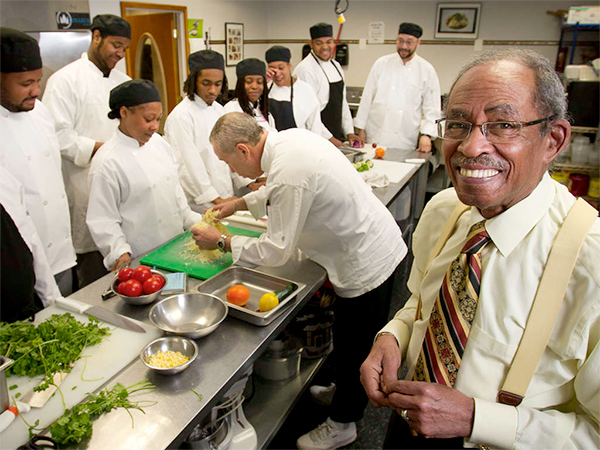
Rob Nelson, president of Opportunities Industrialization Center, with trainees who are learning to work in the hospitality industry, a program Nelson spearheaded in the ´90s.Kudos to Robert C. Nelson, who is stepping down next month after 30 years at the helm of OIC, which was a creation of the late great Reverend Leon Sullivan.  I got to know Mr. Nelson when he chaired the Philadelphia Jobs Commission, which my firm provided analytical support to; we have subsequently done work directly for OIC and are one of the sponsors of their 50th anniversary gala next month. 

It would not be wrong for your thoughts to gravitate towards Mr. Nelson's natty attire, megawatt smile, or sharp wit.  But it would be incomplete, because he should be honored for so much more, for all he's done for and through OIC.  His legacy includes countless people trained in hospitality who are now gainfully employed and rising up in the ranks throughout Philadelphia.  Well done, good sir.

5.12.2014

Lazy Linking, 120th in an Occasional Series

Stuff I liked lately on the Internets:


120.1 Which rappers have the most expansive vocabularies? (hint: Wu members score well) bit.ly/1fGkVU1 @matthew_daniels

120.2 Are athletes improving over time? Or do we just have better materials/equipment? bit.ly/1jJYBIu @tedtalks

120.3 China had 22 dams when Communists took over in ’49; since then they’ve built 1 a day for 60+ yrs bit.ly/1jbGzdh @quora

120.4 Boko Haram says don’t educate girls; John Piper begs to differ bit.ly/1kNsTrR @desiringgod

120.5 #IAm video series of today’s American American role models bit.ly/1nqDoq2 @angryasianman

5.09.2014

Others' Day

http://consecratedtohimbylisacolon.files.wordpress.com/2012/05/bigstock-broken-heart-29474012.jpg?w=290&h=290&crop=1This weekend we rightly celebrate mothers.  And while we are celebrating actual individual people, what we are celebrating is their personification of traits we admire and benefit from.  Traits like sacrificial love, tender nurture, and unwavering commitment.  If we have mothers in our lives who embody these characteristics, we are blessed, and so it is fitting that we give honor to those people on Mother's Day.  And if you are one of those mothers, it is fitting that you receive honor this weekend, and I hope you are able to fully accept it and enjoy it.

For some, though, Mother's Day is tinged with sadness.  Some have lost a child; they will always be a mother to that child, but are no longer able to mother that child.  Some are trying to become a mother, whether biologically or through adoption, and have been unable.  Some have not yet found someone to be a mother with.  The celebration of motherhood is, for some, a reminder of their own loss or void.

There is nothing that can be said that will serve as a suitable salve for such wounds.  They are real and they are deep.  But, in celebrating mothers this weekend, I hope we will not forget to include and honor those who hurt to be mothers. 

The God of the Bible is usually described in masculine terms, but He also manifests those traits we appreciate about mothers and motherhood: sacrificial love, tender nurture, and unwavering commitment.  Those who hurt to be mothers hurt precisely because theirs is a deep desire to also manifest sacrificial love, tender nurture, and unwavering commitment.  It would not hurt as much if it were not true. 

And so the pain is real and hard to overcome.  But it is also an indication of something wonderful, something admirable, something godly, that stirs from deep within.  And I hope that, too, is honored and appreciated and accepted this weekend.  Because it deserves to be so.

5.07.2014

Too Long for a Tweet, Too Short for a Blog Post

http://www.worldpolicy.org/sites/default/files/uploaded/image/Plundered%20Planet%20cover%20image.jpgHere's an excerpt from a book I am reading now, The Plundered Planet by Paul Collier:

"Environmentalists are right that each generation has responsibilities for natural assets that it does not have toward other assets. But economists are right that nature is an asset, to be used for the benefit of mankind. We are not curators of the natural world, preserving nature as an end in itself. We are not ethically obliged to preserve every tiger, or every tree. We are custodians of the value of natural assets. We are ethically obliged to pass on to future generations the equivalent value of the natural assets that we are bequeathed by the past. The natural world indeed presents us with distinct obligations, but those obligations are essentially economic."

5.06.2014

More Lazy Linking

As busy as you might think I am, I still find the time to waste hours on end on the Internets.  At least my occasional "Lazy Linking" series on Mondays has mostly high-brow stories.  But this is where I really spend most of my online time (in no particular order):

Facebook.  Well duh.  Enough with the FB-hating...it's a great way to go through life together with your favorite 1,000+ people in the world.
 

http://rack.3.mshcdn.com/media/ZgkyMDEyLzEyLzA0LzM0L3doeXF1b3Jhc25lLmM1cS5qcGcKcAl0aHVtYgkxMjAweDYyNyMKZQlqcGc/d5117af2/078/why-quora-s-new-boards-feature-makes-it-a-better-network-1c26db7f09.jpgVox.  Between Vox, FiveThirtyEight, and Upshot, this is the one I find myself going to the most.  Easy-to-understand primers + interesting articles = win.

Quora.  My guiltiest guilty pleasure.  This can be a rabbit hole for me, and I'm equally happy learning deep stuff and laughing my arse off.

This Good World.  A very cool directory of socially responsible companies.  I hope this really scales.


Discover Magazine blogs.  I was never good at science in school but it never stopped me from being curious about it. 

Believe it or not, I don't actually spend a lot of time on sports or news.  I like New York Times and Grantland, and will occasionally check the scores on ESPN.  But that's about it. The teenage version of me - I must have memorized millions of sports stats and pored through box scores like a cure for cancer was on the line - would be horrified at what I've become. 

5.05.2014

Lazy Linking, 119th in an Occasional Series


Stuff I liked lately on the Internets:


119.1 What it’s like to write jokes for President Obama bit.ly/1uf4Mc0 @voxdotcom


119.2 Places w/o net neutrality have been good for the poor bit.ly/1hW4Bc2 @umlautmag

119.3 The social/behavior skill gap btwn boys/girls > rich/poor nyti.ms/1hnE5cj @nytimes
 
119.4 Basketball has dealt w/race issues since its earliest days nyti.ms/1ibtuk6 @upshotnyt

119.5 Just looking at these roller coaster pics frightens me wrd.cm/1fVoz6R @wired

5.03.2014

Retail Survey Report

In Fall 2013, a committee I chair within our neighborhood association conducted a survey of retail preferences.  Almost 500 residents responded, demonstrating the importance of retail to a neighborhood’s sense of vitality, safety, and identity, and yielding a trove of information that will be useful to residents, community groups, businesses, developers, and policymakers alike.

I'm happy to announce that our report on this survey is now complete.  The full retail survey report is now available on the Spruce Hill Community Association website.  Also, here are links to some really cool interactive maps:
Favorite Retail: http://bit.ly/PAiwh1
Retail Improvement Opportunities: http://bit.ly/PAkj5z
Respondents: http://bit.ly/PAkwFR
          Combined: http://www.arcgis.com/apps/OnePane/basicviewer/index.html?webmap=86fd4062c19645ddbafea4028635652d

Too Short for a Blog Post, Too Long for a Tweet 522

  Here are a few excerpts from a book I recently read, "Moby Dick," by Herman Melville. Again, I always go to sea as a sailor, bec...