Crazy month. Lee turned 40 and became a part-owner and
senior vice president of his company.
Amy’s taking on more and more managerial responsibilities at work to go
with the many patient consultations she’s juggling. Aaron turned 6 and had his first friend
birthday party. Jada started up ballet
again at our neighborhood dance studio.73-91 born SEA lived SJC 00 married (Amy) home (UCity) 05 Jada (PRC) 07 Aaron (ROC) 15 Asher (OKC) | 91-95 BS Wharton (Acctg Mgmt) 04-06 MPA Fels (EconDev PubFnc) 12-19 Prof GAFL517 (Fels) | 95-05 EVP Enterprise Ctr 06-12 Dir Econsult Corp 13- Principal Econsult Solns 18-21 Phila Schl Board 19- Owner Lee A Huang Rentals LLC | Bds/Adv: Asian Chamber, Penn Weitzman, PIDC, UPA, YMCA | Mmbr: Brit Amer Proj, James Brister Society
1.31.2013
Huang Family Newsletter, January 2013
Crazy month. Lee turned 40 and became a part-owner and
senior vice president of his company.
Amy’s taking on more and more managerial responsibilities at work to go
with the many patient consultations she’s juggling. Aaron turned 6 and had his first friend
birthday party. Jada started up ballet
again at our neighborhood dance studio.1.29.2013
I Don't Know What I'm Talking About More Often Than Not
I found this piece at kottke.org really, really fascinating: "The Challenges of Conversational Journalism." The post quotes someone who has studied the Samoan culture trying to understand the Manti T'eo hoax, and someone who is an audio engineer weighing in on whether Beyonce lip-synched at the inauguration.
Everybody (including me!) is blogging, opining, and otherwise blathering on about the topics du jour. We may be experts in something, but we're not often talking about things we're experts in, and so while every once in a while we might spout of a nugget, more often than not all we're doing is adding noise to an already clangy conversation.
I'm not saying we should save ourselves only for topics we actually know something about. I can't speak for others, but when I write it's often because I don't have it all figured out and instead am trying to organize my thoughts through the practice of writing them out for public consumption. So it's OK to provide commentary even if you don't know what you're talking about - you can still learn from it, and so can others.
But I do think we should take the time to sift through all the noise and find the experts so we know what they're saying. And I do think that those who are experts should not be afraid to put their two cents in, so we can all learn from their perspective. Let's hope we all get better at chiming in and at sifting through.
Everybody (including me!) is blogging, opining, and otherwise blathering on about the topics du jour. We may be experts in something, but we're not often talking about things we're experts in, and so while every once in a while we might spout of a nugget, more often than not all we're doing is adding noise to an already clangy conversation.
I'm not saying we should save ourselves only for topics we actually know something about. I can't speak for others, but when I write it's often because I don't have it all figured out and instead am trying to organize my thoughts through the practice of writing them out for public consumption. So it's OK to provide commentary even if you don't know what you're talking about - you can still learn from it, and so can others.
But I do think we should take the time to sift through all the noise and find the experts so we know what they're saying. And I do think that those who are experts should not be afraid to put their two cents in, so we can all learn from their perspective. Let's hope we all get better at chiming in and at sifting through.
1.27.2013
So Far, So Much
These are heady times, and the firm seems like it's on the right track, so while I'm gasping for breath and wishing I had more down time, I'm thankful for what I get to sink my teeth into and hopeful for the chance to do even more work (which is of course what all professional service providers want, is to get more business). That said, I really ought to mix some some personal recharge time in, not to mention uninterrupted relationship cultivation time with my immediate family members, who are still my most important people. All in a day's work (and rest).
1.26.2013
Philadelphia: The Great Experiment
If you missed Thursday night's airing of Episode III of "Philadelphia: The Great Experiment," you missed a really great half-hour. This piece of Sam Katz's documentary covered the post-WWII and Civil Rights Era years, and was replete with great footage and commentary that brought to life the change, tension, and possibility of this period of Philadelphia history. I encourage you to go to their website to find out more.
1.25.2013
Philadelphia Real Estate Value Trends Q4 2012
Consider this post part public service announcement and part self-serving promotion of my firm's recent publication. Our Real Estate Value Trends report for the fourth quarter of 2012 is now available on our website. You can access the report directly by clicking here. There you'll find a detailed and visually appealing review of residential real estate in Philadelphia. Take a look when you get a chance, and share as you are able to any interested in what's going up and down where and when.
1.24.2013
Sick, Still
I've been sick for most of the past week. It hasn't been fun. But I am always reminded of the poetry line that David drops in the 71st verse of the 119th psalm of the Bible: "It was good that I was afflicted, that I might learn Your commandments." So whenever I get sick, I try to think about what God is trying to teach me.
This time, like all times, I think my lesson is about being OK being still. Being productive is so important in our culture, and so important to me. And there's obviously nothing wrong, inherently, about being productive. But it shouldn't define us. And, if there is a short season in which we can't be productive - when we are forced to be still - and we are struggling with our identity as a result, it's an indicator that we've put too much stock in being productive, and not enough stock in just being.
It's a subtle nuance, but nonetheless incredibly important for the health of our souls. We lard on so many things about ourselves, which make us feel ourselves - roles we play, tasks we accomplish, a certain pace at which we go through life. And then we're laid out by a tiny virus that turns our noses into faucets, our heads into pulsing pain centers, and our whole bodies into punching bags. We have to cancel meetings, we're unable to think straight, we lean on some to fill in for us (big ups to my wife here!) and let down others we're used to taking care of (go watch more TV, kids!).
How OK are we with this? How much are we able to trust that God's work continues, that He is still present in our lives, and that stillness and sickness is no less a time in which He is good? My wife will tell me I don't handle being sick very well. But I am ever trying to learn through it.
This time, like all times, I think my lesson is about being OK being still. Being productive is so important in our culture, and so important to me. And there's obviously nothing wrong, inherently, about being productive. But it shouldn't define us. And, if there is a short season in which we can't be productive - when we are forced to be still - and we are struggling with our identity as a result, it's an indicator that we've put too much stock in being productive, and not enough stock in just being.
It's a subtle nuance, but nonetheless incredibly important for the health of our souls. We lard on so many things about ourselves, which make us feel ourselves - roles we play, tasks we accomplish, a certain pace at which we go through life. And then we're laid out by a tiny virus that turns our noses into faucets, our heads into pulsing pain centers, and our whole bodies into punching bags. We have to cancel meetings, we're unable to think straight, we lean on some to fill in for us (big ups to my wife here!) and let down others we're used to taking care of (go watch more TV, kids!).
How OK are we with this? How much are we able to trust that God's work continues, that He is still present in our lives, and that stillness and sickness is no less a time in which He is good? My wife will tell me I don't handle being sick very well. But I am ever trying to learn through it.
1.23.2013
Stewardship Sunday
We're in the middle of a stewardship campaign at church, and I was one of three people asked to share a little bit about what money has to do with my relationship with God. Here's what I said last weekend.
***
I became a Christian around the same time I got interested
in business and started taking classes at Wharton, which you may have heard is
a pretty good school located just down the street from here. You might find it strange that I was getting
introduced to the concepts of grace and salvation at the same time I was
getting introduced to concepts of profit maximization and portfolio
diversification. But I was. And I actually found that my business
education was actually helping and not hurting my ability to follow Jesus.
Let me explain. In
the 12th chapter of Luke, Jesus is teaching in public and two guys come up to
him arguing over money. Jesus uses the
opening to tell a story about an ambitious man who hoards his wealth and is
proud of himself, and Jesus calls him a fool.
But the lesson Jesus teaches isn't that treasure is bad, it's that the
ambitious man was seeking the wrong kind of treasure: "Sell your
possessions and give to charity; make yourselves money belts which do not wear
out, an unfailing treasure in heaven, where no thief comes near nor moth
destroys. For where your treasure is,
there your heart will be also." In
other words, the ambitious man isn't a fool for being too ambitious, but for
not being ambitious enough; he was storing treasure on earth, when the wiser
thing to do is to store treasure in heaven.
And that is what I wanted to share about stewardship. You see, being Christian is about following
Jesus, and following Jesus is about being a steward of what we've been given,
not squandering our resources nor hoarding them for worldly gain, but rather
investing them for maximum heavenly gain.
Churches, of course, can talk about money and giving in
sinful ways. Churches can seek material
comfort and worldly ambition, and prey on their congregants to provide them
with the resources to do it. But that's
not what Woodland is about. We're taking
stewardship seriously because stewardship is an important part of following
Jesus. And we're also taking stewardship
seriously because we're a good return on your investment. And so I invite you to join with me in
investing in this congregation and the heavenly good it is doing in this
community and around the world.
1.22.2013
Fidelity Investments
It's a trivial example, but it speaks to a deeper, more insidious reality within most (all?) of us men: the temptation to desire someone newer and sleeker than our current partner. I am always surprised when people express surprise at infidelity, as if it is unimaginable that so-and-so could possibly cheat on their spouse. To be sure, infidelity is awful, destructive, and shameful. But being surprised when it happens? That hurts and doesn't help in the effort to avoid it.
Let me explain. Thinking that I could never cheat, or that someone I know could never cheat, is simply false. It's like moving into a high-crime neighborhood and so dismissing the possibility of break-in that you leave your front door wide open and your valuables out in plain sight.
If we are really honest with ourselves, and if we really think infidelity is destructive, then let's take the temptation as seriously as it warrants. Rather than think we are not in peril, let's take extra measure to protect ourselves against sliding in that direction. Let's invest in "security systems" - a regular time of accountability with another person you trust, an explicit commitment to avoid situations that could unravel into temptation, regular cultivation of our marriage relationships - commensurate with the nearness and the magnitude of the threat.
To not do so is to either consider myself more impenetrable than I really am, or to treat as insignificant the downside of giving in, or both. That's a bad call. I value my marriage, my children, and my soul more seriously than that.
1.21.2013
Lazy Linking, 85th in an Occasional Series
85.1 The world is running out of
topsoil (peak soil?) http://ti.me/Wbh3Md @time
85.2 How bad is it in California?
There, they'll tax you retroactively http://bit.ly/10wgItW @xconomy
85.4 Hear directly from football
players about the pain they put themselves through http://bit.ly/XirWKm @esquiremag
85.5 Definition of arbitrage:
outsource your coding job for 1/6th of your salary and then goof off
at work http://bit.ly/Uq8DRk @regvulture
1.20.2013
Liar, Liar
I take this as a good opportunity to explain the Christian perspective on deception. You don't have to be a Christian, of course, to consider deception to be immoral and unadvisable. But I do think that the Christian perspective is a unique one. And I think it is worthwhile to express it. So here goes.
Sin is sin because it is an affront to God. More specifically, it is an affront to God as all-authoritative and (importantly) as all-good. It's that second part - that God is all-good - that is the wrinkle many don't think of when they think of Christian morality. For many, Christian morality is all about the first part - God said so, God gets to say so, so if you break the rule, you're in trouble.
But Christian morality is also about the second part - God has our best in mind, and when we sin we insult God by saying we can do better. Think about that for a minute. God is insulted when we act like we can do more good on our own than with Him. That's how good He is and how much good He wants to do for us!
Which brings us to deception. Armstrong's and T'eo's actions are two good examples of how and why we practice deception. In Armstrong's case, he sought glory: doping gave him an edge, which he exploited to the tune of seven straight Tour de France titles. In T'eo's case (and, I could be wrong here, since I don't actually know the story that well), he was initially duped, and then went along with the deception to avoid looking bad in the public (at a time when he was getting strong consideration for the Heisman Trophy, college football's greatest honor, not to mention positioning in next year's NFL draft).
Deception is certainly a sin I am personally familiar with. I can easily think of many situations in my life in which I lied for the purpose of either personal gain or shame avoidance. In all such cases, my sin might or might not have been against others, but it was always against God, in that I was telling Him with my actions (and my subsequent justifying, hiding, or further lying) that I was going to take care of myself just fine without Him, thank you very much. Again, for a God who has promised so much good for me, even and especially through His commandments for me as conveyed in the Bible, this is a grievous insult.
To be sure, immoral things like deception are wrong because they hurt others. But, from a Christian's standpoint, they are also wrong because they are an offense to an all-authorative and all-good God. Let Lance Armstrong's and Manti T'eo's very public sins be an example for us.
1.19.2013
Line Change
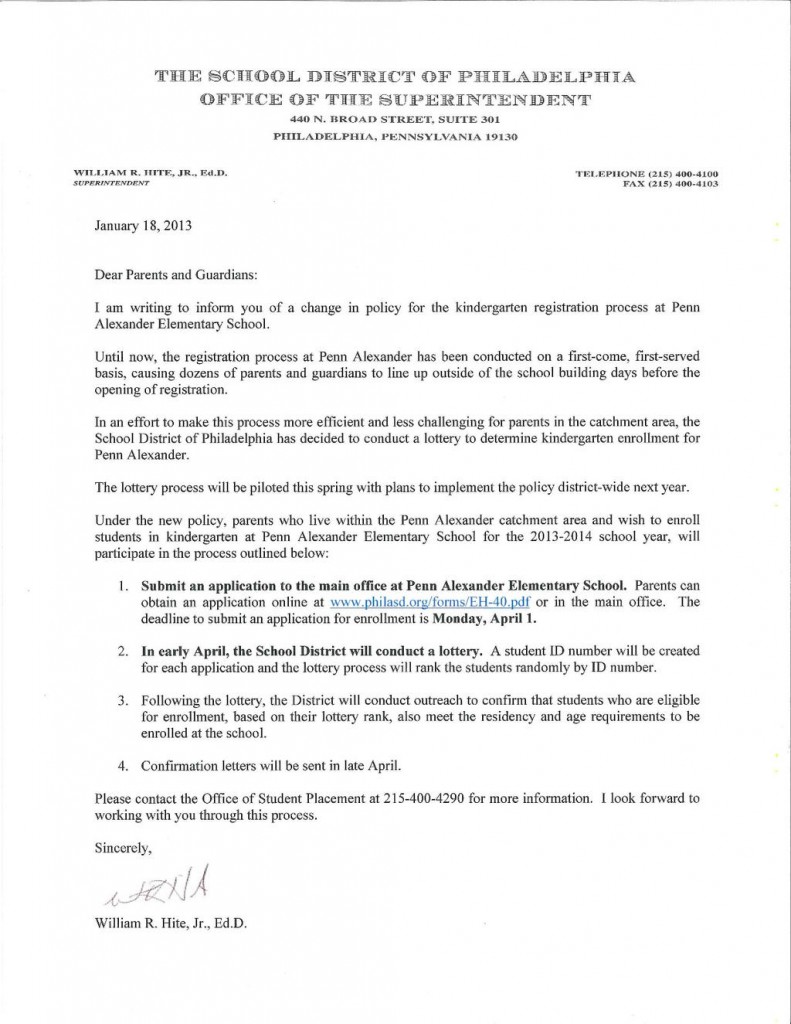
By now, you've probably heard about this year's line-up for kindergarten spots at Penn Alexander. Parents started lining up on Friday morning for Tuesday's morning's kindergarten registration, bracing themselves for four days in the elements.
But in the late afternoon, the school district passed out the letter below, stating that there would be a lottery for kindergarten spots in the spring and that essentially there was no longer any need to wait in line, since all applications would have an equal chance of getting a spot. Passing by to walk my kids home, not long after the letter had been passed out, the reaction from parents in line ranged from confused and stunned to angry and distraught.
There's so much more I could say, on so many facets of this episode which has shone a huge spotlight on our neighborhood and on urban education in general. But I'm going to hold my tongue, because I'm sure that half of my comments will infuriate some, the other half will infuriate others, and all of them may compromise my ability to be involved in coming up with a solution. (Privately, I'm happy to blab all you want!) Stay tuned.
But in the late afternoon, the school district passed out the letter below, stating that there would be a lottery for kindergarten spots in the spring and that essentially there was no longer any need to wait in line, since all applications would have an equal chance of getting a spot. Passing by to walk my kids home, not long after the letter had been passed out, the reaction from parents in line ranged from confused and stunned to angry and distraught.
There's so much more I could say, on so many facets of this episode which has shone a huge spotlight on our neighborhood and on urban education in general. But I'm going to hold my tongue, because I'm sure that half of my comments will infuriate some, the other half will infuriate others, and all of them may compromise my ability to be involved in coming up with a solution. (Privately, I'm happy to blab all you want!) Stay tuned.
1.17.2013
Restoring Our Connections
First, it was a frigid house alerting us to the fact that our timed thermostat had been unknowingly jostled, such that it wasn't connected to the wires that lead to our gas furnace. So you could time it all you wanted, but without being connected, it had no way of telling the gas furnace to fire up.
Second, our hallway and bathroom lights started intermittently shutting down for no reason. An electrician couldn't figure out why it was doing that, but he figured out where it was happening and bypassed the problem area, hooking the wires into another, live source of juice.
Third, Amy's birthday present for Aaron - a roaring dinosaur transformer contraption - wasn't able to turn on, despite the fact that we tried three different sets of batteries and read the user manual from front to back. Her enterprising brother deciding to disassemble the whole console, and when he did, he saw a wire that had come loose; once he connected it back in, the whole thing worked.
Even in 2013, electricity still requires an unbroken connection. No matter how intricate our home heating system, lighting, or toys are, one little break in the action and the juice stops. Let me rephrase this so that you can grasp the incongruity: for all of the complexity involved in heating a home, lighting a hallway, and making a dinosaur transformer roar, it can all be felled if two little wire tips cease to touch.
Is there a lesson here for the church? Are we susceptible to building all sorts of complicated structures for feeding the congregation and reaching out to the world, and we are powered off because a few seemingly insignificant connections have become loose? My threefold experience with how electricity works - and doesn't work - will be a reminder to me to mind all my connections.
1.16.2013
Serving the Waiters
I won't even attempt to conjecture when the line will form (last year it formed 24+ hours in advance) or how much time will elapse between first in line and the last spot available (last year it was probably about 2 1/2 hours), lest I induce palpitations from this year's waiters and encourage premature line-waiting. But when it starts forming, it is likely there will be remarkable amount of "good neighborism" being practiced amongst these parents, amongst other neighborhood residents (especially those who have gone through the line themselves, and especially those located immediately adjacent to the school), and amongst churches in the community who seek to serve their fellow person.
Even as it is likely to be chilly in line, that kind of service in action warms my heart. I'll be sure to report on how it all plays out over the next several days.
1.15.2013
What to Do When You Are Accused of Being a Bigot
The recent hubbub surrounding Pastor Louie Giglio, who was asked to pray at President Obama's inauguration and then subsequently opted out when accused of being bigoted against gays, has followed a well-worn narrative arc: prominent Christian pilloried for "backwards" beliefs, Christians respond with incredulity and defensiveness, and battle lines harden. As a Christian myself, who believes in many things that many around me would similarly consider "backwards," let me offer an alternative response: not that we dilute or disavow our understanding of God's rules for life, but that we are humbled and humbler when we are attacked.Humility is not a natural reaction to attack, especially if we feel the attacks are unfair, incorrect, or pointed. But a response that is purely defensive and explanatory in nature speaks of a heart that thinks that it is nowhere at fault. But the track record of us Christians negates our ability to stand in a place of blamelessness on our own. We who say we are "born again" (once dead in sin, now alive in Jesus) yet hold and act on some very base feelings: hatred, lust, arrogance, condescension. There are far too many such examples for us to be able to speak from a position of moral superiority and moral authority.
At any rate, our ability to positively influence the people around us depends not as much on our being morally perfect as it does on our manifesting God's mercy and forgiveness in our lives. If we think we are better than others and try to convince them to be like us, we are the ones getting elevated; but God is far too jealous for His glory to want our witness to the world to work like that. Conversely, if, instead of being defensive, we just give in, and say that anyone can do anything because who are we to judge, then that doesn't glorify our God either, for it is an act of exaltation to God that we say that there are rules and that He has the authority and right to be the one to set them.
Instead, I wish we Christians were more true to what we are supposed to be about, which is honoring our God. We honor God when we uphold that His standard is the standard, that there is such a thing as sin and that it causes judgment by and separation from God. And we honor God when we respond to accusations by humbly confessing that indeed we have fallen short, but that we have been provided a way for redemption and forgiveness and cleansing.
For Christians, the world desperately needs to hear the story of sin and redemption, of falling short and being forgiven. We have heard it for ourselves, believe it applies to us, accept it for our lives, and seek to make it known to those around us. So why is it that, when those around us bring up the subject of our sinfulness, we choose to argue about who's really being sinful, rather than take the opportunity to agree that we are all sinful and that yet there is still a way to being made whole again?
Luke 18:9-14
9 And He also told this parable to some people who trusted in themselves that they were righteous, and viewed others with contempt: 10 "Two men went up into the temple to pray, one a Pharisee and the other a tax collector. 11 "The Pharisee stood and was praying this to himself: 'God, I thank You that I am not like other people: swindlers, unjust, adulterers, or even like this tax collector. 12 'I fast twice a week; I pay tithes of all that I get.' 13 "But the tax collector, standing some distance away, was even unwilling to lift up his eyes to heaven, but was beating his breast, saying, 'God, be merciful to me, the sinner!' 14 "I tell you, this man went to his house justified rather than the other; for everyone who exalts himself will be humbled, but he who humbles himself will be exalted."
1.14.2013
Work Is Most Dangerous When It is Enjoyable
This makes me somewhat unusual in some (not all) of the circles I run in. I think in particular of my extended family, for which family is first, food is second, travel is third, and work is non-existent, when it comes to topics of conversation at get-togethers. Not to say that my relatives don't have important jobs or don't like their jobs, but that it just isn't something that they value when we are with each other. I recall a relatively large family gathering I attended about a year ago, in which one of my cousins had just gotten a great new job, and when we asked her about it, she hurriedly gave a half-sentence description and then waved away the topic with her hand, both out of genuine modesty as well as a nod to the assumption that no one else wanted to hear more than a half-sentence about it. Indeed, soon enough we were back onto new babies, great recipes, and recent vacations.
Not to pick on my family: I've had similar dynamics with church friends, parents of my kids' classmates, and neighbors. And not to judge, either: work isn't everything, and there are many other things that are more important in life and more enjoyable to talk about in social settings. If anything, this reminds me that I skew towards workaholism more than others, and that I need to be careful.
For a workaholic, the fact that a particular work situation is enjoyable makes it all the more dangerous. To be sure, miserable work situations are not good for one's health and wellbeing, either. But great work situations can become traps, too, as they make it all the more difficult to set healthy boundaries. After all, if I like what I do, why wouldn't I let it eat into my leisure time, since I would naturally want to choose enjoyable things to fill that time?
But it can be a slippery slope. Just because I like my job doesn't mean I don't need a break from it, for sanity's sake and to maintain a healthy balance. And just because my work world intersects with a lot of my personal interests doesn't mean I shouldn't cultivate other interests. And, lastly and most importantly, the fact that my work provides for my family financially doesn't negate the importance of also giving to my family of my time and energy and brainspace, both of which can easily be depleted by my work.
We should keep an eye out for ourselves and others when work ceases to be fun, when we dread going into the office or taking on another responsibility in our jobs. But we should also keep an eye out for ourselves and others, if we tend towards workaholism, when work is supremely rewarding and stimulating, for it makes us need to set boundaries and seek balances all the more.
1.12.2013
No Car, No Problem
This past week, into this mix I jammed in the following errands:
- Monday - ballet practice, church meeting
- Tuesday - eye appointment, community association meeting
- Wednesday - post office, dollar store, school meeting
- Thursday - home all afternoon for an electrician
That's eight separate things, when in a typical week it might be only one or two. It made for a pretty hectic past several days.
One thing that wasn't part of those past several days was using a car. Because of where I live and work, and because of how Philadelphia is organized, none of those errands required a car. In fact, a car would have been less convenient and more time-consuming than walking or transiting. Score one for a location that so easily allows a car-free existence.
1.11.2013
To and Through Chicago Without a Car
I'm sure others may nominate other places, but here's another, non-Northeast city that also fits that bill: Chicago. I was there for a day earlier this month, and, apart from my return flight being delayed 90 minutes, travel could not have gone smoother:
- Walk five blocks from home to subway station
- Take subway to train station
- Take train to airport
- Take plane to O'Hare
- Take subway to downtown
- Walk three blocks to first meeting
- Walk six blocks to second meeting
- Take subway to O'Hare
- Take plane to PHL
- Take train to train station
- Walk two blocks to bus stop
- Take bus to my neighborhood
- Walk one block home
Are there any other US cities you can plop down into by plane or by train that are as easy to get around via transit and foot? SF, LA, and Atlanta, maybe, if you're willing to endure relatively long walks and longer waits. Am I missing any places with sufficient transit service and compactness to render cars unnecessary?
1.10.2013
Reading Rainbow
Books are for right before bed (as well as summer vacations). As an introvert who lives a cluttered existence (kids, sales/service/managerial responsibilities at work), reading is a great way to end the day, recharge, and transition to sleep. But, the real world is complex enough that I don't feel any interest or energy to get into the make-believe worlds of fiction, so I read almost exclusively non-fiction. And, because I like to be well-rounded in my information consumption, I try to balance my choices in terms of topics and worldviews. (In case you're wondering, the book I'm reading now is H.W. Brands' "The Age of Gold, The California Gold Rush and the New American Dream," a fascinating account of the euphoria that swept over much of the world upon the discovery of gold in California.)
Magazines that come to my home address include Wired, The Atlantic, The Economist, and Fast Company. These I like to read during my morning and evening commute and on the weekends.
Magazines that come to my work address include numerous trade publications, some on some pretty obscure topics. (Green Manufacturer, anyone?) These I skim over lunch at work, to see if anything's cooking in any of these worlds that I need to be aware of.
Newspapers include the Philadelphia Inquirer, which I'll daily read over breakfast at home, and the Wall Street Journal, which I'll occasionally read over lunch at work. Newspaper websites are a common visit for me early in the morning, as well, as are a number of econ blogs (Marginal Revolution), social commentaries (Ta-Nehisi Coates), and other interesting aggregators (kottke.org).
Lastly, I keep a "to print" folder at work, where I save research reports, white papers, and publications on a wide range of topics. Every few months or so, I print out the executive summaries (or, if the topic is really interesting, the whole document) and plow through the whole wad (or wait for a long train ride to do so).
How about you? How/what/when/where do you read?
1.09.2013
Owner, Occupied
It's official: I'm a part-owner of Econsult Solutions, Inc. Recently, we spun this new entity out of Econsult Corporation, which continues to operate, and me and another director bought in and are now principals and senior vice presidents of the new firm, as well as co-owners of the new firm with my two bosses.
I'm really excited on so many levels, although with each excitement comes not a little trepidation and worry. After 10+ years working on entrepreneurship and small business at The Enterprise Center, it's nice to finally have the opportunity to own and operate my own venture. It's where I want to be at this stage in my life, so even though the stresses and stakes increase, it's what I am choosing with clear eyes and eager heart.
Work-wise, I'll be picking up a lot of new responsibilities. My client work continues on as before, but even in that I'm stepping things up a notch because I'll be the principal on record on more and more of my gigs, rather than director under some other principal. Added on to that will be a fair amount of working on the business itself, in terms of management and strategy and operations and finances. Plus I've got to get out there more than ever to shake the trees in search of new business. Of course, the transition itself will require a bunch of to-do's over the next several months.
Psychologically, there's something significant about going from worker to owner. Of course, I've always been invested wherever I've worked, but now the investment is as real as it gets. For one, workers get a paycheck at the end of the month, while owners have to first make sure workers get paid, which means my compensation goes from a fixed amount to anything between a really big positive number and a really big negative number. I'd be lying if I said that doesn't make me gulp hard on a daily basis.
But, as noted above, this is where I want to be right now. With the added stress and responsibility comes the added opportunity to make things happen the way I think they should happen. I look forward to the greater satisfaction I will derive from running the company well, rather than just being a good worker within the company.
Monetarily, it will be fun to have my compensation tied more closely to the success of the firm. As an owner, you get paid in three ways. First, your salary, if you're lucky to clear enough to draw one after all the bills and employees have been taken care of. Second, your share of the profits at the end of the year, if you're lucky to have helped bring in more in revenues than you spent in expenditures. And third, a gain from the sale of your share of the firm, if you grow the value of the business such that you can sell for more than you first bought for.
It's that last form of compensation that I find the most intriguing. For what value is there in a professional services firm outside of its workers? After all, we don't have any machinery, any patents, or any proprietary licenses. How will we create value in our entity such that we can sell it at the end and retire off into the sunset? As one who fancies himself a systems thinker (a "clock maker" in Jim Collins parlance), this is a delicious challenge I look forward to taking on over the next several years.
I've tried to minimize my other commitments this calendar year to give myself as much room as possible to grow into these new roles. I'm still committed to being there for my family, to helping out at church, and to pursuing a number of different civic service opportunities. But I'll likely have to give more of my scarce time and brain space to the company, especially as we all transition into figuring out how to run it. Wish me luck as I launch myself into this exciting new direction!
I'm really excited on so many levels, although with each excitement comes not a little trepidation and worry. After 10+ years working on entrepreneurship and small business at The Enterprise Center, it's nice to finally have the opportunity to own and operate my own venture. It's where I want to be at this stage in my life, so even though the stresses and stakes increase, it's what I am choosing with clear eyes and eager heart.
Work-wise, I'll be picking up a lot of new responsibilities. My client work continues on as before, but even in that I'm stepping things up a notch because I'll be the principal on record on more and more of my gigs, rather than director under some other principal. Added on to that will be a fair amount of working on the business itself, in terms of management and strategy and operations and finances. Plus I've got to get out there more than ever to shake the trees in search of new business. Of course, the transition itself will require a bunch of to-do's over the next several months.
Psychologically, there's something significant about going from worker to owner. Of course, I've always been invested wherever I've worked, but now the investment is as real as it gets. For one, workers get a paycheck at the end of the month, while owners have to first make sure workers get paid, which means my compensation goes from a fixed amount to anything between a really big positive number and a really big negative number. I'd be lying if I said that doesn't make me gulp hard on a daily basis.
But, as noted above, this is where I want to be right now. With the added stress and responsibility comes the added opportunity to make things happen the way I think they should happen. I look forward to the greater satisfaction I will derive from running the company well, rather than just being a good worker within the company.
Monetarily, it will be fun to have my compensation tied more closely to the success of the firm. As an owner, you get paid in three ways. First, your salary, if you're lucky to clear enough to draw one after all the bills and employees have been taken care of. Second, your share of the profits at the end of the year, if you're lucky to have helped bring in more in revenues than you spent in expenditures. And third, a gain from the sale of your share of the firm, if you grow the value of the business such that you can sell for more than you first bought for.
It's that last form of compensation that I find the most intriguing. For what value is there in a professional services firm outside of its workers? After all, we don't have any machinery, any patents, or any proprietary licenses. How will we create value in our entity such that we can sell it at the end and retire off into the sunset? As one who fancies himself a systems thinker (a "clock maker" in Jim Collins parlance), this is a delicious challenge I look forward to taking on over the next several years.
I've tried to minimize my other commitments this calendar year to give myself as much room as possible to grow into these new roles. I'm still committed to being there for my family, to helping out at church, and to pursuing a number of different civic service opportunities. But I'll likely have to give more of my scarce time and brain space to the company, especially as we all transition into figuring out how to run it. Wish me luck as I launch myself into this exciting new direction!
1.08.2013
Announcement: Econsult Solutions, Inc. is Formed
I'll be sharing more about this personally tomorrow, and our firm is doing a month-long (year-long?) rollout, but I wanted to let you know there are two big changes at Econsult. First, we've formed something called Econsult Solutions, Inc., and second, I will be a Senior Vice President and Principal of the new firm. You can check out our new website here and read the official announcement here.
1.07.2013
New Year, New Look
"Musings" now has a new look. Apologies for the clunkiness of the previous layouts, and hopefully you'll find this new format to be aesthetically and functionally cleaner. Plus you can now translate posts into dozens of languages, should English not be your easiest read. Enjoy!
1.05.2013
2012 Car Usage
As before, the Philly totals represent, in order, number of trips, number of legs represented in those trips (i.e. going to and from my in-laws, making one stop to get gas, counts as three legs), and number of legs in which I was driven (rather than driving). The other city totals represent, in order, number of times I was in that location, number of days I was in that location, number of trips, number of legs represented in those trips, and number of legs in which I was driven.
Philadelphia 127/306/61
San Jose 2/14/10/27/12
Poconos 1/7/18/50/2
Harrisburg 1/1/0/0/0
North Carolina 1/1/0/0/2
You'll see that the last two Philly numbers add up to just over 366, so while in town I averaged about one leg per day in 2012, thanks to our urban setting and the many everyday locations I can get to without a car. Here's hoping that that delays when we need to purchase a new car, and that it makes a difference for the environment.
Subscribe to:
Comments (Atom)
Too Short for a Blog Post, Too Long for a Tweet 522
Here are a few excerpts from a book I recently read, "Moby Dick," by Herman Melville. Again, I always go to sea as a sailor, bec...
-
PHILADELPHIA NAMED BEST CITY FOR NEW GRADS How about Philly besting Boston, New York, Chicago, Atlanta, and every other city in America for ...
-
I recently had a humorous but telling incident on my bus ride into work. It being rush hour, the vehicle is often crowded and even standin...