11.30.2010

What Am I Working On (The "I Hope" Version)


Let's change up my quarterly "what am I working on" update just this once. Here's a mish-mosh of things we're proposing or have recently proposed (again, details changed or blurred to maintain some confidentiality).

* Analysis of a government's spending distribution to minority, women, and disabled owned businesses.

* Analysis of the racial, ethnic, and income distribution of home lending, business lending, and branch locations of all the banks that a government has its deposits with.

* Overall economic development strategy for an urban neighborhood, with particular focus on housing, retail, and transportation.

* Industry cluster analysis for a suburban county, en route to doing outreach to specific sectors and businesses for business attraction purposes.

* Potential economic impact associated with bringing a single-sport arena to a depressed small city.

* Cost-benefit analysis to a city and state of turning over vacant parcels to a community group to clean up and, in some cases, redevelop.

* Quantitative and qualitative analysis for a foundation's comprehensive investments in an urban neighborhood.

* Updating an economic impact report from three years back that looked at a government's tax incentive program in terms of jobs created and tax revenues generated.

* Conducting research for a government to compare its business attraction tools to those of other competing government jurisdictions.

* Determining what types of public or private interventions have made the biggest difference in terms of retail success in commercial corridors in a big city.

* Advising a small municipality on how to implement programmatic and performance measurement solutions to encourage local minority, women, and disabled owned businesses.

* Helping a small municipality complete an application for stimulus funds by projecting jobs created associated with proposed capital improvements.

* Helping an academic institution review proposals for on-campus real estate developments.

* Estimating the economic impact associated with a big park in a big city.

* Developing metrics for an urban real estate developer to identify and prioritize neighborhoods for potential development.

11.29.2010

Lazy Linking, 29th in an Occasional Series


What I liked lately on the Internets:

* Even in all the rhetoric in '08, Obama had a lot of conservatism in him: Krugman admits so and says liberals didn't hear it because they didn't want to hear it.

* Fuel tax, anyone? 16 transportation policy experts weigh in on if, how, and why.

* George W. Bush, betrayer of conservative ideals and big-time spender? Keith Hennessey says not so fast.

* Megan McArdle rides the rails in China and discusses why we won't be seeing high speed in the US anytime soon and why China's competitive advantage in cheap labor may soon vanish.

* What's a football fan to do during his team's bye week? It appears "looking at more porn" is one answer.

* Capitalism and ministry are more alike than the populists would like you to think: both are most successful when they serve others.

* Someone took the time to actually create a mortgage securitization flow chart. Yes, it's complicated.

* What the color of your poop tells you.

* What are the three most disturbing words on TV? How about "move that bus!" [Hat tip: Desiring God blog.]

* OK, the big negotiation has come down to the final meeting. To seal the deal: offer to host the meeting.

* Tim Harford uses eggs to show how easy it is for neighborhoods to "tip."

* Why so much skepticism about climate change? Maybe it's not about the science or the messaging, but the political process.

* A tale of two states: Pennsylvania and California. Among the eight states in the US with population of 10 million or more, one of these two is first in all four standardized test categories (4th grade reading, 4th grade math, 8th grade reading, 8th grade math), and one of these is last. Can you guess which is which? Are you sure? Click here and look on page 41 (warning: large pdf).

* Some people want their commutes to be longer.

Change in Commuting Patterns Ahead


Walking one kid to one school and then biking the other kid to the other has proven to be fantastically convenient, as well as avoiding the cost of buying another car or even a transit pass. But I have known since the beginning that my days of being in complete control of my commuting schedule are numbered; at some point, I just won’t be able to do it anymore.

What is surprising to me is realizing what the actual reason will be. Extreme cold? No, we can layer up. Rain? We’ve gotten lucky so far. Injury? So far, so good. My workplace moving to Center City? Not for another few months.

No, what is likely going to signal the end of my days as a bicycle commuter is that the bike seat is built to hold up to 40 pounds. And both Jada and Aaron are in the very high 30’s.

So rather than risk straining the seat to the point of a very inconvenient and very dangerous collapse, I think at some point I’m going to have to hang up the helmets and tell the kids we’re riding the buses. They may protest, and I will be out 83 bucks a month for a pass, and the commute will take a tick longer. But better safe than sorry. And, my legs won’t be burning so much and my suit so sweat-soaked every morning.

11.28.2010

Recommended Reads, Fourth in a Series


Stuff I'd recommend from the past three months. Speaking of which, with the holidays come times for reading (and gift-giving!). So don't hesitate to share your recommended reads; I love getting leads on stuff I never would've found on my own. (Hopefully these quarterly lists confirm that my reading interests are broad enough to include whatever you might throw my way.)

* Progress Paradox (Easterbrook). Fun to read these books about American prosperity that were written right before the meltdown. They're no less true, and if anything in the descriptions of wealth contain hints of impending doom.

* It's Getting Better All the Time (Moore/Simon). Speaking of which, here's a useful reminder that the long narrative is that we're really way better off than ever before, recession or no. Love love love the line charts that show data going back 100+ years.

* Hudson Taylor (Christie). Is there anything more riveting (and convicting) to the ardent believer than reading missionary biographies? This one is decidedly average and yet still it gripped me.

* A Severe Mercy (Vanauken). A young couple in love. Intellectuals wrestling through what it means to follow Jesus. An early death, a poignant mourning. And C.S. Lewis interspersed throughout. Boy, this book had a little of everything.

* Bell Curve (Herrnstein/Murray). Rightfully controversial for speaking bluntly about the distribution of intelligence throughout members of society, I appreciated the statistical approach and the willingness to explore the unpopular possibilities.

* A Vanishing Conscience (MacArthur). This is one of those books that is more relevant now than when it was first written 15+ years ago. Would a 2010 version be called "A Vanished Conscience"?

* Having It All (Brown). I couldn't resist this 1982 book by the founder of Cosmo. She expounds on how even a "mouseburger" can have it all - career, looks, men, health. Some of her suggestions made me cringe but a surprising number were level-headed and even quite wise.

Things That Make Me Unhappy: First in What is Hoped to Be a Very Infrequent Series


* 35-3. Ugh. Mercy.

* Main drain broke last week. No water for 48 hours. Big dirty mess for 72 hours. No basement for a week and a half.

* Dear drivers: I am mindful when I need to temporarily cut into your lane. Please do the same when you need to cut into mine. After all, I'm carrying a little boy on my back, and you're carrying 20+ times more mass.

* Speaking of sharing the road, when bikers weave in and out of traffic, race down sidewalks, and blatantly run reds, they make drivers hate all of us, pedestrians dread all of us, and policymakers not want to do hard work to make for a safer biking environment. So how about being a little more responsible?

* Why does it take so long to return something at Ikea?

11.27.2010

Black Friday, Terminator-Style


I'm not much of a shopper, and I certainly don't find going to a physical store appealing on many levels. But for the kids, I will subject myself to the cauldron that is Black Friday. Here is my running diary:

2:00a - Alarms go off. I rise as though powered on like a machine. I will retain this mode for the next several hours.

2:05a - I read in the Bible about Jesus calming the storm. Somehow, I'm not sure the disciples would find my situation to be analogous to theirs.

2:40a - Since I will be riding the bike and watching football when I get home, I put on my workout clothes under a pair of windpants and a fleece. I almost consider stretching before I head out the door.

2:55a - I slice through the non-existent traffic and pull into Kohl's. There's a line about 100 people long.

3:00a - The doors open and people shuffle in quietly. I decide to hit only displays at the end of aisles. It saves me times and concentrates me on deals, rather than on having to find exactly everything on my list.

3:20a - Fearing the long checkout lines from last time I did Black Friday, I decide 20 minutes is enough time in the store. Remarkably, there is no line. Even more remarkably, I wait a whole five minutes because a pair of freaking socks I picked out has no bar code. I'm about to say I don't want them when the cashier gets called back and punches the number in.

3:30a - For all of the care Kohl's put into fully staffing the checkout lines, my post-checkout experience isn't nearly as tight. I can't find an automatic door out to save my life so have to wangle my way through a regular door while pushing a cart with one hand and holding a big item with the other. Then I have to walk the length of the parking lot to put my stuff away, the length back to return the shopping cart, and the length again back to my car. Thankfully, I'm making really good time so this is just a blip.

3:45a - I arrive at Target and this line is a good 300 people long and growing. A security guy on a Segway uses his radio to find out how many Wii Fit Pluses they have in stock (83), where they're stored (Electronics), and where that is in relation to the store entrance (all the way to the back, and then a left).

4:00a - The doors open and we all march in. This scene is considerably more chaotic. Shopping carts are at a premium, people are making a mad rush for the flat-screen TV's, and I make a beeline for the Wiis.

4:20a - I employ the same strategy here as at Kohl's, and as a result am satisfied after just 20 minutes. Target is also on the ball in terms of manning the checkouts, so I'm in and out in no time.

4:40a - Home, bags and boxes unloaded. Two hundred dollars spent, two stores conquered, and I still have an hour and change to get my exercise and shower in before the kids are up. This machine is so pleased with its cruel efficiency that it tries to crack a smile but then remembers its face muscles haven't yet been properly fitted out.

11.25.2010

LeBron Took His Talents to South Beach; Where Will You Be Taking Yours?


Earlier this year, when the sports world awaited where LeBron James would end up, ESPN columnist Bill Simmons wrote an article summarizing LeBron's choices as follows: "loyalty" (Cleveland, where he's from and where he has spent his entire career), "success" (Chicago, where his skills would've been the best fit towards building a dynastic team), or "fame" (New York, the world's greatest stage and its biggest media market). We now know that LeBron chose none of the above; or rather, he chose "friends" (to "take his talents to South Beach" with best friends Dwyane Wade and Chris Bosh in Miami).

Loyalty, success, fame, or friends/fun. Very often, our major life decisions are made according to which of these is most important to us. For most Christians, and probably for many others, loyalty and friends seem to be nobler pursuits than success or fame. All else equal, if given four career paths like LeBron James had before him, we’d have an easier time justifying our choices to our pastor, our small group Bible study, or to other Christian friends if we said we chose loyalty or friends than if we chose success or fame.

All well and good, I suppose. Are loyalty or friends inherently better reasons than success or fame? Perhaps they are. Can success and fame become traps that lead us astray? Most certainly they can.

But let me offer a counterpoint, not necessarily to argue that the convention wisdom is wrong but to provide some balance to this discussion. Whether or not LeBron James made the right choice or had the right reasons can be debated. But what if, out of millions of Christians making similar, albeit less televised, decisions, almost no one chooses the path of success or fame? And, is that necessarily a good thing? In other words, are our natural predilections, to value loyalty or friends as noble and success or fame as dirty, leading us to an outcome in which we are underrepresented in certain arenas that would be better served having some leavening influence from us?

On a related but not completely parallel note, let us consider some specific professions and industries. It may be easier to make the connection between following Jesus and being a teacher, or a social worker, or an international aid worker. It may be harder to justify to one’s Christian peers a decision to become a high-powered investment banker, or a local politician, or a Hollywood exec, and harder still to do those careers well without compromising one’s values or ruining one’s health and family. But what if, out of a million decision points for a million young Christians, very few choose the latter jobs? If we are to be salt and light in this world, to use an analogy from Jesus, would that not mean that some of the very places that most need salt and light remain bland and dark?

Please don’t mistake my point. I am not arguing that we have too many Christian teachers or social workers or international aid workers. I am not arguing that just because one has the opportunity and the skill to serve in the latter professions, one should not be dissuaded from yet avoiding them, to say no to the trappings of success and fame, no to the potentially ruinous sacrifices one might have to make to make it in those sectors. I am not arguing that we should abandon our consciences, such that if we find ourselves feeling compromised because of the innate conflicts in those professions, we shouldn’t make hard choices to get out and leave it all behind.

All I am suggesting is that, if out of a million of us, none of us end up in those places, that might not necessarily be a good thing in terms of making an impact for the now and for the hereafter. If we seek those difficult jobs and feel God is leading us into them, let us seek them with the support of a community of believers who can keep us in check against temptations and dangers, but let us seek them nonetheless. Goodness knows the world could use some justice-seeking investment bankers, some honest politicians, some moral Hollywood execs.

If you have talent and leaning for these or other professions we Christians sometimes look down on, I am not saying you necessarily must end up there. But I am saying we Christians should probably open our minds a bit; and, if it does in fact seem God is leading you in that direction, we ought to be happy for you, and supportive of your effort to go to places not often trod by followers of Jesus, to be an agent for change and for good and for what matters for eternity. At the very least, we should not dismiss your motives as impure or your courage as lacking.

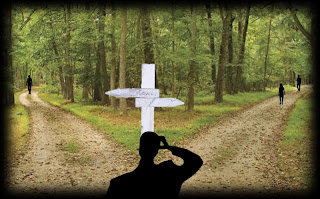
In the journey of life, we will hit forks in the road, and sometimes the paths will be clearly labeled: “loyalty,” “success,” “fame,” and “friends.” To be sure, sometimes there will be a clear sense of which paths are good and which aren’t. But, God is big enough to be with you and use you whichever path you take, if you are willing to go for Him and not for other, lesser motives. And if not enough of us are choosing the paths that seem darker from our present vantage point, I would venture to say we may not necessarily be distributing the light of our influence as effectively as we might.

11.22.2010

These Pictures Scream "Autumn" to Me

These pictures scream "autumn" to me: a kaleidoscope of leaf colors, hats and gloves, the briskness of the temperature somehow conveyable in visual form. Love this time of year, and love how pretty our neighborhood gets.


40,000 Hits


We celebrate another milestone here at Musings: 20,000 hits as of May 2009, 30,000 hits as of February 2010, and now 40,000 hits as of November 2010 since I put a counter on the site in February 2005 (which was two years after I had launched this blog in February 2003). Thanks for visiting, and I hope you'll continue to stay engaged.

11.20.2010

Praying to and with God, Not at Him


Our small group finally got a chance to meet this past weekend, for the first time in the 2010-2011 year. Our busy schedules made hash of our initial plan of meeting every two weeks on a weeknight, and so we opted for a longer, Saturday afternoon format, with kids taken care of by babysitters.

We capitalized on this more extended time slot to, among other activities, have more prayer time. And, we incorporated an exercise we learned from our church's recent fall retreat, in which, instead of sharing requests and then praying for them, we took turns being still and listening for God's leading for each family, and then prayed for that family according to whatever we felt and heard. Afterwards, or even during, we verified if what we were praying about was relevant or not.

It may sound weird if you are not a Christian, or amusingly tame if you a raging charismatic. But for us buttoned-up intellectual believer types, it is a somewhat different but perfectly normal practice. I find it particularly useful because it is so easy, when praying, to use only your head and your words: you hear a request, you process it with your brain, you paraphrase it out with your mouth in whatever words make sense.

But prayer is much more intimate and spiritual than listening and repeating. And being still, even for a couple of minutes, to give God room to nudge you, or even if only for God to remind you of His presence, is very useful. I think I can speak for the whole group when I say we left with a sense that we had really been with God, and done it together, and emerged with a deeper sense of what was going in on our own lives and in the lives of our fellow small group members.

Fancy that: praying to and with God, not at Him. Maybe it's just me, but this is a useful adjustment, and I hope for even better times of prayer in the future as a result.

11.19.2010

Things You Muse About When Your Main Drain Collapses and You End Up with Massive Water Damage in Your Basement


Y'know, I'd been thinking our weekly routine was too easy, too mundane, too boring . . . why not throw a major plumbing fiasco into the mix? Alas, I am being sarcastic about the first half of that sentence, but speaking plainly about the second half: at some point earlier this week, our main drain collapsed upon itself, stopping up all the flow coming from inside and outside our house. (Philadelphia, like many older cities, has unified stormwater and sewage draining.) Amy picked up the problem first when the basement toilet wouldn't flush; at first she thought it was stopped up, so tried plunging and then snaking it, to no avail.

When I called in a plumber the next morning, he quickly diagnosed that it was not a local problem but a main drain problem. And when he took a look outside at the main drain, he quickly diagnosed that it was not a clog in the drain but a complete collapse of the drain. Big bill to rebuild it. They got on that right away, although were delayed a day getting permits from the city.

Until it got fixed, we had to be very judicious about water use, since anything that went down a drain could end up coming out of the basement toilet, which is the lowest point for stuff to come back out. In fact, before we had diagnosed the problem, we did have a little bit of backup, from running a bath for the kids and the washer at the same time. But nothing too terribly hard to clean up.

Alas, the second night, there was a mighty rainstorm. And so most the stormwater that landed on our property, plus any dirt and leaves that mixed with it, backed up from our main drain and came out of our basement toilet and all over our basement floor. The next morning I woke up, ran downstairs, and my worst fears were realized: mud and muck everywhere. I spent the morning before the kids woke up just trying to contain the damage, and later that morning called our homeowner's insurance company.

So that's where we are now, waiting for the vendor that works with our insurance to clean and then restore everything. It's majorly disruptive to our regular routine; for example, Amy and I have had to figure out how to work around not having access to our exercise equipment for the next several days. And, let's just say I can think of numerous things I'd rather be spending a few thousand dollars on. Plus, as I have become very compartmentalized in leaving work at work and tending to home at home, it has been utterly distressing for me to have to race back and forth between the two places several times this week.

As part of practicing a more thankful approach to life, remembering to have perspective in the midst of turmoil, and listening for life lessons God may be trying to communicate through trials and tribulations, allow me to share some musings that have been triggered by all the muck:

* I'm thankful to be well off enough that an unanticipated few-thousand-dollar plumbing bill doesn't utterly ruin us.

* I'm thankful I live close enough to work that racing back and forth on my bike wasn't too too hard.

* I'm thankful that all the problems got properly diagnosed, lest even worse damage or danger befall us at an even more inconvenient time.

* I have a new perspective on the importance of having pervious surface on your property to help soak up all that rainwater so it doesn't all end up in your basement.

* I had fun experimenting with capturing water in a bin as I washed dishes and then dumping the "grey water" on our garden.

* I'm mindful of the fact that we do have running water, which much of the world is forced to live without.

That being said, I have to confess that I had a pretty lousy attitude through it all: huffing and puffing, seething with impatience, becoming undone by the loss of things I wouldn't have thought were so important until I didn't have them anymore, and even being mean to my wife more than once through this whole ordeal. It hasn't been a pretty week, and I've been far from on my best behavior in response. Soon enough, all will be back to normal. But hopefully I'll retain the lessons learned.

11.18.2010

Letters to Congress: Deficit Reduction


It's time again for my elected officials to hear from this citizen. This time's topic is deficit reduction. Feel free to co-sign by sending along to your representatives.

***

It is my hope that you will do your part to put into action some of the recommendations from the Bipartisan Deficit Commission. It is never a good time to tighten the belt, and interest groups who may suffer if these recommendations are advanced have likely made it known to you in no uncertain terms that now is particularly a bad time to take such action. To them I say: tough luck. And to you I say: show some political courage.

While I am a fiscal conservative, I do not take an extreme position on running a large deficit. The world continues to have faith in our money and our economy, and interest rates are low, so given slack demand and pressing needs, one could make a good case for actually borrowing more, going further in debt, and building lots of things right now.

What I like about the recommendations of the Commission is that they make sense. So it is less about "Chicken Little" and more about doing what is sensible, that I push the following actions:

* A higher retirement age. Social Security was enacted when the ratio of workers to retired was 14 to 1; it is now 3 to 1 and will be 2 to 1 by the time my kids retire. It was also enacted when the life expectancy was barely past 65; now we may expect to live a good quarter of our lives or more beyond that age. And besides, tongue kind of in cheek: we're not France. Some of us actually might want to work into our 60's and even 70's and 80's.

* Lower, broader rates. Interestingly, we are looking at something like that locally here in Philadelphia. Lower, broader rates lead to less distortive behavior, fairer burdening, and more focus on actually doing business rather than avoiding taxes. We all know the tax code has gotten too complicated, and this is one way to simplify it.

* Capping the mortgage interest deduction. This is a highly regressive tax perk, benefiting wealthier people and not a help to any of those low-income households that do not itemize. It has also led folks to buy a little more house than they really need, and we now know what happens when that happens at a national level.

* Upping the federal gas tax. We've spent too much energy (no pun intended) regulating and incentivizing our way to a more sustainable economy and not nearly enough on improving the price signals of consuming carbon. The federal gas tax rate is going on 20 years without even an inflation adjustment. It's time for an environmentally-driven adjustment.

I don't claim to understand the pressures you face to please all of the different constituencies you represent. I realize that politics consists of a series of compromises, and in times like this and on an issue like this, that is all the more true. But I would be remiss if I did not convey where I am coming from. Thank you for your service and attention.


11.17.2010

The Economic Value of Protected Open Space


How many times have we heard this debate before: while meanies clamor for more development, greenies clamor to protect farmland and parks. I personally am probably more meanie than greenie, but above all I want a fair and informed discussion.

So I'm happy to announce that a report my firm worked on has been released for public consumption: "The Economic Value of Protected Open Space in Southeastern Pennsylvania." You can see a copy of the report here, here, and here.

The aim of this study was to inject the notion that in the weighing of "development" versus "no development," the gains associated with the "no development" option are not non-existent. Whether they exceed the gains associated with the "development" option is an argument for another time; but they are not zero, when you account for 1) jobs and revenues associated with the activities like agriculture and tourism, 2) property value enhancement associated with wanting to live near outdoor amenities, 3) recreational benefits and health care cost reductions associated with using parks and trails, and 4) ecological services rendered by the natural resources on these lands.

Kudos to Greenspace Alliance and the Delaware Valley Regional Planning Commission for being great clients, and for hosting a fantastic news conference yesterday at Valley Forge National Park. I'm proud to have been part of the effort, and hopeful it will be used to have meaningful land use discussions about balancing the need for development with the need for preservation.

11.16.2010

A Message for the Masses


As I alluded to earlier this month, I am working my way through "The Message," Eugene Peterson's contemporary translation of the New Testament. It's been a little bit since I've studied the New Testament, and this version is particularly fresh, as its more casual style reads more breezily.

As Peterson points out in his introduction, it comes as quite a surprise that the Bible was written in this more informal tone, for one would suspect that if one were writing for posterity, a more formal tone would be taken, rather than the flow and idiom reserved for family letters and chats with neighbors:

"And this is the language used throughout the New Testament. Some people are taken aback by this, supposing that language dealing with a holy God and holy things should be elevated - stately and ceremonial. But one good look at Jesus - his preference for down-to-earth stories and easy association with common people - gets rid of that supposition. For Jesus is the descent of God into our lives, just as they are, not the ascent of our lives to God, hoping he might approve when he sees how hard we try."

Sadly, we Christians, especially those of us with letters next to our names and sheepskins hanging on our walls, have too often buried Jesus and the Bible in high-falutin' language, decipherable only to ourselves and accessible to no one else. If Jesus and the Bible were for the masses, how is it that we have become so unknowingly elitist? It's for this reason that I try hard - in this blog, when I am out and about, and even in church - to avoid Christianese jargon and other impenetrable words and phrases.

Jesus and the Bible hold fast to timeless truths about right and wrong, about who it is right to worship and who it is wrong to follow, so there is no "modernizing" or "progressivity" there; but there is a refreshing consistency to the commonness and earthiness of the words and syntax used to communicate them. God forbid that we modern-day believers should be any different.

11.15.2010

Lazy Linking, 28th in an Occasional Series


Things I liked lately on the Internets:

* Big big big shout out to fellow BAP 2008 delegate Jared Genser and his organization, Freedom Now, for the release from house arrest of Burmese political activist Aung San Suu Kyi, and let's hope this leads to real change in that country, instead of all the other times. Speaking of jailed Nobel Peace Prize winners, another Freedom Now client is China's Liu Xiaobo, so let's work for a release there as well.

* 20 most common passwords. What's up with "Nicole," "Daniel," "Jessica," "Michael," and "Ashley"?

* If I'm Land Line Magazine and I want to run an article about how to plan ahead for when your truck is stuck and needs a lift, well, yeah, I'd probably also title that article "Avoiding the Tow Jam."

* Speaking of puns, my favorites from this list were the first and the last: 1. Two antennas met on a roof, fell in love and got married. The ceremony wasn’t much, but the reception was excellent. 20. And finally, there was the person who sent twenty different puns to his friends, with the hope that at least ten of the puns would make them laugh. No pun in ten did.

* How about an atlas of recorded accents? [Hat tip to Marginal Revolution.]

* Most cost-effective way to combat climate change? How about making sure girls get educated? [Hat tip: Freakonomics Blog.]

* David Brooks outlines a compelling blueprint for what sort of America will continue to be the world's magnet in the future.

* Megan McArdle, David Frum, and Greg Mankiw on the deficit commission's proposal.

* Will we have self-driving cars by the year 2026? Ryan Avent is betting so, and I am inclined to agree (but am too chicken to actually put money on it).

* Another bookmark for my browser, courtesy of Keith Hennessey: Advancing a Free Society.

* Some are still in a fit that SEPTA took cash from AT&T to rename Pattison Station. Well, Chicago's selling naming rights to anything and everything it can.

* First woman mayor. (Yawn.) First Asian-American mayor. (And?) First mayor voted in by ranked-choice voting. (Wowza!)

* To help prove that casual sex doesn't exist, a biological anthropologist cites a survey in which it was found that 50 percent of women and 52 percent of men entered into a hookup in the hopes of starting a relationship. Hello? To me, that proves the opposite, for it means that 50 percent of women and 48 percent of men entered into a hookup not hoping to start a relationship. (And, am I the only one who thinks most of the 52 percent of men were lying?)

11.13.2010

Someone Else's Son, Someone Else's Script


On the short bucket list of darn near every guy is the deep desire to have a son and raise him to be a man. What can particularly rewarding - and touching - is seeing in the little guy a little of yourself. I'm not referring to an unhealthy "living out your unfulfilled dreams through someone else," but rather a special bond and burden, borne of seeing this duplicate of yourself progressing through the stages of development under your watch.

As Aaron is not my biological son, I get the same vantage point and the same opportunity and responsibility to shape and mold, but I don't share his genes and so I don't quite have the same connection to him as other dads have to their sons. I don't think my relationship to and love for my son is any less than any other father's, but because of this it is a little different. As with many aspects of our lives, God's plans for us are not often what we would have scripted, and they come with some losses and pains, but they ultimately lead us to richer, fuller lives.

This morning, as I make my way through "The Message," Eugene Peterson's translation of the New Testament, I am reminded of another father of a son who was not his own biologically. Joseph, eager to marry Mary and start a family with her, discovers his bride-to-be has become pregnant. Rather than spiral in despondency or lash out in rage, he does right by his fiancee even though it appears she has not done right by him; he seeks to quietly cut ties so as not to cause her public shame, even though she has caused him public shame. But an angel visits Joseph and tells him this is all part of God's plan: Mary is to be part of an immaculate conception, Joseph is to stay with his woman, and they are to raise a child who is the Son of God.

We know the story so well that it has lost its shock value, but put yourself in Joseph's shoes. It's a lot for a young guy to take in, no? Embarrasment, racking your brain to figure out who Mary slept with, what'll my community think, who will marry me now, and now an angelic being has told you you'll be playing father to God's Son. In light of all of that, I would be a mess; Joseph, in contrast, comes off looking like Tom Brady in the pocket amidst a sea of pass rushers.

The plot thickens from there, as you know. For the baby is born while Joseph and Mary are in transit, a horse trough serves as its first crib, wise men visit them with gifts from afar, an enraged king tries to seize the baby, and Joseph and Mary abscond in the night. And you thought your first days as a dad were stressful.

Through it all, Joseph, who has proven his cool to me already by this point in the story, must have contemplated deeply what was unfolding before his very eyes. Someone else's son, someone else's script, certainly not his own in either sense. There must have been questions - "How?" "Why?" "What's next?" - but the overall sense you get is that this is a man who is faithful, humble, and thoughtful, and above all devoted to that which God has given him to do and be, no matter how incredibly more it is than this lowly carpenter seems capable of.

My situation has far less drama, to be sure. And yet there is a lesson for me in Joseph's cool and committed approach to fatherhood. Aaron is not the son, and this is not the script, I would've envisioned for myself way back when, when I, like all guys, looked ahead and thought about being a father and raising a son. And yet he is the son, and this is the script, that God has for me. Like with Joseph, He has a different, better, richer plan. This morning, I seek to be more like Joseph in his faithful, trusting response.


Joseph's Song, by Michael Card

How could it be this baby in my arms
Sleeping now, so peacefully
The Son of God, the angel said
How could it be

Lord I know He's not my own
Not of my flesh, not of my bone
Still Father let this baby be
The son of my love

Father show me where I fit into this plan of yours
How can a man be father to the Son of God
Lord for all my life I've been a simple carpenter
How can I raise a king, How can I raise a king

He looks so small, His face and hands so fair
And when He cries the sun just seems to disappear
But when He laughs it shines again
How could it be


Things That Make Me Happy, Third in a Series


* How 'bout them Raiders? Let me be the millionth sports pundit to say this was the kind of game they would have choked away before. After two blowouts, nice to eke out a gritty overtime win against the division leader. In other developments, I have put my wife on notice that our next two kids' names (regardless of their gender) will be "Jacoby" and "Ford."

* Speaking of football, I am hoping that network coverage breaks just right next Sunday so that I will be able to record for viewing the following morning a triple-header of Raiders-Steelers, Colts-Patriots, and Giants-Eagles. That would make me very happy.

* A nice article by Jennifer Lin of the Philadelphia Inquirer, on the high cost vacant land imposes on Philadelphia, which was based on a report we completed earlier this year. Whenever I get quoted in the paper, my first reaction is always of dread: "Oh no, do I look like an idiot? Did I give the wrong number?" Thankfully, in this case, I got to the second reaction: "Oh whew, it doesn't sound half-bad!" Well covered by the Inky, taking a topic that is quite complex and multi-layered and cutting to the really important parts.

* Wired Magazine gives me New York City 311 calls, charted by type in glorious color. (Swoon.)

* It is the 13th of November, and I still haven't set foot inside a car this month.

* So proud of my family. Aaron got moved him to his new classroom ahead of schedule, and all the teachers sing his praises. Jada is authoring and illustrating her own books. And Amy is hitting her groove at work, in terms of finding a rhythm with her patients and her diagnoses.

11.12.2010

Other Reasons to Want More Affordable Housing


I had the pleasant opportunity to speak at the Housing Alliance of Pennsylvania's "Homes within Reach" conference earlier this week in Harrisburg. This is an energetic and devoted group of affordable housing advocates that I always like being with.

For my session, I assembled two Philadelphia-based colleagues of mine, Maisha Jackson of TJ and Associates and Jay Appleton of Kitchen and Associates, to help me provide the audience with additional talking points in support of affordable housing. In other words, the central message of affordable housing advocacy is the inherent importance of affordable housing; but, it is useful to make decision-makers aware of the other benefits that accrue when more affordable housing is made available.

My points, about the upfront and ongoing economic benefits of affordable housing, were forgettable. But I found Maisha's and Jay's remarks to be very thoughtful and profound. Maisha, who spoke about environmental issues, noted that too often we reserve "greening" actions for the "have's," giving little consideration that it is in fact the "have not's" that have the most to gain from energy efficiency, and so why aren't we trying to figure out how to bring "green" into affordable housing discussions. Jay, who spoke about how design matters, properly framed his points around the central premise that design matters and affordable housing matters because people matter; sounds logical, but how often have we heard planners, engineers, architects, and designers act as if the built form is central and the human users merely cosmetic.

All in all, it was a great session and a great gathering. Kudos to Maisha and Jay, and to the good people at the Housing Alliance of Pennsylvania for all they do on this important issue.

11.11.2010

Oh the Places You'll Go (Without a Car) - The "Three Cities,Three Days" Version


Last month a Facebook friend of mine commented on a post of mine, about making it a bit of a game to avoid using a car, by asking, "Do electric vehicles count?" Here is my response:

From the standpoint of my "game," yes they count.

I would also note that they certainly count if you are thinking about this in terms of negative externalities. Two points:

1) I'm still not convinced that electric vehicles are that much less impactful on the environment than your traditional combustion engine. When you factor in manufacturing, electricity generation, and disposal, the gap narrows considerably, and in some cases you could argue it ends up being worse for the environment. I don't know the numbers precisely, but by no means is it a slam dunk that electric cars have minimal environmental impact.

2) Not all of the bad of driving is due to gas guzzling. There's tons of other things that have nothing to do with what goes into the car or comes out of it that are societal bads that are not properly accounted for in drivers' calculation of how costly it is to use their car - congestion, land use impacts (roads and parking lots), risk of accidents, and the list goes on. (Check out my post from March 5, 2009, which links to a study that listed and estimated all of these categories.)


Yes, gas guzzling is bad on a number of levels: environmental, geopolitical, climate change. But the driving part is bad, too, and worthy of personal, regional, and governmental "nudges" to reduce and in some cases eliminate.

I end by again commending Philadelphia to you, if you are thinking of ways to reduce or eliminate car use. To offer a personal example, the first three days of this work week have been rich on a professional level, and yet have not required the use of a car:

* Monday - Three meetings in three different parts of downtown Philadelphia

* Tuesday - A full-day conference plus four meetings in four separate places in Harrisburg

* Wednesday - An internship fair in Camden, sandwiched by two meetings in downtown Philadelphia

If you're keeping score, that's 11 off-site meetings in 11 distinct locations in three cities in two states, one of the cities being one of the ten most populous cities in the country (#6) and one of the cities being the capital of one of the ten most populous states in the country (#6). And, none too inconvenient either: I had breakfast and dinner with the family all three days, did my usual school drop-offs and pick-ups, and got a little exercise along the way without wearing myself out too too much.

In other words, if you live and work in Philadelphia, you won't lack for an exciting professional lifestyle and an abundant quality of life. You just won't necessarily need a car.

11.09.2010

The British are Coming (to Philadelphia)


This morning wraps up the 25th annual conference of the British American Project, a fascinating group that brings young Brits and Americans together for cultural exchange and social discourse. I was baptized into this group at the Los Angeles meet-up in 2008, missed the 2009 gathering in Edinburgh, and then served on the host committee for this year’s bonanza here in Philadelphia. Next year will bring us to London and the year after to New Orleans, although family obligations and cost considerations make me a solid “maybe” for both.

Though I am not super active and am in fact am very much a fringe player within this crew, I quite fancy this gathering, and not just because its members are so incredibly smart, enthusiastic, and well-connected. In many ways, my participation seems out of character:

• The group is largely fiscally liberal, while I am staunchly conservative and pro-markets;

• The group is leery of fundamentalism and is proudly secular, while I am a Bible-believing Presbyterian elder; and

• The group is very extroverted and loves to party and drink into the wee hours, while I am more on the introverted side, don’t do alcohol, and have been known to hit the sack before 8.

And yet, in the spirit of being open-minded and desirous of having my viewpoints stretched, challenged, and even changed sometimes, it is these very differences that make me gravitate towards this group. It is natural to want to cozy up with people whose shared beliefs make you feel good about yourself, but I tend to be quite the opposite. Let me be found in the company of those who chastise the groups they don’t know I affiliate with, that I might hear how the other side thinks. As noted above, in some cases, it sharpens what I am about, while in other cases, it gives me pause and sometimes even makes me consider anew a position I thought I had already settled on.

In closing, I say kudos to the other host committee members and especially my dear colleague, Farah Jimenez, who served admirably as conference coordinator even though she knew just how hard it is to herd 200 energetic young BAP’ers through a gauntlet of sessions and locations. Not sure when I will discourse with you all again, but at the least I will see you all in cyberspace.

11.08.2010

Ode to a Working Woman


Since I am the chief author of this blog, you loyal readers get to read all about what I do. What you may not be as aware of is all Amy does to keep Huang Family Inc. afloat. A month and a half into the "two jobs, two kids" era, it's now clear what's on Amy's to-do list for the weekend:

* Lots of laundry
* Iron all my shirts
* Clean the whole house
* Grocery shopping
* Make enough food for the entire week
* Just enough hugs and kisses to sate the kids

These massive undertakings are a combination of the busyness of the work week and my close to zero contribution to the aforementioned chores (except for the hugs and kisses; the kids are insatiable and therefore need lots from both of us!). Somehow, through fatigue and illness and headaches and work worries, she powers through it all. That makes her ode-worthy.

11.07.2010

My Little Transit Riders


Don't know if he just got lucky or if he really knows this, but as we were taking the bus from our house to the Penn museum yesterday morning, Aaron asked me, "Is this the 42 bus?" To which I replied, "yes, it is." And, then, a split-second later, as we crossed through an intersection, he asked, "Was that 43rd Street?" To which I replied, bemusedly, "yes, it was."

Meanwhile, Jada chilled in the seat next to him, looked out the window, recognized that we had taken this bus before, and began orienting Aaron as to how exactly we get from our house to their grandparents' house in California (since I have taken her out there twice in a row now, but the next time we go Aaron is coming with us): bus, train, plane, plane, car.

My little transit riders, getting comfortable with getting around without a car. Given how much insurance is once you add a teenager, and how much anxiety parents have over their new drivers getting into a wreck, I could sure live with them postponing their interest in getting their license.

11.06.2010

Pray for Woodland


Some of you are members of the Woodland Presbyterian Church diaspora, or perhaps you are otherwise familiar with my family's congregation. I would therefore be remiss if I did not periodically share some ways you can be praying for us. Here are three that come to mind:

* Our pastoral search process is underway. Pray that God would connect us to the person who would lead us next.

* Consecration Sunday is November 21. Pray that God would impress on our hearts the spiritual importance of giving.

* I am praying for 10-12 new families to join our church in 2011. Please pray with me that God will add to our community.

11.05.2010

Huang Boys Need A Costume Change


With the exception of Aaron’s first day of school and the week in which I decided to buy a weekly Transpass and go all SEPTA, I’ve gone all bicycle in our morning commute. As convenient as SEPTA is, being on bike is even more: slicing through stop-and-go (although obeying all traffic laws; trying to do my part to engender more goodwill with pedestrians and motorists), being able to go on my schedule, and getting a little exercise along the way.

With winter approaching, we may need to revisit what clothing we wear, especially Aaron and I. Jada only walks two blocks and then is at school, but it’s the Huang boys that have to bear two miles and about 15 minutes of the elements, heightened by the wind chill factor of riding a bicycle.

And then there’s rain. I’ve ridden Aaron in the rain before, but yesterday was the hardest so far, and harder than I anticipated when I looked at the forecast and then when I peeked out of the window earlier that morning. By the time we got to Aaron’s school, he was soaked and in need of a full costume change, which I started and then his teacher finished. My new jacket protected all but my legs, so when I got to the office, I did a half-costume change, changing my pants and socks, and stuffing newspaper in my shoes.

I know it can rain harder than it did yesterday, and on those days, I’ll likely go SEPTA. But anything less than a downpour, if there’s dry clothes waiting at our respective end locations, the Huang boys might be emboldened to keep on riding.

11.04.2010

Things That Make Me Happy, Second in a Series


* What do you get when you cross the Mural Arts Program, Penn Glee Club, the Market-Frankford Line, a Canadian couple, and a marriage proposal? A sweet video you simply must watch if you love Philly, a capella music, or young love.

* How about following a 59-14 stomping of your hated divisional rival with a 33-3 stomping of your former divisional rival? Ladies and gentlemen, after a long stay, they are checking out of Hotel Laughingstock . . . your Oakland RRRRRRRRRRaiders! (Btw, do not doubt that, having posted about the Raiders last week, and having them win the next Sunday, I will be doing this again in the hopes that it again leads to a win. But I'm not superstitious.)

* Love that on the same day the City of San Francisco passed an ordinance prohibiting restaurants from including toys with high-fat meals for kids (and requiring them to serve fruits and vegetables in those meals if they do include toys), McDonald's started selling McRib sandwiches nationally again. I gotta admit: I'm with McDonald's on this one.

* I'm attending a news conference later this month about protected open space, which will take place in the heart of Valley Forge National Park. It makes me happy that I can take the bus there.

* Jada is starting to write and illustrate her own little books. Best part is her "creative" spelling: for example, "owz" is "always." Am I biased, doting, misguided, or underachieving to say this is actually a positive development for her?

* "Goonies turns 25." That is all.

11.03.2010

Shout-Out to Brightside Academy


A belated shout-out to Brightside Academy, where Jada went to pre-school from March 2008 to September 2009 and where Aaron went to pre-school from March 2008 to September 2010. You may recall we ended up there under duress two-and-a-half years ago, and since then we have been very grateful for its existence and for the good people who have worked there. Between the good care, the convenient location, and the reasonable price, they are on the very short list of places we are thinking about for Summer 2011.

Until then, I say thank you from the bottom of my heart. I recently attended a JEVS Human Services awards luncheon, and Brightside took home the Business Leadership Award for its commitment to serving as a landing place for JEVS clients. A local organization that does the right things and takes care of my kids? That warrants a hearty kudos from me.

11.02.2010

What Canaan Has Meant to Me


The church where I became a Christian is celebrating its 30th anniversary next month, and is collecting stories from members past and present. Here's mine.

***

I didn't grow up in the church or in a Christian family, so Canaan holds a particularly special place in my heart because it was where I became a believer. My good friend Ben, who I had always respected as a person, had been inviting me forever to come to their Friday night youth group meetings. Even though I had an emerging intellectual interest in spiritual matters, I considered church to be a little too weird for me, but because I trusted Ben so much I eventually decided to go with him. I quickly found out that there were cute girls there. Ben could've saved a lot of time recruiting me to Friday meetings if he had just started there.

The Lord, of course, works in spite of our not-always-honorable intentions. God, as I noted above, was cultivating in me a hunger for spiritual matters, and it was at Canaan where He provided human answers for my deepest questions, and human manifestations of spiritual concepts like truth and love and devotion. I learned not only how to become a Christian but how to live like one, in terms of conduct and witness and worship. And I made lifelong friendships that continue to sustain me in my walk with Jesus.

I'm sure that others of my generation will share about our musical productions, but at the risk of repeating what they have said, I will share my account. Practicing, performing, and traveling for that purpose was a formative moment in my spiritual development. I learned a lot that summer, about working with others and trusting God and being on a mission. It is one thing to play church on Sunday morning and Friday night; when you are in the midst of something like a church musical tour, you learn what it means to live and breathe Jesus, and it's something I wish for all young believers. I know I was changed from the experience.

I don't know anything about how and why Canaan was formed 30 years ago, but I imagine that when its fathers and mothers came together, they prayed for it to bear fruit in its community and in the people that passed through it. I'm forever thankful to be part of the proof of God's answer to that prayer. And I pray for many more years and generations and answered prayers to come for Canaan.

11.01.2010

Huang Family Newsletter, October 2010


Amy’s job is tiring on many levels but also rewarding: she’s using all she’s learned in school and more, and can really make an impact in her patients’ lives. She’s been efficient with her shrinking free time, getting sleep as needed and also making sure the house is clean, the laundry’s done, and we’re all fed.

Lee has his own rhythm down in terms of getting the kids to and from school on his bicycle. He had speaking engagements in Philadelphia, Lancaster, and Baltimore for work, and also played hooky from work to do lunch with Aaron one day and a fall festival with Jada another day.

The kids quite enjoy their schools. Aaron will move from Transitional Pre-K to regular Pre-K next month, and Jada loves all the cool stuff she gets to do in kindergarten and in her after-school program.

We had a great church retreat at America’s Keswick – spiritually meaningful and also a lot of fun recreation. Speaking of fun, we packed the schedule again, with two trips to the zoo, a Gotcha Day celebration for Jada, a jaunt to Northern Liberties, homecoming on the Penn campus, and all sorts of Halloween-themed activities.

What Should We Do


Interesting commentary from Ben Casnocha regarding the latest Nike/LeBron ad: "What Should I Do?" When the beloved hometown boy becomes the narcissistic villain, the consummate teammate and favorite son turned backstabber and heartbreaker, why not appeal to something all Americans respect: individualism. Can we fault young LeBron - still only 25 years old - for wanting to 1) get out of a bad job/company/city 2) be with his friends 3) win championships 4) live/work/play in South Beach? Most of all, can we fault him for choosing his own path?

I'm not here to judge the man from the standpoint of basketball, career, or morality. I do find it fascinating that the Nike commercial includes a reference to Charles Barkley's line, "I am not a role model," delivered by LeBron with an unmistakable smirk. For as with Barkley's attitude, so does LeBron presume we will extend grace to him under the assumption that we can't possibly expect him to be someone he hasn't himself chosen to be.

And yet isn't that what life truly is, if you take community and relationships seriously? Not that we are someone else's automaton or are stuck living under someone else's expectations of us. But, that we take seriously that with a certain place within a certain ecosystem, we are necessarily bound by a certain set of roles and responsibilities. "To him who has been given much, much is expected," and this goes not only for material wealth but also status, power, influence, trust. and, yes, the adoration of millions of fans.

Our actions and attitudes affect others, for good and for bad, and so as good and American a trait as rugged individualism is, it is not the end all and be all of how we ought to make, announce, and implement our life decisions. Think of the husband who chases the dream job without fully accounting for the effect his relocation will have on his wife and children, or the community activist who thinks what he does on his own time is his own business but it isn't (because young eyes watch and are influenced by the way he carries himself), or the business leader who glories in listening no one but himself even as he drives his venture into the ground.

But these are negative examples, for they suggest that subsuming the "I" for the "we" is always stifling and compromising and second-best. Consider positive examples, instead: that if others are affected by our decisions, that means we hold more power than we thought to do good for others. And, if our sense of personal gain is aligned with the extent to which others gain, it can be incredibly empowering (rather than unfortunately stifling) to say no to rugged individualism and yes to a decision-making framework that considers how we might achieve the greatest good for ourselves an others.

I neither excuse nor vilify young LeBron for doing what he did or for doing it the way he did it. But for me, his saga continues to enlighten and inform me as to how this generation believes and acts, and causes me to pause to consider if there isn't a word that is worth saying to this generation about how it should believe and act.

Too Short for a Blog Post, Too Long for a Tweet 522

  Here are a few excerpts from a book I recently read, "Moby Dick," by Herman Melville. Again, I always go to sea as a sailor, bec...