11.30.2022

You Need to Calm Down


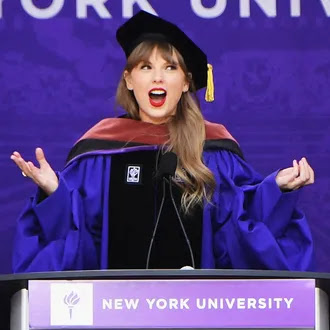
Being a fan of Taylor Swift, I recently watched her commencement speech for NYU's Class of 2022. Appropriate, of course, since she has a song called "22," and "Welcome to New York" for that matter. Not surprisingly, in Swiftian fashion, she embedded song titles and lyrics throughout her roughly 20-minute speech. 

She is obviously a talented and thoughtful person so of course the speech was very good. I particularly appreciated the through line of not being afraid of failure. She has a great perspective from which to offer such sage advice, having both ascended to the highest heights of success and been subject to near-constant scrutiny.

We tend to think of famous people in revisionist ways, as if Taylor Swift or Barack Obama or Warren Buffet or Diana Taurasi were destined for greatness from the moment they were born and simply had to walk a predestined path to actualize it. Of course, this is not true. Each success story will tell you they encountered hardship, opposition, defeat, and doubt along the way, that their path to success was often foggy, never guaranteed, and certainly ever winding. 

Furthermore, wrap your head around the thought that for each success story, there are countless others that perhaps could've attained to similar heights but didn't. Why do some succeed and others don't? God-given talent alone can only explain so much. Luck is a bigger factor than we'd like to admit given our longing for neat and tidy reasons. Of what we can control, what does it take?

I submit to you an important factor is a willingness to try. Anything worth pursuing in life is not easy and is certainly not mastered on the first go. Indeed, in the really precious things in life, you are likely to be quite terrible quite often. Which means that if you refuse to put yourself out there, you will end up leading a life that is far more constrained than it could be. What a loss for you and for the world that longs for your contribution!

Since I like her music, I'm glad Taylor Swift was willing to endure all of the lonely nights, rejections, and criticisms, and not only endure them but subsume them into her story. We may never be as famous as she, but we are equally presented with the opportunity to try or to hide, to work ourselves up over an actual or possible failure or alternatively to brush it off and live to do it again. How amazing would our world be if we were this fearless?

11.23.2022

Too Short for a Blog Post, Too Long for a Tweet 354


Here are a few excerpts from a book I recently read, "The Fountainhead," by Ayn Rand.


“Do you mean to tell me that you're thinking seriously of building that way, when and if you are an architect?”

“Yes.”

“My dear fellow, who will let you?”

“That’s not the point. The point is, who will stop me?”


 “I have, let’s say, sixty years to live. Most of that time will be spent working. I’ve chosen the work I want to do. If I find no joy in it, then I’m only condemning myself to sixty years of torture. And I can find the joy only if I do my work in the best way possible to me. But the best is a matter of standards—and I set my own standards. I inherit nothing. I stand at the end of no tradition. I may, perhaps, stand at the beginning of one.”


"I was afraid you’d turn him down. I’m not blaming you, Howard. Only he’s so rich. It could have helped you so much. And, after all, you’ve got to live.”

“Not that way,” said Roark.


“I like to receive money for my work. But I can pass that up this time. I like to have people know my work is done by me. But I can pass that up. I like to have tenants made happy by my work. But that doesn't matter too much. The only thing that matters, my goal, my reward, my beginning, my end is the work itself. My work done my way. Peter, there's nothing in the world that you can offer me, except this. Offer me this and you can have anything I've got to give. My work done my way. A private, personal, selfish, egotistical motivation. That's the only way I function. That's all I am.”

11.16.2022

Too Short for a Blog Post, Too Long for a Tweet 353


Here are a few excerpts from a book I recently read, "The Mothers and Daughters of the Bible Speak Lessons on Faith from Nine Biblical Families," by Shannon Bream.


What a paradox that Pharaoh’s plan was to subdue the Hebrew people by killing their sons, and it turns out a group of females thwarted his plan. Jochebed fought to save her son. Miriam boldly stepped up to protect him. Then Pharaoh’s own daughter took pity on him and spared his life!


How long had it been since Zechariah had prayed for a son? Was there a point when he assumed it was no longer even worth asking? Are there hopes and dreams you’ve abandoned, things you prayed over for years and then put on a shelf for good? We often cannot see how God is weaving together the threads of our lives until long after the tapestry is complete. He may present you with an answer you never imagined decades after your original request. I sometimes struggle mightily to bring about what I see as the perfect path forward, only to realize, when that season is in my rearview mirror, that the agenda I so desperately wanted to achieve was wildly inferior to God’s design. I also believe some of what wounds us most on this earth won’t make sense until we are in heaven, with an eternity to praise God for His infinite wisdom during the times we just couldn’t see past our own pain.


Mothers devote themselves to a future that will outlive them, and they do so in the footsteps of Mary, who also worked for a promised expectation. 

11.14.2022

Recommended Reads, 45th in a Quarterly Series


Books I've read lately that I would recommend:

How You Say It: Why We Judge Others by the Way They Talk—and the Costs of This Hidden Bias (Kinzler). A masterful unpacking of how we discriminate based on accent and what the consequence of this legally allowed bias has been.

The Brothers Karamazov (Dostoyevsky). High drama, intricately written.

1Q84 (Murakami). An immersive experience.

False Alarm: How Climate Change Panic Costs Us Trillions, Hurts the Poor, and Fails to Fix the Planet (Lomborg). A very contrarian view on climate change, at least among the circles I run in.

Don Quixote (Cervantes). Literally laugh out loud funny.

21 Lessons for the 21st Century (Harari). A futurist explores what's on the horizon.


11.09.2022

Chain Reaction


Last month a tweet went viral about the late Anthony Bourdain acknowledging that he was too harsh towards a review of Olive Garden, conceding that piling on the popular Italian restaurant chain was a form of snobbery he realized he didn’t want to engage in. Being somewhat of a coastal elite, I often swim in similar circles, where the impression of chains ranges anywhere from disdain to vehement anger.

To be sure, chains deserve some pushback. It’s better for a community when you spend your dollar at an independent place, where more of that dollar circulates locally and there may be a closer tie to food sources and other restaurant inputs. Some chains have a less than sterling record on the environment and worker rights. And beyond following the food and the money, chains for some represent a soulless, faceless corporatization that they cannot help but rage against.

Yet for most of this country, chains are beloved or at least functional. I know folks for whom Red Lobster is a special treat to be spoken of in hallowed words. Others who have dietary restrictions or finicky palates find the predictability of chains a godsend, the crapshoot of independent places a risk they cannot easily bear.

 At any rate, if you don’t want to support a chain, just don’t go. No need to rain on other people’s parade. Outside my office window is a two-story Cheesecake Factory, and while it is admittedly an imperfect sample, when I look out onto the dining area I see a diverse mix of people and they’re usually having a good time. Seems fine to me.

11.07.2022

Tell Me About Yourself


I’ve conducted countless interviews over the course of my professional life. Untold resumes screened, characteristics identified, questions prepared – over and over and over again. What a concept: deciding whether to meet someone based on one piece of paper, and deciding whether to hire someone based (in part) on one brief conversation. Talk about thin slices!

I used to frown upon people having a “Personal Interests” section. I want to know about education, experience, and volunteer opportunities, I contended, not what you do in your spare time. I wouldn’t ding folks for it, but nor would I bring it up.

But I’m coming around to how it helps me as an interviewer. Still not sure I’d recommend that people do this. But, if you do, that tells me something is so important that in an otherwise professional document you are eager to share something somewhat personal. And, given that the professional and personal are inseparable, I’m going to take the opportunity to probe on that.

My goal is not to make small talk; after all, I have an objective in the interview, as does the interviewee, and it’s not conversation for conversation’s sake. Rather, I’ll ask something like, “I notice you mention that X is a hobby of yours. Tell me a life lesson you’ve learned from that that would be applicable here.”

I’ve found this question to be invaluable in my interviewer arsenal. Think about what it unlocks in the interview. First, it shows how people process experiences in one setting to advantages in another. Second, it forces people to think about how something important in their life can be of help in our firm. Third, it often gets people revved up because they get to talk about something meaningful to them, and in doing so you get a window into what moves them and how they communicate it.

This applies not only to the hobbies people sometimes put on the bottom of their resume, under “Interests,” but also to non-traditional items in the rest of the resume. Someone who did a semester abroad in an unusual place or studied something unrelated to their major. Someone who, before racking up more traditional professional experience, was a professional athlete or artist. Someone who started a non-profit and did something amazing through it. These are the kinds of experiences that are invaluable in making for the kind of person I want to work with.

Not trying to denigrate the standard qualifications and signals that we look for when screening candidates. College still matters. Work experience is invaluable. What you study and what responsibilities you had at your previous jobs has direct relevance to my feeling comfortable that you can succeed with us. But the converse is not true. An econ major doing a year in Hawaii studying marine biology: that’s not an irrelevant experience. Neither is playing D1 football if you are applying for an entry-level marketing position. So long as I’m in the business of hiring people and not robots, this will always be the case.

11.02.2022

Do What You Dig


“Do what you love and you’ll never work a day in your life” is an oft-heard nugget of advice that I’ve always winced at. Too often it is solely the purview of the incredibly privileged and oftentimes clueless, the proverbial “born on third base” set who think they have a secret to success, but their own success is mostly not of their own making. Or it becomes a convenient out for folks to shirk the kinds of things that may not spark joy but are essential to being successful, building a career, or even at times just making a paycheck.

That said, the saying is not without its merit, so there’s no need to throw the whole thing out. Most of us will spend a plurality of our years and hours working, so figuring out what moves you and then figuring out how to do that in a job is paramount.  

Nowadays, many people have a very conflicted view of working for pay. So I realize that I may be making assumptions here that not everyone agrees with and in fact some people are quite upset over. I do subscribe to the notion that work is a matter of creating value for others, even though I know that exploitation of workers does exist. And I do subscribe to the notion that your reward for working is a combination of intrinsic and extrinsic compensations, one being your pay and the other being the things you get out of the work itself, even as I know that rampant inequity exists in what people make and how they are treated on the job.

All these injustices are things we must work to name and oppose. Is that necessarily inconsistent with a worldview that says that work can be a good, perhaps necessary, part of a fulfilling life? I’m not sure.

I do know that a lot of people ask me for career advice. And, I have two teens with whom I increasingly have conversations about the choices they will be making about where they go to school and what they study and ultimately what career path they want to work towards.

One colleague who I connected my daughter to gave some really good advice, which I’d like to repeat here, when asked how they got into law school (she is a law professor at a school Jada wants to go to for undergrad). This highly accomplished person said, “do what you dig.” The thought being that if you pick a major that interests you, and then after graduating from college you pick a job that interests you, then you will be interesting. And when you are interesting, you become a better candidate for law school. This advice was given in contrast to what people think law schools are going for, which are academic topics and extra-curricular activities that are just fine, but overdone in that a lot of people do them, so it’s harder for you to stand out. And, if you’re doing them because you’re supposed to and not because you enjoy them, then it doesn’t really grow you in any meaningful way that helps you stand out further.

“Do what you dig” can be extrapolated beyond getting into law school. Pursuing what you’re interested in and becoming an interesting person as a result is a good pathway to becoming a good consultant, which is the career I specifically recruit and screen for. And I would venture to say it’s pretty good life advice too.

It may still smack of privilege, which by definition means you have choices, and are able to opt into any number of things as opposed to having your life limited by life circumstances. But, wherever you are on the continuum of having opportunities before you, doing what you dig is pretty good advice. Would that more people actually do that.

Too Short for a Blog Post, Too Long for a Tweet 522

  Here are a few excerpts from a book I recently read, "Moby Dick," by Herman Melville. Again, I always go to sea as a sailor, bec...