3.28.2022

Too Short for a Blog Post, Too Long for a Tweet 323


Here are a few excerpts from a book I recently read, "10 Days That Unexpectedly Changed America," by Steven Gillon.


But the pattern of brutal repression established in New England became the model for how whites would treat natives across the country. The Pequot War set up the tragic irony of American history: a nation founded on the highest ideals of individual liberty and freedom was built on slaughter and destruction of epic proportions.


The balance of power in the nation was fundamentally altered as a result of the war. Before 1861, the slave states had achieved an extraordinary degree of power in the national government. In 1861 the United States had lived under the Constitution for 72 years. During 49 of those years, the country's president has been a southerner - and a slaveholder. After the Civil War, a century passed before another resident of the Deep South was elected president.


During the 1950's, California opened one school every week.


In 1946, about one of every eighteen thousand people owned a TV set. BY 1960, nine out of every ten American homes had a TV.

3.25.2022

The Case for Cities


Most of my family members and school friends live in the suburbs. None of them are necessarily anti-city or pro-suburb, they've just chosen the package that makes sense for them and I don't begrudge them that. But let me lay out an argument for why the future of cities is so important for all of us and not just those who happen to prefer them.

Let me start by simplifying things in saying that what I mean by cities is basically density. There's a lot that comes with being a city, and a lot of ways scholars can define them, but fundamentally let's strip it down to the premise that cities are where there is a dense concentration of people and stuff, and everywhere else is less dense in those things. Again, this is all descriptive, nothing prescriptive or judgey.

But let's unpack what you get what you cram a bunch of stuff together. And here is where I strongly believe that our shared destiny rests on whether cities will thrive going forward. Because they are our path forward for innovation, equity, and sustainability.

I've said often that the myth of the solo inventor toiling away in his lab is just that: a myth. We now know innovation happens incrementally, due to the collision of many planned and unplanned interactions, preferably with groups of people who come from diverse disciplines and perspectives. Well, I've just described a city, because what is a city if not a place where you can have many planned and unplanned interactions with groups of people from diverse disciplines and perspectives. Obviously, innovation can happen from one person out of nowhere. And, it can happen in less dense settings, where people do still get together and exchange ideas and riff and explore. But the most fertile ground for such action is cities. And whether we are racing to stay ahead of the next public health disaster, environmental crisis, or business cycle shift, a lot of the planting and germination and flourishing of those seeds will happen in cities. Or, alternatively, it won't, if we don't preserve the conditions for innovation. In which case we all lose out.

We also all lose out when cities cease to be places where diverse groups of people feel welcome to exist, exchange, and be their full selves. It has long been established that diversity isn't just a feel-good thing: it contributes to more successful businesses, more abundant artistic expression, and more just societies. And cities are where we are exposed, by choice and by proximity, to people who are different from us. In our neighborhoods, in our public gathering places, and on the streets, we rub elbows with all walks of life, and it reminds us that we are more alike and less scary than we might otherwise think. Other places, you can opt out of such inter-mingling; indeed, most non-urban places are officially organized to self-sort. So cities are where we can be in diverse settings, and pursue intentional acts of inclusion and equity in the process. But this does not happen on its own, but rather must be cultivated. For it can also be true that cities hollow out, or become just as segregated, or metastasize into places where warmth and open-mindedness are replaced by prejudice and exclusion. In which case we all lose out.

Lastly, if there were an existential crisis we face as a human race, it is our environment. And no matter how much we want to think that driving electric cars and protesting coal plants is our path to salvation, the fact of the matter is that continued human flourishing requires a dramatic rethink of how we live and move about. It's crazy to me that when most people think "green," they consider rolling hills rather than a dense urban grid, and yet the latter is vastly superior in carbon footprint and ecological sustainability. If we fail our cities and our cities fail us, leaving everyone to scatter to their corners to live and circulate in relative isolation, not only do we miss out on opportunities for innovation and equity, but we also put the final nail in our own coffin as residents of this planet Earth. In which case we all lose out.

So that's my case for cities. You don't have to live in them or even like them. But don't think that a pro-city agenda and pro-city investments have nothing to do with you. Rather, they hold the key to our collective future.

3.21.2022

Two Forms of Privilege


I’ve often said that it’s better to watch less news and read more books. There’s a leadership lesson in there about taking the long view, and a self-preservation element in that news is aggravating and books are denser with wisdom.

But there’s some privilege in this approach. If I can opt in or out of keeping tabs on current events, that means my life is buffered from the consequence of how something might play out. Geopolitics, elections, public health calamities are, for many, not stimulating topics for intellectual discourse but things that impinge upon very personal matters of wellness and safety. It behooves us, if we want to be empathetic people, to stay tuned, so that we can support those for whom “the news” is not some abstract social pursuit but of life-or-death consequence. Shame on us, conversely, if we are willfully oblivious, unaware of how protected we are even as we mingle with those far more vulnerable.

But there’s another form of privilege at play here as well. Having the time and emotional bandwidth to follow a news topic that isn’t of direct and immediate relevance to you is a nice thing to be able to do, but represents a luxury that others do not have, as their time and emotional bandwidth is consumed with other more immediately personal and pressing things. And so as we invariably go down the rabbit hole of news coverage begetting stress begetting the need to consume more news coverage, we are engaging in a leisure pursuit, while for others following it is no leisure pursuit, and for still others there is no leisure available to pursue it. Even worse, we act like the aggrieved victim in all this, when in fact all around us are people who are really hurting while we manufacture ourselves as the main character in a great drama in which we too are hurting.

I am guilty on both fronts almost all the time. “Check your privilege” is something that I have to do because I am privileged on so many levels. Here are two more that I have been increasingly mindful of.

3.18.2022

Too Short for a Blog Post, Too Long for a Tweet 322


Here are a few excerpts from a book I recently read, "On the Come Up," by Angie C. Thomas.


Nothing’s been the same since Nas told me the world was mine. Old as that album was back then, it was like waking up after being asleep my whole life. It was damn near spiritual. 

I fiend for that feeling. It’s the reason I rap.


Yeah, my mom and dad were those stereotypical teen parents. They were grown when I came along, but Trey made them grow up way before that. Granddaddy says my dad had two jobs at sixteen and still pursued rapping. He was determined that . . . 

Well, that we wouldn’t end up like this.


She keeps her head in the freezer as she stuffs another pack of frozen meat inside. “I got my EBT card in the mail today.” 

EBT? “You got food stamps? But you said we weren’t gonna—” 

“You can say a whole lot before things happen,” she says. “You never truly know what you will or won’t do until you’re going through it. We needed food. Welfare could help us get food.” 

“But I thought you said they don’t give college students food stamps unless they have a job.” 

“I withdrew from school.” She says it as casually as if I asked her about the weather. 

“You what?” I’m so loud, nosy Ms. Gladys next door probably heard me. “But you were so close to finishing! You can’t quit school for some food stamps!” 

Jay moves around me and gets a box of cereal from a bag. “I can quit to make sure you and your brother don’t starve.” 

This . . . 

This hurts. 

This physically f**king hurts. I feel it in my chest, I swear. It burns and aches all at once. “You shouldn’t have to do that.” 

She crosses over to me, but I watch the glimmer of sunlight that’s shining through the window and lighting up the tile on the floor. Granddaddy used to say, look for the bright spots. I know he didn’t mean literally, but that’s all I’ve got. 

“Hey, look at me,” Jay says. She takes my chin to make sure that I do. “I’m fine. This is temporary, okay?” 

“But becoming a social worker is your dream. You need a degree for that.” 

“You and your brother are my first dream. That other one can wait to make sure you two are okay. That’s what parents do sometimes.” 

“You shouldn’t have to,” I say. 

“But I want to.” 

That makes this harder. Having to is a responsibility. Wanting to is love.


There’s so much I wanna say but don’t know how to say. I mean, how do you tell your mom that you’re scared you’re losing her again? How selfish is it to say, “I need you to be okay so that I’ll be okay”? 

Jay cups my cheek. “I’m okay.” 

I swear, moms are equipped with mind-reading abilities.

3.14.2022

Recommended Reads, 43rd in a Quarterly Series


Books I've read lately that I would recommend:

The Curious Incident of the Dog in the Night-Time (Haddon). I need to read more books like this, which are fiction first-person narratives that take me into new perspectives.

Maybe You Should Talk to Someone: A Therapist, HER Therapist, and Our Lives Revealed (Gottlieb). So interesting to delve into the world of therapy, especially seeing both sides of the couch.

Four Hundred Souls: A Community History of African America, 1619–2019 (Kendi, Blain). Powerful idea for an anthology, and many of the contributions were deeply probing.

A Dutiful Boy: A memoir of secrets, lies and family love (Zaidi). Heart-rending at times to follow the challenges of growing up gay and Muslim.

Fifty Things That Aren't My Fault: Essays from the Grown-up Years (Guisewite). The cartoonist's amusing musings on being sandwiched between elderly parents and a teen daughter were hilarious.

Let Nobody Turn Us Around: An African American Anthology (Marable). So many good works in here.

Little Fires Everywhere (Ng). Absolutely exquisitely written.


3.11.2022

Too Short for a Blog Post, Too Long for a Tweet 321


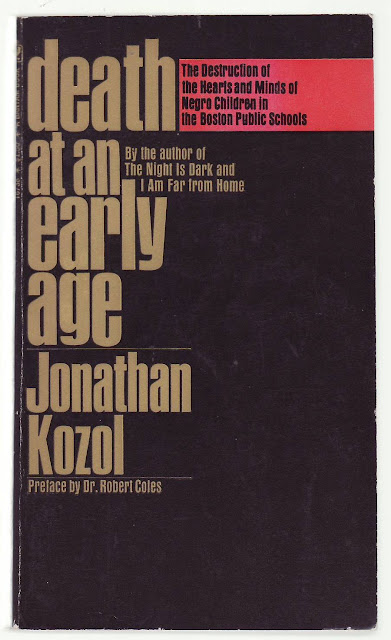
Here are a couple of excerpts from a book I recently read, "Death at an Early Age: The Destruction of the Hearts and Minds of Negro Children in the Boston Public Schools," by Jonathan Kozol.


All white people, I think, are implicated in these things so long as we participate in America in a normal way and attempt to go on leading normal lives while any one race is being cheated and tormented. But I now believe that we will probably go on leading our normal lives, and will go on participating in our nation in a normal way, unless there comes a time where Negroes can compel us by methods of extraordinary pressure to interrupt our pleasure.


On a number of other occasions, the situation is repeated. The children are offered something new and lively. They respond to it energetically and their attention doesn’t waver. For the first time in a long while, perhaps, there is actually some real excitement and some growing and some thinking going on within that room. In each case, however, you are advised sooner or later that you are making a mistake. Your mistake, in fact, is to have impinged upon the standardized condescension upon which the entire administration of the school is based. To hand Paul Klee’s pictures to the children of a ghetto classroom, particularly in a twenty-dollar volume, constitutes a threat to the school system. The threat is handled by a continual underrating of the children. In this way many students are unjustifiably held back from a great many experiences that they might come to value, and are pinned down instead to books the teacher knows, and tastes that she can handle easily.

3.07.2022

We Can Go Either Way


I bristle when people I know from other parts of the country ask me if I feel safe in Philadelphia. When grisly criminal activity makes the national news, it creates a skewed perception of the day-to-day in our fair town. While I respect the concern, I need to squelch the assumption that is borne of an anti-urban bias or something even worse. I have to remember that people have different preferences, and the things I like vs. the things that don't bother me as much mean that I am going to like and be more comfortable in an urban setting than many of my friends and family members.

But that does not mean that my tie to my adopted city is sacrosanct. I owe this great city so much, have given and gained so much, and ride hard for the place in every facet of my life. But it doesn't mean I'm not still a consumer who has choices, and is more than willing to choose differently for myself and for my family. 

I recognize that my privileged state does not apply to many. But that is the point about cities in this present pregnant moment. Many people do have choices, and places need to be destinations of choice in order to thrive. Because once people leave it becomes a slippery slope to more depopulation. We can go either way right now in Philadelphia, as with many other cities on the razor's edge of booming economic opportunity and equitable participation in it on the one hand, and a return to the death spiral of the 70's and 80's and early 90's on the other hand.

Nuisance crimes and more severe ones hit a little bit close to home, and all of a sudden families with choices start to exercise those choices. A two-year-long pandemic has robbed our downtown of the steady flow of commuters whose aggregate numbers make possible mass transit, a vibrant set of retail and restaurant choices, and the sense of safety and vitality that come when city streets are full of people. I still predict and hope for recovery, but I am sobered at the possibility - which is right in front of my face at times as I walk about - of blight and abandonment and decline.

We can go either way. I could be excited or I could be devastated. So I'm rolling up my sleeves. But I'm also worried.

3.03.2022

Too Short for a Blog Post, Too Long for a Tweet 320


Here are a few excerpts from a book I recently read, "The Hate U Give," by Angie C. Thomas.


Spring in Garden Heights doesn’t always bring love, but it promises babies in the winter. I wouldn’t be surprised if a lot of them are conceived the night of Big D’s party. He always has it on the Friday of spring break because you need Saturday to recover and Sunday to repent.


I’ve seen it happen over and over again: a black person gets killed just for being black, and all hell breaks loose. I’ve tweeted RIP hashtags, reblogged pictures on Tumblr, and signed every petition out there. I always said that if I saw it happen to somebody, I would have the loudest voice, making sure the world knew what went down. Now I am that person, and I’m too afraid to speak.


Sometimes you can do everything right and things will still go wrong. The key is to never stop doing right.


A lump forms in my throat as the truth hits me. Hard. 

“That’s why people are speaking out, huh? Because it won’t change if we don’t say something.” 

“Exactly. We can’t be silent.” 

“So I can’t be silent.” 

Daddy stills. He looks at me. I see the fight in his eyes. I matter more to him than a movement. I’m his baby, and I’ll always be his baby, and if being silent means I’m safe, he’s all for it. 

This is bigger than me and Khalil though. This is about Us, with a capital U; everybody who looks like us, feels like us, and is experiencing this pain with us despite not knowing me or Khalil. My silence isn’t helping Us. 

Daddy fixes his gaze on the road again. He nods. “Yeah. Can’t be silent.”

Too Short for a Blog Post, Too Long for a Tweet 522

  Here are a few excerpts from a book I recently read, "Moby Dick," by Herman Melville. Again, I always go to sea as a sailor, bec...