First, I'll say that most of this still holds up three years later. I do do a lot more "too long for a tweet, too short for a blog" posts because I'm lazier and busier. And a few more hashtags have entered into the "Musings" lexicon, like #SorryNotSorry, #DaddyAcademy, and (replacement for #FitBitOrgasm) #EveryLittleStepITake.
73-91 born SEA lived SJC 00 married (Amy) home (UCity) 05 Jada (PRC) 07 Aaron (ROC) 15 Asher (OKC) | 91-95 BS Wharton (Acctg Mgmt) 04-06 MPA Fels (EconDev PubFnc) 12-19 Prof GAFL517 (Fels) | 95-05 EVP Enterprise Ctr 06-12 Dir Econsult Corp 13- Principal Econsult Solns 18-21 Phila Schl Board 19- Owner Lee A Huang Rentals LLC | Bds/Adv: Asian Chamber, Penn Weitzman, PIDC, UPA, YMCA | Mmbr: Brit Amer Proj, James Brister Society
11.29.2018
Social Media Diet
First, I'll say that most of this still holds up three years later. I do do a lot more "too long for a tweet, too short for a blog" posts because I'm lazier and busier. And a few more hashtags have entered into the "Musings" lexicon, like #SorryNotSorry, #DaddyAcademy, and (replacement for #FitBitOrgasm) #EveryLittleStepITake.
11.28.2018
Letters About Congress
I'm due for my annual letters to Congress and find myself woefully unable to draft such a piece. It's obviously not for lack of issues or motivation. I must fess up that it's mostly because I've been too busy to follow close enough to know what to say. Although surely preparedness is not a prerequisite for engaging with your elected officials on a regular basis on whatever you want.I do have to say, which is the motivation behind today's post, that some of it is an uncertainty about the role of Congress in our modern tripartite system of government. It is my understanding that our Founding Fathers, even in ensuring our hallowed sense of checks and balances, imbued particular authority in our legislative branch. They were after all deeply distrustful of power concentrations, and so rather than an all-powerful singular executive or a judiciary group with lifetime appointments, they figured our best bet at governance lay in a popularly elected legislative body.
11.26.2018
Lazy Linking, 210th in an Occasional Series
Stuff I liked lately on the Internets:210.1 The history of North America was paved, literally, by beavers bit.ly/2znanX1 @wired
210.2 We spend way more on lotteries than I would've guessed (~$600/yr per playing person) wapo.st/2DKdLP3 @washingtonpost
210.3 File under "automation kills AND creates jobs" - food-serving robots controlled by the severely disabled bit.ly/2PTjfxV @spoontamago210.4 Artificial intelligence is alien intelligence, in that it'll think of solutions we never thought to think of bit.ly/2Alel2a @margrev
210.5 Let graduates celebrate however they want to! bit.ly/2DUjz9x @chronicle
11.22.2018
Giving Thanks
Thanksgiving can be about a lot of things - turkey, football, and four-day weekends come to mind - but of course at its core it is about giving thanks. Which is such a simple sentiment, and yet it is appropriate that we have an actual holiday to remind us since we often fail to do even this.Giving thanks can also be quite a complex thing to do well. Who exactly are we giving thanks to? How ought we feel about things that we are grateful for that are as a result of an unjust system that leaves many around us without access to those same things? How can we convert gratitude into action without doing so in ways that lead to burnout and bitterness?
Giving thanks should never not compel us to dig deeper and strive to do more. But it is also more than acceptable to simply give thanks as an end unto itself. Today's a good day to do both. Happy Thanksgiving!
11.19.2018
What Am I Working On
As has become my custom every three months, here's what I'm
working on now at work. I won't repeat
anything from last time that I happen to still be working on, and for
confidentiality's sake I have to blur some of the details for some of these
studies).Economic and social impact study for a STEM-focused university.
Demonstrating the significant return in jobs created and innovation spawned by a public private effort to repurpose vacant land into a medical research district.
Quantifying the jobs created and tax revenues generated by a city’s community development corporations.
Order of magnitude estimate of funds generated by tax increment financing to support investment in recreational amenity.
Articulating the positive economic ramifications of a citywide green stormwater infrastructure program.
Making the business case for investment in an affluent suburban jurisdiction’s downtown retail district.
11.16.2018
Too Short for a Blog Post, Too Long for a Tweet 157
Here are two excerpts from a book I recently read, "The Ascent of Money: A Financial History of the World," by Niall Ferguson.
Money is not metal. It is trust inscribed.
What
went wrong in China between the 1700s and the 1970s? One argument is
that China missed out on two major macroeconomic strokes of good luck
that were indispensable to the North-West’s eighteenth-century take-off.
The first was the conquest of the Americas and particularly the
conversion of the islands of the Caribbean into sugar-producing
colonies, ‘ghost acres’ which relieved the pressure on a European
agricultural system that might otherwise have suffered from
Chinese-style diminishing returns. The second was the proximity of
coalfields to locations otherwise well suited for industrial
development. Besides cheaper calories, cheaper wood and cheaper wool and
cotton, imperial expansion brought other unintended economic benefits,
too. It encouraged the development of militarily useful technologies -
clocks, guns, lenses and navigational instruments - that turned out to
have big spin-offs for the development of industrial machinery. Many
other explanations have, needless to say, been offered for the great
East-West divergence: differences in topography, resource endowments,
culture, attitudes towards science and technology, even differences in
human evolution. Yet there remains a credible hypothesis that China’s
problems were as much financial as they were resource-based. For one
thing, the unitary character of the Empire precluded that fiscal
competition which proved such a driver of financial innovation in
Renaissance Europe and subsequently. For another, the ease with which
the Empire could finance its deficits by printing money discouraged the
emergence of European-style capital markets. Coinage, too, was more
readily available than in Europe because of China’s trade surplus with
the West. In short, the Middle Kingdom had far fewer incentives to
develop commercial bills, bonds and equities. When modern financial
institutions finally came to China in the late nineteenth century, they
came as part of the package of Western imperialism and, as we shall see,
were always vulnerable to patriotic backlashes against foreign
influence.
11.15.2018
Too Short for a Blog Post, Too Long for a Tweet 156
Here are some excerpts from a book I recently read, "Bobby Kennedy: A Raging Spirit," by Chris Matthews.
But the news of Kennedy’s decision to run struck many
antiwar activists as both threat and insult to those already in the
fight. I had this reaction myself. Despite having spoken out boldly
against Johnson’s war, Bobby Kennedy had for months refused to match
Gene McCarthy’s courage by committing himself as a candidate. That’s the
way I saw it as a grad student in economics at the University of North
Carolina at Chapel Hill. For me, along with others of my generation
facing the draft, Gene McCarthy had become a hero.
Let
me put this feeling of ours in the simplest, most human terms. McCarthy
galvanized us and claimed our loyalty by being the lone grown-up with
the courage to assert that the Vietnam War was ill-conceived and that
he, Gene McCarthy, meant to stop it. In this escalating conflict between
sons and fathers—Gene, a guy of my own dad’s era, was on our side. He
told us we were right, and not just selfishly opposing a war because we
were personally afraid to fight in it. We understood the patriotic call
to duty our dads and uncles had answered in World War II, but Vietnam
was different. They wouldn’t admit it. McCarthy had.
11.13.2018
Too Short for a Blog Post, Too Long for a Tweet 155
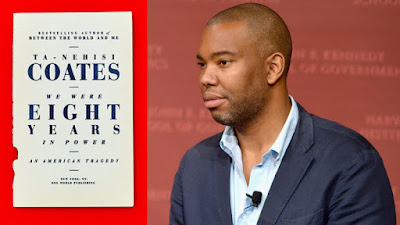
Here are a few excerpts from a book I recently read, "We Were Eight Years in Power: An American Tragedy," by Ta-Nehisi Coates:
Toward the end of the Civil War, having witnessed the
effectiveness of the Union’s “colored troops,” a flailing Confederacy
began considering an attempt to recruit blacks into its army. But in the
nineteenth century, the idea of the soldier was heavily entwined with
the notion of masculinity and citizenship. How could an army constituted
to defend slavery, with all of its assumptions about black inferiority,
turn around and declare that blacks were worthy of being invited into
Confederate ranks? As it happened, they could not. “The day you make a
soldier of them is the beginning of the end of our revolution,” observed
Georgia politician Howell Cobb. “And if slaves seem good soldiers, then
our whole theory of slavery is wrong.” There could be no win for white
supremacy here. If blacks proved to be the cowards that “the whole
theory of slavery” painted them as, the battle would literally be lost.
But much worse, should they fight effectively—and prove themselves
capable of “good Negro government”—then the larger war could never be
won.
The central thread of
this book is eight articles written during the eight years of the first
black presidency—a period of Good Negro Government. Obama was elected
amid widespread panic and, in his eight years, emerged as a caretaker
and measured architect. He established the framework of a national
healthcare system from a conservative model. He prevented an economic
collapse and neglected to prosecute those largely responsible for that
collapse. He ended state-sanctioned torture but continued the
generational war in the Middle East. His family—the charming and
beautiful wife, the lovely daughters, the dogs—seemed pulled from the
Brooks Brothers catalogue. He was not a revolutionary. He steered clear
of major scandal, corruption, and bribery. He was deliberate to a fault,
saw himself as the keeper of his country’s sacred legacy, and if he was
bothered by his country’s sins, he ultimately believed it to be a force
for good in the world. In short, Obama, his family, and his
administration were a walking advertisement for the ease with which
black people could be fully integrated into the unthreatening mainstream
of American culture, politics, and myth.
And that was always the problem.
One
strain of African American thought holds that it is a violent black
recklessness—the black gangster, the black rioter—that strikes the
ultimate terror in white America. Perhaps it does, in the most
individual sense. But in the collective sense, what this country really
fears is black respectability, Good Negro Government. It applauds, even
celebrates, Good Negro Government in the unthreatening abstract—The
Cosby Show, for instance. But when it becomes clear that Good Negro
Government might, in any way, empower actual Negroes over actual whites,
then the fear sets in, the affirmative-action charges begin, and
birtherism emerges. And this is because, at its core, those American
myths have never been colorless. They cannot be extricated from the
“whole theory of slavery,” which holds that an entire class of people
carry peonage in their blood. That peon class provided the foundation on
which all those myths and conceptions were built. And as much as we can
theoretically imagine a seamless black integration into the American
myth, the white part of this country remembers the myth as it was
conceived.
I think the
old fear of Good Negro Government has much explanatory power for what
might seem a shocking turn—the election of Donald Trump. It has been
said that the first black presidency was mostly “symbolic,” a dismissal
that deeply underestimates the power of symbols. Symbols don’t just
represent reality but can become tools to change it. The symbolic power
of Barack Obama’s presidency—that whiteness was no longer strong enough
to prevent peons from taking up residence in the castle—assaulted the
most deeply rooted notions of white supremacy and instilled fear in its
adherents and beneficiaries. And it was that fear that gave the symbols
Donald Trump deployed—the symbols of racism—enough potency to make him
president, and thus put him in position to injure the world.
There
is a basic assumption in this country, one black people are not immune
to, which holds that if blacks comport themselves in a way that accords
with middle-class values, if they are polite, educated, and virtuous,
then all the fruits of America will be open to them. In its most vulgar
form, this theory of personal Good Negro Government denies the existence
of racism and white supremacy as meaningful forces in American life. In
its more nuanced and reputable form, the theory pitches itself as an
equal complement to anti-racism. But the argument made in much of this
book is that Good Negro Government—personal and political—often augments
the very white supremacy it seeks to combat.
11.08.2018
Too Short for a Blog Post, Too Long for a Tweet 154
Here are a few excerpts from a book I recently read, "Scalia Speaks: Reflections on Law, Faith, and Life Well Lived," by Antonin Scalia.
One’s
work is not to be taken lightly. Not only because it is a necessary
means of putting bread on the table, but because it is perhaps the
single most influential factor (apart from your own free will) in
determining what kind of people you will be. There is a profound
spiritual connection between a human being and his or her work. What we
do for a living is at once and the same time an expression of our
identity, and a formation of it. It is less true that we are what we eat
than that we are what we do to eat.
11.06.2018
Too Short for a Blog Post, Too Long for a Tweet 153
Here is an excerpt from a book I recently read, "The Storm Before the Storm: The Beginning of the End of the Roman Republic," by Mike Duncan.But though there were no formal parties, it is true that there were now two broadly opposing worldviews floating in the political ether waiting to be tapped as needed. As the crisis over the Lex Agraria revealed, it was no longer a specific issue that mattered so much as the urgent necessity to triumph over rivals. Reflecting on the recurrent civil wars of the Late Republic, Sallust said, “It is this spirit which has commonly ruined great nations, when one party desires to triumph over another by any and every means and to avenge itself on the vanquished with excessive cruelty.” Accepting defeat was no longer an option.
11.05.2018
Lazy Linking, 209th in an Occasional Series
Stuff I liked lately on the Internets:209.1 B/c of a lack of faculty diversity, students of color are far less likely to seek out professors to mentor them bit.ly/2Q16Wvr @chronicle
209.2 Tech firms have claimed data on workforce diversity is "proprietary"; as w/banking sector, is it time for federal regulation to force disclosure as a public good? bit.ly/2CRd6dZ @ssrn
209.3 @AshleeEats wonders if Amazon Go is the future of retail shopping without fear of implicit bias cnet.co/2QbjZLf @cnet
209.4 Witness in Harvard lawsuit astutely differentiates btwn "Harvard is discriminating against Asians" and "affirmative action is a bad idea" bit.ly/2Q6TQwZ @chronicle
209.5 Death of Maryland football player is just one tragic symptom of a very sick culture, for which univ president is losing his job bit.ly/2Prd6bt @chronicle
11.02.2018
Too Short for a Blog Post, Too Long for a Tweet 152
Here's an excerpt from an article I recently read, "Faith Is the Diversity Issue Ignored by Colleges. Here’s Why That Needs to Change," in the Chronicle for Higher Education.
It is important to know, for example, that religion is the dimension of diversity that our Founding Fathers came closest to getting right. Those straight white male slaveholders somehow managed to create a constitutional system that protects freedom of religion, bars the federal government from establishing a single church, prevents religious tests for those running for public office, and offers more than a few poetic lines about the importance of building a religiously diverse democracy. This history is especially relevant at a time when exclusionary talk regarding Muslims emanates from the highest office in the land. It helps students ask and answer the question, "What are America’s ideals with respect to religious minorities?"
Subscribe to:
Comments (Atom)
Too Short for a Blog Post, Too Long for a Tweet 522
Here are a few excerpts from a book I recently read, "Moby Dick," by Herman Melville. Again, I always go to sea as a sailor, bec...
-
PHILADELPHIA NAMED BEST CITY FOR NEW GRADS How about Philly besting Boston, New York, Chicago, Atlanta, and every other city in America for ...
-
I recently had a humorous but telling incident on my bus ride into work. It being rush hour, the vehicle is often crowded and even standin...