6.30.2018

Tomorrow is the First Day of School Board

Today is the last day of existence for the School Reform Commission, which was created 17 years ago by the Commonwealth of Pennsylvania to oversee the School District of Philadelphia and to try to get it back on solid operational and financial footing.  Tomorrow, a nine-person locally appointed board, the Philadelphia Board of Education, takes over the role of overseeing the School District, an enterprise that serves 203,000 children and has a $3.2 billion budget.

I am one of those nine lucky people to serve on the School Board.  It is the public service opportunity of a lifetime, and my fellow board members and I are up for the moment even if we are sobered by the magnitude of the challenge ahead of us.

One thing that has buoyed us up as we have prepared to govern, in addition to the tireless efforts of so many people who walked us through hours and hours of orientation, is the enthusiastic engagement of people and organizations throughout the city of Philadelphia.  Parents, neighbors, teachers, principals, community advocates, spiritual heads, corporate execs, and non-profit leaders alike have taken the time to speak to us, educate us, encourage us, and yell at us.  We receive it all in the spirit that it has been offered, which is that the School District and each child and each neighborhood matters and is worth fighting for and giving our all to.

By the grace of God, and with some first-day jitters dancing in my stomach, I step into this role.  Wish me well!

PS Here's more info on us if you are interested:

About the School Board

Summary of things we learned from our listening sessions earlier this year

Agenda for first meeting on July 9

List of resolutions we will be acting on at our first meeting

6.27.2018

When Generous Grace is Greater Than Outraged Protest


We are living in contentious times, so I want to be careful not to stoke fires even further.  But I do want to lean into a sentiment I have been feeling lately in the midst of so much rancor, which is that sometimes generous grace is greater than outraged protest. 

To be sure, there are seasons for outrage and protest, and we are surely living in the midst of one.  Disengagement and rebuke are necessary tools we needn’t shy away from using when appropriate, and I don’t begrudge anyone from considering current events worthy of their full use.  I get there are people and decisions and opinions that are so abhorrent that they don’t deserve to be engaged with nor do they warrant anything but stinging rebuke.  However, I wonder if, if the goal is to change people’s minds, change policy, and ultimately change the world, we might consider using generous grace instead of outraged protest. 

Take, for example, the recent kerfuffle over White House Press Secretary Sarah Huckabee Sanders reporting that she was asked to leave a Virginia restaurant by the restaurant’s proprietor.  Responses to this incident fell along expected lines, with some crying foul while others defended the proprietor’s right to refuse service, found irony in the outrage over not feeling welcome, and used the opportunity to heap even further scorn upon Ms. Sanders for her own behavior and for the behavior of the person she is speaking for. 

I contend that everyone who has participated in this incident and ensuing discussion is well within their rights to act and express as they have.  What a country we live in, that we can freely do so.  However, just because you have the right to do something doesn’t mean it’s the best thing to do, if what you want is to change minds, change policy, and change the world.

What if, instead of showing Ms. Sanders the door, the proprietor said something to the effect of: “Ms. Sanders, I vehemently disagree with the position of the administration of which you are the spokesperson.  And I do so because I am in the service business, and in my line of work hospitality is everything, and I think this administration has demonstrated the opposite of that in its cruel and narrow-minded policies.  So to show you the power of a welcoming spirit, I am rolling out the red carpet for you.  I have instructed everyone on my staff to pull out all the stops to give you a wonderful meal and an unforgettable evening.  Please enjoy with our compliments.”

I can hear you rolling your eyes.  “You are so naïve.”  “This won’t work.”  And, of course: “She doesn’t deserve it.” 

Ah, but that is what generous grace is, is unmerited favor to the undeserved in over-abundance.  You may think Sarah Huckabee Sanders (or the Republicans or Donald Trump) don’t deserve to be treated so nice, or even that they don’t deserve anything but disengagement and rebuke.  And you might be right.  But that doesn’t mean that that is the best way to effect change.  Outraged protest can be powerful.  But generous grace can be even more powerful.

It calls to mind a story in the Bible (2 Kings 6:8-23 if you want to look it up), in which Elisha’s servant wakes up one morning to an invading army that has assembled against Elisha.  The servant fears for his life, but Elisha calmly reminds the servant that those who are with them are greater than those who are against them.  Then Elisha prays for God to open his servant’s eyes, and lo and behold an even greater army appears to surround their attackers.  The marauding enemies are struck with blindness, and the servant asks Elisha if he should kill them.  But Elisha says to prepare a feast for them and send them on their way. 

The attackers were out for Elisha’s head.  Did they deserve to be spared, let alone fed a feast?  Not at all.  But that is generous grace in action.  And it has the effect Elisha intended; the story ends by saying that those invaders never entered the land again.

Of course, central to the Christian faith is that none of us are worthy of God’s love, but that through the sacrificial death and subsequent resurrection of Jesus His Son we who deserved condemnation now live in God’s favor.  Because He knew the power of generous grace, Jesus could accept the scorn and abuse heaped upon Him, knowing He didn’t deserve it but needed to endure it in order to fulfill a grand purpose for humanity.

Generous grace is hard.  I won’t speak for others, but I am not naturally generous or gracious.  Why, just this week, Amy and I had an impromptu lunch during the work day.  I ordered a very large burrito, which I couldn’t come close to finishing, so I wrapped it up and asked her to bring it home.  But she was planning on walking a considerable distance to get home, and didn’t want to lug this heavy burrito all the way home, so she half-jokingly but half-seriously said she’d give it to the first needy person who asked for food along the way.  I said that would be fine, but in my mind I was thinking to myself, “But I have a long work day ahead of me, and I want to be able to go home and finish my burrito!”  In my heart, it wasn’t about not having enough resources to give away the burrito and get another one for myself, it was about who deserved to get to eat it.  I realized then how hard it was for me to let go of a stupid half-eaten burrito.  I am not naturally generous or gracious. 

But, with God’s help, we all can practice generous grace.  And, if I may mix metaphors, generous grace can move mountains.  It can get marauding armies to stop invading your land.  It can secure a salvation story for humanity.  And it might even get a president and his team to change their tune on immigration policy.  Maybe your heart is softer than mine in terms of being able to share half-eaten burritos.  But maybe you are having trouble extending grace to people you disagree with politically or find morally repugnant.  They may deserve your harshest words and more.  But maybe what will change them, and the world, is generous grace instead.

PS Let me append one more sentiment to this already too long post, which is to revisit the time Vice President Pence attended a performance of "Hamilton" and the actors took the opportunity to publicly appeal to the Vice President and to disagree with the Trump Administration's policies.  Some thought this an inappropriate interruption to what should've been a night out for the Vice President and others in attendance.  But art is inherently expressive, and sometimes that expression takes political voice.  Indeed, throughout history it is often the artists - the musicians, the poets, the movie directors - who are on the front lines of political discourse and policy change.  I hope my recollection of that night at "Hamilton" is not faulty, in that I remember the passion of the actors and the respectful acknowledgement of Vice President Pence.  This is what is great about our country, not that we always agree (because we don't) and not even that when we disagree that we do so cordially (because sometimes it is warranted to be "rude"), but that we uphold most of all the freedom to express ourselves, to hear and be heard.  When that breaks down, and we can't even eat in the same restaurants together, somebody has to break through with generous grace in order to make a way forward.

6.25.2018

Lazy Linking, 204th in an Occasional Series

Things I liked lately on the Internets:

204.1 Kids from around the world w/their toys bit.ly/2JZEJGL @thisiscolossal

204.2 Turns out the "marshmallow test" proves nothing about future success, just past affluence theatln.tc/2kFlEdM @theatlantic

204.3 Sounds obvious but still helpful to parse out and prove statistically: education is the best way to raise intelligence bit.ly/2tsUQ4f @psychscience

204.4 Separating kids from their families is abhorrent yes, but if you want to understand the border issue better this is a useful articulation of the logic behind it bit.ly/2lmLHXe @nro

204.5 Separating kids from their families is abhorrent yes; it has also been happening throughout the history of this country bit.ly/2IhBmVE @theintercept


6.21.2018

Too Short for a Blog Post, Too Long for a Tweet 133

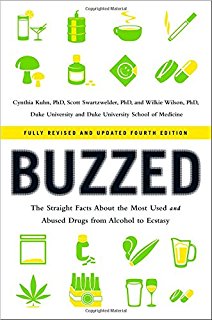
Here are some excerpts from a book I recently read, "Buzzed: The Straight Facts about the Most Used and Abused Drugs from Alcohol to Ecstasy," by Cynthia Kuhn.


As scientists, we have devoted years to the study of the effects of drugs on the brain and behavior. We have seen the stunning advances in understanding the actions of the chemicals that have been with us for thousands of years. Yet surprisingly, little of this information is effectively translated for the public. We have become convinced that contemporary efforts to educate people about the effects of alcohol and other drugs are inadequate and misdirected. There is a lot of important information in the scientific literature about addiction and the effects of drugs, but it is not reaching the people who need to know it. The actions of drugs on the brain are complicated and vary tremendously from drug to drug and person to person, making it impossible to make blanket statements like “drugs kill” and have them believed by anyone who has any drug experience.


The marijuana controversy is an excellent example. Some organizations have taken a hard line that this drug is devastating to anyone who uses it. Other organizations view it as harmless and support its legalization for totally unregulated consumption. In our opinion, the truth is somewhere in between. As you will read in the marijuana chapter, marijuana causes memory problems and interacts with the immune system in unknown ways. It has effects many hours after it enters the body, even if the user is unaware of those effects. So it is not harmless. But people do not die from marijuana overdoses (as they do from overdoses of alcohol). Any truthful discussion of marijuana must include a range of topics and a realistic representation of risk, which cannot be accomplished by exchanging slogans.


By the 1600s, trade merchants had introduced coffee to Europe, and “coffeehouses” spread rapidly. One of the hallmarks of these establishments was intellectual conversation. Not all of this conversation was viewed as politically correct, however, and coffeehouses were outlawed in England. That ban was very brief, and the growth of coffeehouses and the use of coffee spread even more rapidly thereafter. In fact, coffeehouses came to be known as places where one could go to learn from notable academic and political figures of the day. The environment created in coffeehouses turned out to be one that gave rise to creative thinking in the entrepreneurial and business realms as well. As an example, the giant insurance firm Lloyd’s of London actually began as a coffeehouse in the early 1700s.


How can we tell if we are releasing endorphins? First, we could give a drug like naloxone (Narcan) and see if the endorphin high stopped. This approach has actually been tested on people listening to their favorite music, who found that they didn’t enjoy the music as much if they were treated with an opiate antagonist.


Many addiction researchers think that once people are established addicts, the desire to avoid withdrawal maintains addiction more than the pleasurable effects of the drug. Obviously, when people first get addicted, they haven’t been taking the drug long enough to go through intense withdrawal if they stop. However, after several months or years, the withdrawal is stronger and may contribute more to an addict’s continued drug taking. If you know taking the drug will solve the problem, it seems an easy solution, doesn’t it? In the end, it is a combination of changes in the brain that create the overwhelming compulsion to keep using narcotics (or any other highly addictive drug). Researchers think that the craving for a drug may result from chemical changes in two parts of the brain that unfortunately combine their efforts: the parts of the brain that seek reward are chemically changed to respond strongly to drug cues, and the parts of the brain that create anxiety and bad feelings start firing as soon as the drug wears off.


Why isn’t there still cocaine in Coca-Cola? The tale is familiar in today’s environment of public activism about product safety. During the early 1900s, unregulated sales of “tonics” containing potent ingredients such as opium and cocaine boomed. Some of these formulations contained so much cocaine (hundreds of milligrams per milliliter instead of the 0.5 milligrams per milliliter in the original Parke-Davis formula) that toxicities became widespread. The medical establishment finally took note. Unfortunately, a scare campaign with racist overtones also contributed to the public furor. Reports that cocaine made African Americans powerful and uncontrollable contributed to the wave of negative publicity. In 1906, the Pure Food and Drug Act required that manufacturers list the ingredients on all tonics, and in 1914, the Harrison Narcotic Act imposed severe restrictions upon the distribution of opium and cocaine products. Today, Coca-Cola contains only caffeine, and clinical cocaine use is restricted to a few surgical procedures.

6.19.2018

Doing Good or Looking Good

I have made this point before in this space but wanted to elaborate further today.  I often wonder (about others AND myself) if we truly want to do good in the world, or if our primary objective is to be seen by others as doing good independent of whether what we are doing is actually effecting real change.  It is only natural, as social creatures, to want people to see what we care about and to see that we care about it.  After all, it's what mobilizes more helpers and provides us with the encouragement and support we need to keep doing what we're doing.  But when are we guilty of taking our eyes off the prize and engaging in do-gooding simply to attract positive attention and feel good about ourselves?  Let me offer a few things that we can do to make sure that what we truly care about is not positive strokes for ourselves but positive change in the world.

1. Do something good when you know no one will see and you won't tell anyone.  To be sure, as noted above, there is something good about doing good out in public, where you can mobilize others and you yourself can be encouraged.  But every once in a while, do something good and keep it to yourself.  Examine how you feel.  Satisfied?  Affirmed?  Or empty?  If the latter, maybe too many of your eggs are in the basket of "I need people to see how righteous I am," and not enough are in the basket of "this matters to me no matter if I don't get any glory."

2. Learn from, listen to, and love others who are on the other side of an argument.  There is no shortage of easy punching bags that, depending on what circles we run in, we can score major brownie points by resisting, opposing, and vilifying them.  And, to be sure, sometimes doing good means calling out the other side for inhumanity or ignorance or idiocy.  But sometimes, personal attacks are a lazy and mean-spirited way of making ourselves feel good rather than actually contributing to doing good.  Again, sometimes engagement is not the right answer.  For example, I respect the many reasons offered by athletes who choose not to accept a visit to the White House.  But sometimes, opting out of interacting with those you oppose is the easy way out, borne of an expediency that seeks out pats on the back rather than doing the hard work of understanding an issue and its players better.

3. Play the long game.  Any real change is going to take time, maybe even longer than our lifetimes.  It takes humility to realize that people far greater than we are have spent themselves for many years and decades to make just a tiny dent in things, so we should not lose heart but nor should we expect immediate results.  It also takes focus, because we can't be spread thin and we can't sprint for a few months and expect real change to happen.  Which means we have to learn to extend grace to ourselves and others, to have seasons for self-care and to even stay on the sidelines and trust others to labor while we focus on the issues closest to our hearts.  Sound obvious, but how often have we burned with righteous anger when others don't care about our issues enough to act?  Ah, but they have their issues that they are saving their attention for, and we should let them.

4. Engage head and heart.  In some circles, all of the heat is through emotion.  In those places, learn to use your head.  In other circles, everything is an intellectual discussion.  In those places, show some emotion.  Again, sounds obvious, and yet oftentimes what happens is that we learn what gets us cheap applause and we play to the crowd rather than doing what is needed to make change.  Whether it is a reasoned argument or an impassioned screed, whatever is not celebrated but is needed, consider doing it.

In our socially media wired world, much our lives is lived in a highly curated way.  What an incredible opportunity to mobilize action and to give and receive support.  But also what an incredible temptation to focus on being seen doing good rather than, you know, just doing good.  Shout out to those faithful laborers who do their work outside of the limelight, who are respectful of those who oppose them, who play the long game, and who engage head and heart.

6.15.2018

Too Short for a Blog Post, Too Long for a Tweet 132


Here's an excerpt from a book I recently read, "Coming Apart: The State of White America, 1960-2010," by Charles Murray:

The secularization of Europe is yet another symptom. Europeans have broadly come to believe that humans are a collection of activated chemicals that, after a period of time, deactivate. If that’s the case, saying that the purpose of life is to pass the time as pleasantly as possible is a reasonable position. Indeed, taking any other position is ultimately irrational. 

The alternative to the Europe Syndrome is to say that your life can have transcendent meaning if it is spent doing important things—raising a family, supporting yourself, being a good friend and a good neighbor, learning what you can do well and then doing it as well as you possibly can. Providing the best possible framework for doing those things is what the American project is all about. When I say that the American project is in danger, that’s the nature of the loss I have in mind: the loss of the framework through which people can best pursue happiness.

The reasons we face the prospect of losing that heritage are many, but none are more important than the twin realities that I have tried to describe in the preceding chapters. On one side of the spectrum, a significant and growing portion of the American population is losing the virtues required to be functioning members of a free society. On the other side of the spectrum, the people who run the country are doing just fine. Their framework for pursuing happiness is relatively unaffected by the forces that are enfeebling family, community, vocation, and faith elsewhere in the society. In fact, they have become so isolated that they are often oblivious to the nature of the problems that exist elsewhere.

6.14.2018

Too Short for a Blog Post, Too Long for a Tweet 131

Here are a few excerpts from a book I recently read, "Hit Refresh: The Quest to Rediscover Microsoft's Soul and Imagine a Better Future for Everyone," by Satya Nadella:


He knew more than anyone that the company had to change, and he selflessly stepped out of his role as CEO to ensure the change happened in a deep way. As a consummate insider, I was being told to start anew, to refresh the browser and load a new page—the next page in Microsoft’s history. And so, my memo to the board called for a “renewal of Microsoft.” It would require embracing more ubiquitous computing and ambient intelligence. This means humans will interact with experiences that span a multitude of devices and senses. All these experiences will be powered by intelligence in the cloud and also at the edge where data is being generated and interactions with people are taking place. But this renewal would only happen, I wrote, if we prioritized the organization’s culture and built confidence both inside and outside the company. It would be only too easy to continue to live off our past successes. We had been like kings, albeit now in a threatened kingdom. There were ways to cash-cow this business and drive short-term return, but I believed we could build long-term value by being true to our identity and innovating.


Steve kicked things off with a moving and encouraging speech. Bill spoke next, his dry sense of humor immediately present. Surveying the room, he feigned surprise at what a large market share Windows Phone enjoyed in this room. Then he got down to business. Bill succinctly captured the challenge and the opportunity that lay ahead. “Microsoft was founded based on a belief in the magic of software, and I’d say that opportunity ​today is stronger than it’s ever been. The magic of what we can do for people at work and at home with our software is totally in front of us. We’ve got some amazing strengths with the Windows platform, the things we’re doing in the cloud, with Office. And we’ve got some challenges. There are a lot of people out there on the cloud doing interesting things. There’s a lot of mobile activity, which we’ve got a slice of, but not as big a slice as we need to have.” Then he called me forward. 

When the applause subsided, I wasted no time in calling my colleagues and teammates to action. “Our industry does not respect tradition. What it respects is innovation. It’s our collective challenge to make Microsoft thrive in a mobile-first and a cloud-first world.” If there was any one theme I wanted to emphasize that day, it was that we must discover what would be lost in the world if Microsoft just disappeared. We had to answer for ourselves, what is the company about? Why do we exist? I told them it was time for us to rediscover our soul—what makes us unique. 

One of my favorite books is Tracy Kidder’s The Soul of a New Machine about another tech company, Data General, in the 1970s. In it, Kidder teaches us that technology is nothing more than the collective soul of those who build it. The technology is fascinating, but even more fascinating is the profound obsession of its designers. And so what is soul in this context of a company? I don’t mean soul in a religious sense. It is the thing that comes most naturally. It is the inner voice. It’s what motivates and provides inner direction to apply your capability. What is the unique sensibility that we as a company have? For Microsoft that soul is about empowering people, and not just individuals, ​but also the institutions they build—enterprises like schools, hospitals, businesses, government agencies, and nonprofits.


Because I’ve made culture change at Microsoft such a high priority, people often ask how it’s going. Well, I suppose my response is very Eastern: We’re making great progress, but we should never be done. It’s not a program with a start and end date. It’s a way of being. Frankly, I am wired that way. When I learn about a shortcoming, it’s a thrilling moment. The person who points it out has given me the gift of insight. It’s about questioning ourselves each day: Where are all the places today that I had a fixed mindset? Where did I have a growth mindset?


The son of an economist and as a business leader, I am hardwired ​to obsess about these problems. Are we growing economically? No. Are we growing equality? No. Do we need new technological breakthroughs to achieve these goals? Yes. Will new technologies create job displacement? Yes. And so how can we, therefore, solve for more inclusive growth? Finding the answer to this last question is perhaps the most pressing need of our times.

6.08.2018

Too Short for a Blog Post, Too Long for a Tweet 130

Here are two excerpts from a book I recently read, "Astrophysics for People in a Hurry," by Neil deGrasse Tyson:


In our own solar system, for example, everything that is not the Sun adds up to less than one fifth of one percent of the Sun’s mass.


Every second of every day, 4.5 billion tons of fast-moving hydrogen nuclei are turned into energy as they slam together to make helium within the fifteen-million-degree core of the Sun. 

Helium is widely recognized as an over-the-counter, low-density gas that, when inhaled, temporarily increases the vibrational frequency of your windpipe and larynx, making you sound like Mickey Mouse. Helium is the second simplest and second most abundant element in the universe. Although a distant second to hydrogen in abundance, there’s fifty times more of it than all other elements in the universe combined. One of the pillars of big bang cosmology is the prediction that in every region of the cosmos, no less than about ten percent of all atoms are helium, manufactured in that percentage across the well-mixed primeval fireball that was the birth of our universe.

6.05.2018

Too Short for a Blog Post, Too Long for a Tweet 129

Here's an excerpt from an article I recently read, "The Psychology of Money," from the Collaborative Fund:

Singer Rihanna nearly went broke after overspending and sued her financial advisor. The advisor responded: “Was it really necessary to tell her that if you spend money on things, you will end up with the things and not the money?”

You can laugh. But the truth is, yes, people need to be told that. When most people say they want to be a millionaire, what they really mean is “I want to spend a million dollars,” which is literally the opposite of being a millionaire. This is especially true for young people.

A key use of wealth is using it to control your time and providing you with options. Financial assets on a balance sheet offer that. But they come at the direct expense of showing people how much wealth you have with material stuff.


Too Short for a Blog Post, Too Long for a Tweet 522

  Here are a few excerpts from a book I recently read, "Moby Dick," by Herman Melville. Again, I always go to sea as a sailor, bec...