11.30.2013

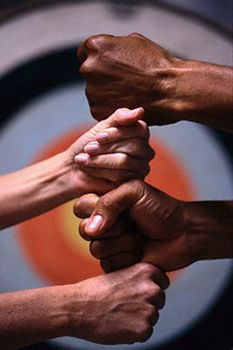
The Case for Diversity


http://blog.linniecarter.com/files/2010/10/diversity_workplace.jpg
Although it is long played out as a buzzword, diversity as a concept still has a lot of room to grow.  Most of us pay lip-service to its importance but do very little outside our comfort zones to encourage it in our own personal and professional lives.  Why is that?

I suspect it's because we think we have more to gain from seeming to value diversity than from actually experiencing it.  Spouting off on diversity's importance makes us look worldly and modern, but actually diversifying our friend pool and work networks seems to be a high-effort, low-payoff action. 

We'll get to the effort part in a minute.  Let's talk about what we believe the payoff to be.  Obviously, if we really thought it would benefit us, we'd put more time into actually pursuing it.  It leads me to believe we don't actually think it will benefit us.  

I can't speak for social gains, but conceptually the more different your friends are from you the richer your interactions should be.  Not to mention you'll probably score some killer food that you would never come across on your own.  

But as for work gains, here's an incredible data point from a recent study: up to a fifth of the growth in output per worker in the last 50 years is due to the fact that there are just more non-white men in professions like medicine, law, and management.  Here's a quote from the study:

In 1960, 94 percent of doctors were white men, as were 96 percent of lawyers and 86 percent of managers. By 2008, these numbers had fallen to 63, 61, and 57 percent, respectively. Given that innate talent for these professions is unlikely to differ between men and women or between blacks and whites, the allocation of talent in 1960 suggests that a substantial pool of innately talented black men, black women, and white women were not pursuing their comparative advantage. This paper estimates the contribution to U.S. economic growth from the changing occupational allocation of white women, black men, and black women between 1960 and 2008. We find that the contribution is significant: 17 to 20 percent of growth over this period might be explained simply by the improved allocation of talent within the United States.

In other words, by diversifying various professions, many more talented folks were brought into the mix, leading to far better outcomes across the board.  This is the power of diversity at work, in entire professions as well as in individual workplaces.  Said in another way, when we don’t have diversity, we are missing out on a lot of talent out there.

Now, tapping into that talent takes effort.  (I told you I’d come back to the effort part.)  Diversity, however you want to define it, means differences.  And, inherently, we tend to cluster with people who have similarities with us, whether race/ethnicity, age, educational background, whatever.  So it takes effort to bridge those differences enough to make meaningful connections that can lead to real progress. 

I’m not arguing that diversity is easy to pursue.  I am arguing that it’s worth it.

11.27.2013

Thanks, Giving


http://blog.meettheneed.org/wp-content/uploads/2012/05/Serving-changes-lives-300x227.jpg
Of all the things we Americans - we restless, hungry, and driven Americans - pursue, happiness is the overarching concept that is codified in our Declaration of Independence.  What could be more inspiring and yet banal than the pursuit of happiness?  Surely it's both revolutionary and non-controversial all at the same time, this notion that the most important thing is to go hard after happy.

Ah, but there's been a flurry of writing and research that suggests that the pursuit of happiness has its dark side.  See for example what Penelope Trunk has written and linked to here: "The Pursuit of Happiness Makes Life Shallow." It turns out that there are much better things to give our lives to than to maximize our own happy quotient.  In particular, real joy comes from loving and serving others.

There's a deeper message here but I'm lazy so let me just say that I hope that this holiday season we'll be more grateful, yes, but also that we'll be more giving.  Because, even more than an unbridled pursuit of happiness, that's what makes for a truly wonderful and meaningful life.


11.25.2013

Absolutely


http://www.fatherjames.org/wp-content/uploads/2012/09/truth-2.jpgWhat I first learned at Fels and have had reinforced for me in my consulting job since then is that there is no such thing as purely apolitical analysis in the worlds in which I circulate.  Maybe in science, engineering, or health care, there is a right answer and a wrong answer, and all one needs to do is be smart enough to get to the right answer, and then the whole world will gladly accept your work as true and right. 

But in the public arena, the numbers and the facts are explored, crunched, and presented in a certain context.  There is no escaping that context, because there is no pure right answer or wrong answer, simply opinions and perspectives and pros and cons.

On the one hand, this is deeply troubling to me.  On a moral level, I believe in absolute truths.  And, on an intellectual level, I believe in the power of data to tell the truth.  It is unnerving that no one cares what the right answer really is, and is willing to discard facts if they don't support their position.

On the other hand, this is deeply intuitive for me.  I believe that there are two sides to every story, and that there are merits to both sides.  And, I believe that the power of narrative trumps the power of numbers, in that what people really want to know at the end of the day is not whether 2 + 2 is 4 but rather something that can be boiled down to them in the form of an anecdote or life example.

I grew up being really good at math, so much so that I entered in and won many math competitions.  In that world, the problem at hand was known, the data points handled to me on a platter, and the task simply to determine the right way to the right answer.  For many people, this is how the whole world should work.

But it's not.  We dismiss things that have been proven when they don't fit our preconceived notions of what we imagine to be so obviously true that to think otherwise is blasphemous.  Consider how Ray LaHood, US Transportation Secretary, reacted when presented with evidence that child car seats are unnecessary after a certain age, or how Mitt Romney was castigated for suggesting that smaller class size wasn't the best way forward for struggling schools.  There was a little bit of a blip around President Obama's proposal for universal pre-K - little bit because the few who suggested this a poor way forward were roundly mocked, even though more and more evidence is piling up to support that position

What's a citizen and a consultant like me to do?  Do we no longer care about rigorous and fact-based analysis because no one cares what the right answer is anymore?  Is changing the world no longer about what's real and is rather all about having the most tightly crafted message and most carefully polished campaign?  To put a religious spin on things, are we truly in a post-modern era in which there is no such thing as absolute truth, only gradients of beliefs different groups hold to at varying levels?  And, if this is true, is this a historically awful reality or is it all really so bad?

I don't know.  (I say this a lot at work, so I've gotten comfortable with the phrase.)  Over time, I do think that the right way wins out, even if it is mocked at the time.  (For example, care to wager who will have more wins over the next five years: the low-budget Moneyball A's with their advanced metrics and counter-intuitive methods, or the high-spending Phillies, who rely on scouts and on big contracts to veterans on the decline?)  I also think that what you really want is depth of analysis AND a powerful narrative message, and that you're not in a good place if you only have one or the other, analysis alone being unconnected and unpersuasive and messaging alone being unmoored and flawed.  That's how I'm going forward.


11.22.2013

Change is Constant

https://blogger.googleusercontent.com/img/b/R29vZ2xl/AVvXsEgR4mFXOTyaw8JpxTklHWd9hVEc4D6cHNEGbv7IpAtC52Dv1NwKYSlDQ50uqXBUWvZme8MxbCG6gGl8iZuTeGNc0oKbLWTGyaS00p37LKn5clKnOPZKovUyr5hUJHYiaEuRNAND/s1600/DSC_0107.JPGA dear friend of mine who used to live in Philadelphia is visiting us from his new home in the rural South.  Gone barely a year, he marveled at the new developments that had sprouted up in our neighborhood since he was last here.  To be sure, our neighborhood is popping.  But that's only part of the story.  The other part is that we are a typical big city in that change is constant.

Cities are dynamic.  For better or worse, there's a lot of churn: people move in and out, neighborhoods rise or fall, failing stores close and new ones open up, buildings get erected and torn down. Of course, there is good change and bad change, change we can lobby hard for and change we fight hard against.  But change is inevitable. 

It is through that lens that I digest stories like the one my friend recently sent me, about Chinatowns in Philadelphia and elsewhere being squeezed by gentrification and other forces.  I need to be a bit cagey about what I think on this issue in a public form like this blog - feel free to ask me directly "off the record" - but at the very least I can comfortably say that it is neither possible nor recommended to put a halt to the steady churn of urban change. 

People can have different opinions about what kind of change and how much, and I give wide berth to the full range of those opinions.  But one can no more capture a sandstorm in one's hands than bottle up the dynamism of our cities.  We may revel in it or find it maddeningly frustrating, but we who love cities come to accept this reality and concentrate on how best to harness, guide, and enjoy it. 

11.20.2013

Going Home to Pittsburgh

http://i.usatoday.net/sports/_photos/2009/02/02/pitt-fans-med.jpgI'm certain that every big city in America has a "Steelers bar," which is to say a place where Steelers fans can meet up and root for the Black and Gold.  While the team has had enough success and stars to attract fans from all over, many of these bar attendees are transplants from Pittsburgh.  So the fact that there are former Pittsburgheans throughout the US is good for the Steelers but bad for Pittsburgh, an indicator that the city once had many more people in it who have now left for other places, largely for economic reasons.

Ah, but as with Philadelphia and with other older northeastern cities, the post-industrial transition in Pittsburgh has largely run its course.  And, with a world-class knowledge sector, Pittsburgh has remade itself in ways that are beginning to draw young'uns back.  According to a recent article in Atlantic Cities, Pittsburgh is getting younger, and a lot of it is hometowners coming home.

I have a soft spot in my heart for Pittsburgh.  I have an aunt who lives there, and in fact when I flew out with my dad to go to Penn my freshman year, I actually flew into Pittsburgh first before we drove out to Philly.  It's a beautiful city with two of the nicest sports stadiums around (PNC Park and Heinz Field), excellent waterfront space, and a nice architectural mix of old and new.  I am always glad when I have the opportunity to visit.  And, I'm glad to hear that the next time I do visit, I'll be seeing more and more young guns coming home and making a life there.

11.18.2013

Lazy Linking, 102nd in an Occasional Series

http://www.newmomstalk.com/wp-content/uploads/2013/04/rit-dye-married-a-gerber-onesie2.jpgStuff I liked lately on the Internets:

102.1 Deforestation slowing, now at 0.6%/yr http://bit.ly/1aHIIZW

102.2 Good news: my alma mater 122nd best HS in US...Bad news: our archrival 103rd best (grrr) http://bit.ly/1g1w4eN

102.3 Are we better or worse off as fans if machines replace the umps? http://es.pn/17AfKeB


102.4 "Onesie" is actually a trademarked name (like Kleenex and Aspirin) (yeah, I didn't know either) http://bit.ly/17z4F2O

102.5 Apparently our aversion to poo is something not all species have the luxury of enjoying http://bbc.in/1eETVCb

11.15.2013

Being There

http://www.suffolk.edu/images/Campus%20Life/counseling_rdax_544x278.jpg
I recently had the pleasure of catching up with an old friend of mine who is a pastor in the Philadelphia suburbs.  He told me his congregation has been besieged with a lot of personal tragedy lately, and it was challenging but rewarding for him to be there for his congregants during these dark moments. 

"Being there."  This is, I suppose, part of what it means to be a pastor (or any kind of religious leader), is being there for people when they are mourning.  This is not something I am naturally good at, but I am learning.  As someone who tends to approach everything in problem-solving mode, I need to remember that there are no easy solutions in calamities, and in fact usually those who are mourning aren't looking for solutions of any kind as much as they are looking for someone to "be there."

I am reminded of an NPR article that came out a while back but that I just recently read, as shared by a Facebook friend of mine: "Always Go To The Funeral."  Meaning, it's important to be there for people in their time of grief, vastly more important than anything else you could've done that day. 

My pastor friend desires to help people, when they are hurting, to see God's presence and hand at work in the midst.  By "being there" with people in their most difficult times, he is a very real and very meaningful part of that, for eventually when the sting of their pain has subsided a bit, they will remember his assuring presence and his willingness to be present.  Would that we all make sure we make time to "be there," realizing nothing more is needed and nothing else is more important.


11.13.2013

Green and Goode

Last week, I attended a City Council hearing on a proposed tax increment financing district for a combined W and Element hotel at 15th and Chestnut Streets downtown.  We had done some work for the developer and were asked to attend but not testify.  I knew from private discussions and public coverage that the hearing was likely to be contentious, and in fact it was.  
http://upload.wikimedia.org/wikipedia/commons/thumb/c/c6/William_J._Green.jpg/220px-William_J._Green.jpg
But my point in bringing this up is not to go over the details of the proposed development or of the hearing; that's been covered fairly well by the local press.  What I did want to note is that two current City Council members brought up the work of their fathers, both former mayors of Philadelphia, in their remarks.  Since much of the hearing related to the role of tourism in the Philadelphia economy, it was nice to hear Councilman Green and Councilman Goode both pay homage to the work of Mayor Green (who served from 1980 to 1983) and Mayor Goode (who served from 1984 to 1991) on that very issue, since that 12-year period coincided with some significant events in Philadelphia tourism history, most notably laying the foundation for the opening of the Pennsylvania Convention Center downtown. 

Especially for us younger folks, we can think that modern Philadelphia history began with Ed Rendell in the early 1990's.  In our minds, Philadelphia was on the brink of bankruptcy, chaos, and irrelevance, and everything that is great about our city today emerged from the Rendell administration, negating any need to worry over the details of the 1980's or before. 

For a place that prides itself on its history, we should know better than to be so short-sighted.  I know I could benefit from knowing more about post-WWII Philadelphia, since it continues to influence modern day matters.  For that reason, I'm thankful our current City Council contains two mayor's sons who are at the ready to remind us all of the relevance of the important work their fathers did not long ago. (Btw, if you're interested in the 10-30 years before the Green and Goode administrations, I commend you to my friend Greg Heller's recently published biography on Ed Bacon.)

11.11.2013

Lazy Linking, 101st in an Occasional Series

http://blogs.msdn.com/cfs-filesystemfile.ashx/__key/communityserver-components-imagefileviewer/communityserver-blogs-components-weblogfiles-00-00-01-32-81/4353.Kinect_2D00_Translator_5F00_403x270.png_2D00_403x0.pngStuff I liked lately on  the Internets:

101.1 The high cost of free bread bit.ly/1dNehqb @insidescoopsf @sfgate

101.2 Microsoft Research's sign language translator seems like a game-changer bit.ly/176Z57x @msftresearch

101.3 Keith Hennessey on Obama "you can keep your plan" statement, ensuring presidential accuracy in general bit.ly/1b7n4Tm @keithhennessey

101.4 This says blacks avoid Cal, but wait: is 58% decline rate (% admitted that go elsewhere) high or low? bit.ly/1eiTE7U @eastbayexpress

101.5 The key to economic growth in developing world is educating girls; the key to that is...weather insurance? econ.st/17vGId8 @economist

11.08.2013

Nano is a Big Deal

http://www.nanotech-now.com/news_images/41760.jpgThe Singh Center for Nanotechnology is now open.  There's a free tour today and tomorrow but I'll likely be too busy to partake.  Luckily, Penn's alumni magazine did a nice feature on it this month.  It's very cool how nicely designed the place is, and since the place is barely a mile from my house, I'm sure I'll find the time to check it out in person someday soon. 

Nanotech, if you don't know, is the study of things at the very, very small scale.  Apparently, when you get down to the individual atom level, you see some strange and potentially quite useful things. Befitting Penn, nanotech has been a cross-disciplinary effort, and is in fact the first building jointly undertaken by two schools within Penn. 

Having a nanotech center thus lends itself to all sorts of collaborations across disciplines and schools.  And, since you need some really expensive equipment to measure, monitor, and safeguard your research, there aren't exactly a whole lot of these places in the world.  Which means that, once again, the world will be beating a path to Philadelphia and the Penn campus.  Which of course is good for our economy and our reputation.

Who knew that something so small could be such a big deal?

11.06.2013

It's Electric

https://fbexternal-a.akamaihd.net/safe_image.php?d=AQATulFwWab-OLzr&w=377&h=197&url=https%3A%2F%2Fscontent-b-lga.xx.fbcdn.net%2Fhphotos-frc3%2F1390649_10151882874897808_1735561358_n.jpg&cfs=1
Since it's November (gasp!), it's not too early to look ahead to holiday festivities.  It's been fun creating new traditions for our young family.  One is going downtown to see the Macy's and Comcast shows.

Here's a relatively new entrant to the holiday show scene: the Electrical Spectacle Holiday Light Show at Franklin Square. Carousel and mini-golf are now available all the way until the end of the calendar year, there are hot spots to stay warm, and every half-hour between 4:30p and 8p there'll be a show that features lights, water, and music. 

As if I needed more reasons to go to Franklin Square.  Hope to see you there!

11.04.2013

Positive Association

If you live in my neighborhood, you got an extra piece of mail this weekend: the Spruce Hill Community Association 2013 Year in Review.  A bunch of us went door-to-door over the weekend to hand this out.  (I enlisted my kids' help, natch.)  I assume an electronic version will be available online, but for now I'll just list a few things we packed into this document: updates on school issues and proposed development projects, an invite to participate in a retail survey, and info on grants for sprucing up your block. 

And, of course, a membership application form, so you can join in all the fun.  I've attached a couple of videos from this year's Halloween parade, one of the big neighborhood events we help make possible.  Now that looks like a great place to live!


11.01.2013

Huang Family Newsletter, October 2013

Lee joined or is joining three boards: Sustainable Business Network of Greater Philadelphia, Welcoming Center for New Pennsylvanians, and Community Design Collaborative.  Amy was maid of honor at her friend's wedding in Long Island, which made for a fun little weekend getaway for the whole family.  The kids also enjoyed excursions to Chinatown, Morris Arboretum, and Philadelphia Zoo, as well as Halloween festivities in the neighborhood (parade, trick-or-treating). 


Too Short for a Blog Post, Too Long for a Tweet 522

  Here are a few excerpts from a book I recently read, "Moby Dick," by Herman Melville. Again, I always go to sea as a sailor, bec...