9.30.2011

Huang Family Newsletter, September 2011

What a whirlwind for the Huangs. Amy and I struggled to keep up with our burgeoning work responsibilities, stay on top of things with the kids, and manage a major kitchen renovation. I took the kids to San Jose to see my parents and other family and friends. Jada loves first grade so far, and it took a while but Aaron is starting to make friends at his new preschool. We go to the YMCA every Saturday now, as each of them has soccer practice; we work out while they're there, and then we all get into the pool after. My sister made a short visit from California, and it was fun to try out some of our local eats and even catch a late-night movie with her. Throw in the usual assortment of downtown excursions, church gatherings, barbecues, and one last zoo run before our membership expired, and it was a full and fun month all around.


9.27.2011

Passing the Torch - October 6


Dear friend,

Please consider making a contribution to and/or attending The Enterprise Center's annual fundraiser, Passing the Torch, which this year will take place on Thursday, October 6th, from 5:30 pm to 8:00 pm at The Enterprise Center at 4548 Market Street in West Philadelphia. This is a really good event (celebrating wealth creation and "passing the torch" on to the next generation of entrepreneurs) for a really good organization (accelerating minority entrepreneurship through access to capital and to contract opportunities, capacity building, and business education). For more information or to buy a ticket or make a donation, you can go to the event's website: http://www.theenterprisecenter.com/ptt2011/. I hope to see you there!

Lee Huang
The Enterprise Center
Staff, 1995-2005
Board, 2006-present

9.26.2011

Money Bawl


With the acclaimed opening of the movie, "Moneyball," starring Brad Pitt, one can unequivocally say that the Oakland A's of earlier last decade will go down in the history books as a game-changer, helping usher in a new way of thinking about baseball, balancing "feel" with cold analytics and slightly or totally refuting some traditionally held beliefs about strategy. However, as A's GM Billy Beane (who is the main character of "Moneyball") points out in this article in the New York Times, the upshot of the A's success is that there is no longer a sustainable advantage for it and other small-market teams as they do battle with teams that have double or triple the payroll size.

Sure, every season a small-market team finds success, and sportswriters and pundits knight them "the new A's" and trip over themselves discerning the secret to their success. But by and large, there is no secret, just the predictable noise of the otherwise random walk that the game of baseball has become: every once in awhile, a stray team will go on a hot streak for a whole season, but by and large it's the Yankees and the Red Sox and the Phillies that are able to sustain success year in and year out because of their payroll advantage. We want to believe that there is a way to game the system, but baseball is just like any other sport, in that the best players make the best teams, and therefore the best teams are usually fielded by franchises that have the most money to buy them. (Of course, it is not always true that teams with money are good teams, since it is far easier to waste lots of money and build a lousy team than it is to build a good team with little money. Hello, New York Mets!)

Watching "Moneyball" was fun, to see my team get celebrated for its process and for its accomplishments. But it was a little sad, too, for the movie is based in the year 2002, and the A's have enjoyed far less success in recent years, so it is easy to wonder if the best of times are behind them. Every spring, I have hope that it is not so, but by late summer, it becomes clear a playoff berth is not in order, and that the team just isn't good enough to deserve one. As a fan, I cannot help but hope for better. I bought a shirt for my wife that says "In Billy We Trust," and I do still believe in our celebrated GM, especially because of his willingness to stick to the game plan instead of flip-flopping in response to public outcry or small sample size. Maybe we'll get 'em next year. But for now, another mediocre season leaves me hollow.

9.24.2011

Infrequent Partaker of the Night Life


Last night, I threw all caution to the wind and stayed up past 9:00 pm. Way past.

My sister was in town so we decided to all go out to dinner after we got home from work and school. We ended up at Manakeesh, a fantastic Lebanese joint just a block from our house. I ordered way too much food, which is not hard to do at this place, given how visually appealing everything is and how sizeable the portions are. At any rate, we had a great time.

After the kids went to bed, I pounded out some work on my laptop, and then my sister and I headed down the street to the local movie theater to catch the movie "Moneyball" on its opening night. It was the 10:30 pm show, and, given that the hour was over two hours long, and that there were 15 minutes of previews at the beginning, we didn't get home until after 1:00 am.

Walking home at an hour I haven't seen in awhile, the area on and just off campus was still bustling, with college kids socializing on front stoops and house parties spilling out into the street. To be sure, there's a downside to neighborhoods like University City: the smell of stale beer, kids urinating in the alleys, trash everywhere the morning after. But I still liked that we could walk home well after midnight and capture a little bit of the vibrancy of an urban setting, never feeling unsafe because there were plenty of people out and about, and not having to deal with the stultifying routine of getting in a car and driving home.

I may not be a frequent partaker of the night life here in this big city, but one of the perks of living here is that it's out there. It doesn't miss me if, 999 out of 1,000 nights, I'm fast asleep. But the one night I'm out - to watch a movie in the theater, too, for crying out loud - it's there to help round out the whole experience. That's a nice perk.

9.22.2011

Making Philadelphia Work


Even in the midst of a very busy work week, I was able to grab coffee with a dear friend of mine. Since he also lives in the city and has two small kids, we inevitably ended up talking about school. It took a little finagling on his side, but he has a situation that works for their family, in terms of the quality of the school, the type of kids his kids will grow up with, and the time and stress levels associated with commuting. Best of all, since they're going with a charter school, there's no tuition, which is a big deal since some of the private school options he was looking at were north of a G a month.

Given where I am in life, I tend to have a lot of these kinds of conversations. And it has been neat to see how other families piece together city living so their kids will be OK. Whether it's a French schohttp://www.blogger.com/img/blank.gifol, Chinese after-school, home-schooling, or car-pooling, parents are being really creative in figuring out how to make it work. And in a city like Philadelphia, there are countless permutations of options to work from.

With the recent news coverage of a baby boom in Center City (is there something in the water?), you'll likely overhear many more conversations between young parents about how they finagled school for their kids. All of this for the joy of living in a vibrant, multi-modal big city with all of its great restaurants, cultural scene, and dominant sports teams, instead of settling for the mind-numbing, auto-dependent existence of the suburbs.

If the school choices keep getting better, and the reasons for urban living keep on proliferating to provide motivation to young parents to figure out how to make school work for their kids, I think Philadelphia is on the verge of something special. Of course, I've thought this for awhile. But now that I am thinking it as a parent of two school-age kids, and have been hearing from others in my position, I think it all the more.

9.20.2011

Investing in the Neighborhood


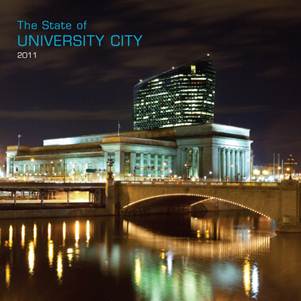
A last-minute meeting at work earlier this week prevented me from attending the University City District's annual "State of University City" presentation until the very end, but I did pick up a copy of the report, and though I would consider myself fairly well informed on matters pertaining to my neighborhood, I found myself marveling at new things and new stats on almost every page. Truly this is a fantastic place to live, work, and play, and the report deftly uses words, numbers, and pictures to capture the vitality, diversity, and innovation of University City.

Hats off to Matt Bergheiser and his crew, and I extend my kudos back to past executive directors and staff members, as I have directly observed the hard work has been carried out for almost two decades now and have benefited from the fruit of all that labor. As we remodel our kitchen and get involved in our kids' schools, we are making a very real investment - financial, physical, relational, and psychological - in University City. And we couldn't be happier.

Waste Pitch


My hatred of waste is well-documented in this space. And yet I have much to learn and much to go in this area. Tom Szaky's "Revolution in a Bottle," which is about his firm, Terracycle, explains that trash is a modern Western phenomenon and that it imposes significant costs on the planet in the form of massive amounts of undegradable materials in our landfills and even in the middle of our oceans. I am reminded of my brother-in-law's extended family's plantation in southwestern India, which is completely sustainable in that it requires no running water or electricity and generates no waste.

In contrast to that, my family easily generates one or two trash cans' worth of trash, plus two or three bins of recyclables, every week. Not to mention the trash I throw out at work or anywhere else. I am spurred on by Aaron's new teacher, who has a "zero trash" policy in the classroom (there are no trash cans) and who teaches her students about composting. I may never get to "zero trash," and my wife still needs some convincing on the composting, but I am more aware, and I am taking baby steps. I hope you will too.

9.19.2011

The Blind Leading


I was intrigued by a recent piece in Wired Magazine (no link yet) about Claudia Folska, a Ph.D student who has been blind since the age of 5 and was encouraged by her dissertation advisor at University of Colorado to study how blind people navigate cities. It turns out that her mapping of how the blind make their way around a city has helped her to "see" some remarkable insights: where people feel safe, what represents barriers, and what areas are avoided altogether.

By tapping into a group of people who are lacking in one area - the ability to see - and have as a result become more aware in other areas, Folska hopes her research will help make cities safer and navigable for all pedestrians. Yet another reminder that in one sense there really aren't any such things as "disabilities" as there are the "differently abled," who with a little ingenuity can use those different abilities for great common good.

9.17.2011

Snapshots in the City


There is no unifying theme to the following snippets from this past week, except to say that I guess our little family in the city is unlike any other:

* While Aaron's classmates' parents raved on and on about how articulate, creative, and progressive their kids are (the question posed at the back-to-school orientation was "what are you proud of about your child"), Amy said, "Aaron had to go to a special school because of behavioral issues, and I'm proud that he was one of the few kids to actually graduate out of the program."

* The other night, I went to the Y for a swim after the kids went to bed. Even though the bus there comes every 10 minutes, somehow I had to wait 22 minutes.

* Speaking of bus snafus, it took 22 minutes for my bus to go less than three miles last night, because of massive traffic. I arrived at my kids' school two minutes late. Note to self: walk the extra few blocks and take the subway if I'm ever cutting it close.

* Probably because our kitchen remodeling project has unsettled everything on the western side of our house, we had a major mouse infestation in our basement, which sent me out of the house on Amy's orders to go find some mouse traps. Even though it was relatively early (9:00), walking around some parts of our neighborhood is a little scary. By the way, I never did find any mouse traps.

* Sitting in Jada's desk at her back-to-school night with all of her classmates' parents, I could not help but notice how diverse her class is, with a pretty balanced mix of blacks, whites, Asian Americans, and recent immigrants from East Asia, South Asia, and the Middle East.

* Amy's synopsis of her day at work as we all arrived home one evening: "Well, I got sexually harassed by an inmate again."

9.16.2011

The Heavenly City


I'm almost at the end of my year-long reading through "The Message," a contemporary English version of the New Testament. Earlier this week was the 21st chapter of the book of Revelation, a glorious portrayal of the new heaven and of the God who will reign there.

If you don't know your Bible, you may be surprised to know that heaven is described as a city. Yes, what many of us viscerally consider to be dirty, sinful, and unsafe is what the Bible describes as the final destination for believers: a city.

But not just any city. It's a city where evil has been banished, God's presence is constant and illuminating, and a diversity of people stream in to render to that God the adoration He is due. What a vision of perfection!

Our cities, circa 2011, are a far cry from such a vision. Though there are slivers of goodness, we city dwellers are often weighed down by the constant onslaught of evil: violence, decay, brokenness, despair. It's enough to want to pack up, give up, or tune out.

But the powerful imagery of Revelation is intended to give us hope. The appeal of it all is meant to stoke our longing for a better place. But the fact that we are to end up in a city should cause us to redouble, and not abandon, our efforts to bring some of that goodness into the present day and into our urban settings. Here's hoping we are thusly renewed for today's work.

9.14.2011

Things That Make Me Happy, the "What a Great Morning" Version


Monday night my wife put a spring in my step by offering to hold down the fort in the crucial 6am to 7am time slot the next morning. Now that the kids are older, and are sleeping in longer, it's usually not a time they're in need of us. But, because Amy is not a morning person and because she is often called on to head into work early, I do feel an obligation to be in the house, even if downstairs churning out the miles on our treadmill or exercise bike while fast-forwarding through sports and listening on the baby monitor. So no long or leisurely runs, and if I dare hit the YMCA it is simply to sneak in a few reps in the weight room right as it opens at 6am so I can dash back home in time to be showered up and ready to go once the kids are up.

Amy saying she'd be up and ready meant I could be at the Y longer, which meant I could get my swim on, something I've always wanted to do. Rather than swim in the evening after the kids go to bed, when I'm carrying a full belly from dinner, swimming in the morning seemed consistent with when I normally like to exercise (first thing), and would put my mind and body in a good mood for the rest of the day. Plus I could just shower there, thus saving a little on my water bill. (Yes, I am that cheap.)

And so the combination of my wife doing a really nice thing for me, getting to swim in the morning, being out of the house at a time I am normally stuck at home, and feeling great about it all once I had returned home just put a big smile on my face. It also helped that I got home just as the kids were waking up, so I didn't even miss seeing their sleepy faces as they got themselves up, put their clothes on, and trudge towards breakfast. To pile on even more joy, I saw that my beloved Raiders eked out a win against the hated Broncos. An opening day win - heck, any win - is to be cherished when you are of the Silver and Black.

I realize not every morning will be like this. But maybe once a week I can have a great morning like this. (And maybe the Raiders will scratch out a few more wins this season as well.)

9.12.2011

Respect


I've been having a spirited and insightful discussion with my friends on Facebook, stimulated by this question I posted a few days back:

Here's a 25-point toss-up for educators, parents, and anyone else with an opinion: who gets to decide what someone is called? Aaron's new teachers insist on being called by their first names, even though I prefer that I and Aaron call them Ms. So-and-So. Do people have the right to choose what they are called, or is it within my bounds to have my children call them something else (and to model it, and show my own level of respect, by calling them Ms. So-and-So as well)? I'm torn.

A wide range of friends chimed in with a wide range of opinions. Some felt it was well within my rights to insist on conferring respect through the use of a title (Mr. Joe, Ms. Kim, Dr. Lucy, Officer Mike, et al), while others felt it was a sign of respect to honor a person's request to be called by their first name. Said another way, the first group felt it was disrespectful to not use a title, while the second group felt it was disrespectful to ignore what a person told me they wanted to be called. By the way, age seemed to play some role in approaching the question (the bigger the age difference, the more correct it seemed to use a title) but not totally (many of us use titles even when talking to someone younger than us).

While I'm still torn as to what to do, I think the best lesson I took from this excellent back-and-forth is that the key thing is, titles or no, to have a sit-down with my kids about showing respect, so that, titles or no, they understand its importance and act accordingly. And, since I am their role model, I ought to remember the same. Thanks to all who chimed in to guide me along on this important life issue.

9.11.2011

9/11, Ten Years Later


It's all still pretty fresh, even after ten years and even though an initial burst of civility and patriotism have long given way to cynicism and squabbling and partisanship. Here's hoping today's (and future's) remembrances of the events of 9/11 stir us to something better: a cherishing of life, a reminder of the existence and ultimate conquest of good in the midst of so much evil, and a commitment to double down on service and mercy and love and sacrifice. God bless America and God bless mankind.

9.09.2011

Recommended Reads, Seventh in a Series


Stuff I'd recommend from the past few months (beach read or no):

Modern Times (Johnson) - Yeah, a lot happened in the 20th century.

God Behaving Badly (Lamb) - My friend Dave at his provocative and insightful best.

The Coke Machine (Blanding) - A Coke and a smile? There's a dark side.

One Good Turn (Rybczynski) - Only Witold can write a whole book about screws.

Class (Fussell) - Cheeky words about class stratification in America.

Age of Turbluence (Greenspan) - Remember when we ran a budget surplus?

Yellow (Wu) - Nice to get the Asian perspective on race in America.

Blind Side (Lewis) - A compelling story made even better in Lewis' hands.

Number Crunchers (Ayres) - Someday soon data mining will be so prevalent we'll wonder how we got by without all of the customization, optimization, and automation it will afford us.

9.08.2011

What Am I Working On


As has become my custom every three months, here's what I'm working on now at work. I won't repeat anything from last time that I happen to still be working on, and for confidentiality's sake I have to blur some of the details for some of these studies.

* Estimating the economic, fiscal, property value, environmental, direct use, and health care cost reduction impact of a regional trail expansion

* Estimating the consequences to government, communities, and individuals of proposed public cuts to a particular social program

* Helping a small municipality figure out how to reform its business tax structure to become a more competitive location

* Helping a university to assess retail and commercial development opportunities near campus

* Conducting a reputational survey and an environmental scan for a major regional institution

* Providing market research for a non-profit writing a long-term strategic plan

* Estimating how many jobs of a proposed research park expansion can be fulfilled by local residents

* Recommending real estate policies for a government trying to respond to rapidly rising housing prices brought about by an oil boom

* Helping a city evaluate potential revenue generation options to avoid having to raise taxes to balance its budget

9.07.2011

Honoring Mr. Hunter


Via a Facebook friend, I saw this article last month honoring my junior high school teacher, Robert Hunter, who taught phys ed and coached teams for 39 years. The YouTube video embedded in the article was particularly mesmerizing. Even at 80, he looks great.

So when I was in San Jose earlier this month, I decided to pay him a visit one evening. He graciously invited my kids and I into his home, insisted that I take some candy for them, and regaled us with stories from his life. There was a pang of dread when he questioned me as to why I missed his birthday celebration, but my mumbled response - "actually, I live in Philadelphia now" - seemed to be satisfactory to him. Whew.

I'd be lying if I said that voice still doesn't strike fear in my legs. Even after all these years, I can remember that voice saying things like "it's going to be a blood day, gentleman," followed by him counting off 12-count burpees for what seemed like an eternity while we all tried to keep up with a 50ish man who was in better shape than we could ever imagine ourselves to be.

Man, we hated blood days. But we never hated Mr. Hunter: he was too fearsome, too dignified, and too decent, that even though we dreaded him working us, we always respected and even revered him.

The YouTube video starts with a shot of his house, which was next door to our family friends' house, so I saw him occasionally outside the school setting, and he was as friendly there as he was fearsome in second period gym. It is really heartening to read this article and see so many others chime in with kind words for Mr. Hunter. Happy 80th birthday, Mr. Hunter, and you'll be happy to know I can still do 12-count burpees.

9.06.2011

San Jose Summer 2011

Another week, another week off. While Amy stayed home and worked (and manned our kitchen renovation project), the kids and I flew to San Jose to see my parents. I've back-posted some pics and blurbs from each day's festivities at my Huang Kids blog. A good time was had by all.

9.05.2011

Lazy Linking, 54th in an Occasional Series


Stuff I liked on the Internets lately:

54.1. Could it be that scoring and homers are down in the last few years because of iPads and not because of steroids?

54.2. Why didn't the stimulus create more jobs? Because the people firms wanted to hire with the extra money were the ones who already had jobs.

54.3. If a tree falls in a hurricane, who pays for it? Here's a handy guide.

54.4. Markets in everything, the "looking for love" version - top ten least romantic dating sites.

54.5. Animated liquid letters. I predict you will see this during the opening credits of a scary movie sometime soon.


9.04.2011

Money Matters


It has been heartening to see how well The Enterprise Center has done through this extended time of fiscal pain. I give all the credit to Della Clark and her staff for being aggressive in their revenue generation and prudent in their cost containment.

I'd like to say that some of the foundation for this success was built during the last major recession, which hit us (I was on staff at the time) around 2003. Heretofore, we were growing and times were good. But, in retrospect, it was the lean times and not the fat times that molded us for future success, for it was the scarcity of resources that forced us to figure out how to operate efficiently and effectively.

I've heard this said of for-profits as well, that when times are tough, you figure out what you're really about and force yourself to a better place as an operation. The converse is often true: when times are good, firms have to be careful not to grow complacent and lazy, lest those habits come back to bite them when there is a pullback.

I think this truth can be applied to our personal finances as well, for those of us who are followers of Jesus. It may or may not come as a surprise to you how often money is talked about in the Bible, but that frequency, in light of our present materially-driven generation, means that how we are with money is a pretty good barometer of how we are with our souls and with our Maker.

As a child of penny-pinching immigrants, and a student at the Wharton School of Business, I always tried to take money seriously, in terms of avoiding materialism and giving sacrificially. Not that I don't struggle in these areas, but at least I am struggling against the struggle instead of giving in.

But even for me, who considers himself doing pretty good in this area, I must be careful. For as I grow older, and advance in my career, my financial position becomes stronger, and it takes discipline and remembrance to practice financial restraint in my purchases and financial generosity in my giving.

One of the reasons so many billionaires are eccentric is because they literally can do anything they want. As I once explained to one of my students, having a billion dollars in wealth means that just on the interest alone, you could kick off tens of millions of dollars alone in perpetuity. You almost literally can't spend your way down from a billion dollars of wealth. So you can do anything you want. Do you want to hire somebody to give you a piggy-back ride to work? You can. Do you want to pay Rod Stewart a million dollars to sing at your birthday party? You can.

I'm not a billionaire, obviously. But there are a lot more things I can do with my money than before. If I want to buy that shirt in the store window, I can. If I want to take my family on a nice vacation, I can. If I want to buy my kids toys and books and classes and clothing, I can.

Possessions are not inherently evil. But the happiness they give us can be seductive. At a time of great need, and in a world with so many perilously poor, we die a little when we are selfish with our spending, choosing instead to satisfy ourselves with fun experiences and new gadgets.

It may seem snooty to rant about how hard it is to have means. But if we are materially rich (and most of us in this country are, relative to the rest of the world), it does behoove us to consider what our position is with respect to money. As my non-profit strengthened during a time of fiscal distress, and as firms must be wary of not getting fat and happy when all is well, so must we as believers guard our hearts against materialism and against closing off to the need around us.

It matters for our souls, for eternity, and for many around us who could benefit from our generosity, whether we settle for passing pleasures and personal leisures, or whether we heed the many calls in the Bible and deploy our resources outward to help others in need. Whether times are good or not, may we choose wisely.


9.03.2011

Greener by Doing Nothing


Believe it or not, I am an on-again, off-again member of the Sierra Club. My reasons are mercenary: membership usually comes with some nice schwag, and I get to read their monthly magazine for a year. The rag is good for getting the far-left green perspective, which I sometimes take in and sometimes roll my eyes over.

One recent eye-roller was its ranking of most sustainable colleges. Many of its campuses reflect the sort of imagery you'd expect of a Sierra Club publication: bucolic, grassy, near to nature. I for one did not even know that such places existed as Green Mountain College (#2) or Evergreen State College (#9).

Of course I looked for my alma mater, Penn, and was disappointed, on two fronts, to see it only at #21. Disappointed first because I want my school to rank high, but disappointed also that the Sierra Club didn't seem to take into account the inherent sustainability of dense urban campuses like Penn or NYU (#28) or Pitt (#52).

It may seem cheating to be green by doing nothing, but setting really does make a huge difference. I will bet you that the body-to-parking-spot ratio at Penn, NYU, and Pitt is a fifth to a tenth of that of most of the schools ranked ahead of them. And that matters. For schools are huge hives of activity, what with students and faculty and administrators and janitors and athletes and attendees coming and going. If almost every trip in these so-called green schools happens by car, and almost every trip at Penn, NYU, and Pitt happens by foot, bike, or public transit, you tell me who's practicing a more environmentally sustainable way of existing.

To be sure, people drive to and from Penn, NYU, and Pitt. And I'm sure a lot of people ride their bikes at Green Mountain College and Evergreen State College. But the difference in mode split is probably pretty stark. Without trying, schools in dense urban settings necessarily are greener than those in scenic natural settings. Too bad the Sierra Club missed an opportunity to state the obvious, and instead reinforced a not-quite-right stereotype.

9.02.2011

Year-Round Vacation


I think it's clear I live out my "be productive at all times" mantra to a fault. My carefree daughter, irksome as her behavior can be for my Type A personality, has a thing or two thousand to teach me about taking it easy every so often; for awhile, she would tell me out of the blue, "Daddy, you have to be silly once a day." The words of a strange girl with speech issues? Or profoundly wise?

Anyway, whether or not I am silly today, here are a few things I try to do often to add some frivolity to life:

* Go to the Y. I equate swimming or lifting weights with vacation, because usually the only times I can do that sort of stuff is when I'm staying in a hotel. It's still a little dissonant to feel like I'm in vacation mode while walking home through the 'hood in flip flops and a swimsuit.

* Eat on the porch. Having breakfast or dinner on a weekday on the small table on our front porch while the world goes by is really fun.

* Listen to music. I never listen to music, and I hardly ever get a free moment to myself, so putting in the earbuds and letting my playlist works its thing at the end of the day after the kids go to bed is a little bit of magic.

So there you have it. For as hard as I work, every day can feel like vacation. Life's not so bad.

9.01.2011

Real People


One of my dear friends pastors a new church on the West Coast. We got a chance to catch up last month over the phone, and he regaled me in story after story of people in his congregation rallying around him and around each other in times of great happiness and deep sadness. Whether it was celebrating a pregnancy after several miscarriages or mourning a father's critical health issues, the unifying themes were that congregants loved and were loved, and that they did so without prompting from my friend but rather with spontaneity and persistence and sacrifice.

As we thanked God for these precious moments of true fellowship, we had to take a step back and feel a bit sad that such instances are the exception and not the rule. The world has gotten busier, more cynical, and more guarded, and the great tragedy is that the church is no exception. We are too caught up in our own schedules to extend ourselves for others, and too afraid of opening up to others to be cared for.

The place we believe to be the great salve for our society - ourselves, the body of Christ in the form of our groups of believers - is not only failing to extend compassion and honesty to a hardened and hurting world around us. Even worse, it is failing itself: my friend's examples of all members mourning as one mourns, and all members celebrating as one celebrates, should be commonplace within our faith communities, and yet they are not.

God so loved the world that He entered into it, as a man, and one who washed his followers' feet, prayed vulnerably before them in his last moments as a free man, and otherwise shared life and death openly and without reservation or pretense. That is good news. Would that we who believe it live so, for each other and for those around us who are just as hurting and alone, just as hungry for true human connection.

Too Short for a Blog Post, Too Long for a Tweet 522

  Here are a few excerpts from a book I recently read, "Moby Dick," by Herman Melville. Again, I always go to sea as a sailor, bec...